Microsoft and Apple India Investments Can’t Help MSFT Stock, Forbes $345 Target
Microsoft's stock is still struggling as investor confidence is impacted by growing AI expenses, risks associated with worldwide expansion..
Quick overview
- Microsoft's stock has dropped over 13% in two months due to rising AI costs and weakening investor confidence.
- The company's recent $17.5 billion investment in India's cloud and AI ecosystem has raised concerns about its ability to manage escalating expenses.
- Technical indicators show a significant shift in sentiment, with the stock struggling to maintain support levels and facing potential deeper pullbacks.
- Operational challenges, strained partnerships, and ethical controversies are complicating Microsoft's position as it navigates a costly AI landscape.
Live MSFT Chart
[[MSFT-graph]]
Microsoft’s stock is still struggling as investor confidence is impacted by growing AI expenses, risks associated with worldwide expansion, and deteriorating technical signs.
Market Mood Turns Against a Once-Untouchable Giant
Microsoft’s shares have entered a downward spiral over the past two months, slipping more than 13% from the record highs above $555 as investor confidence deteriorates. Rising operating costs, intensifying skepticism about AI profitability, and the perception that Big Tech valuations are running ahead of fundamentals have created a heavy drag on the stock. The recent slip below $500 has further reinforced the sense that the market’s patience for expensive AI bets is running thin.
Tech Infrastructure Investment in India
Tuesday’s session brought another wave of selling, triggered by Microsoft announcing a massive $17.5 billion investment in India’s cloud and AI ecosystem—the company’s largest commitment in Asia to date. While the expansion is intended to strengthen Microsoft’s footprint in the world’s fastest-growing digital economy, the scale and timing of the investment have heightened concerns about how much more AI infrastructure spending the company can absorb without eroding margins.
Microsoft’s move follows similar large-scale pledges from U.S. tech competitors. Amazon has mapped out $35 billion in India through 2030, with a broader focus on AI-driven digitization, trade expansion, and jobs—adding to the sense that hyperscalers may be entering a cost-inflation arms race.
A Once-Reliable Rally Loses Its Grip
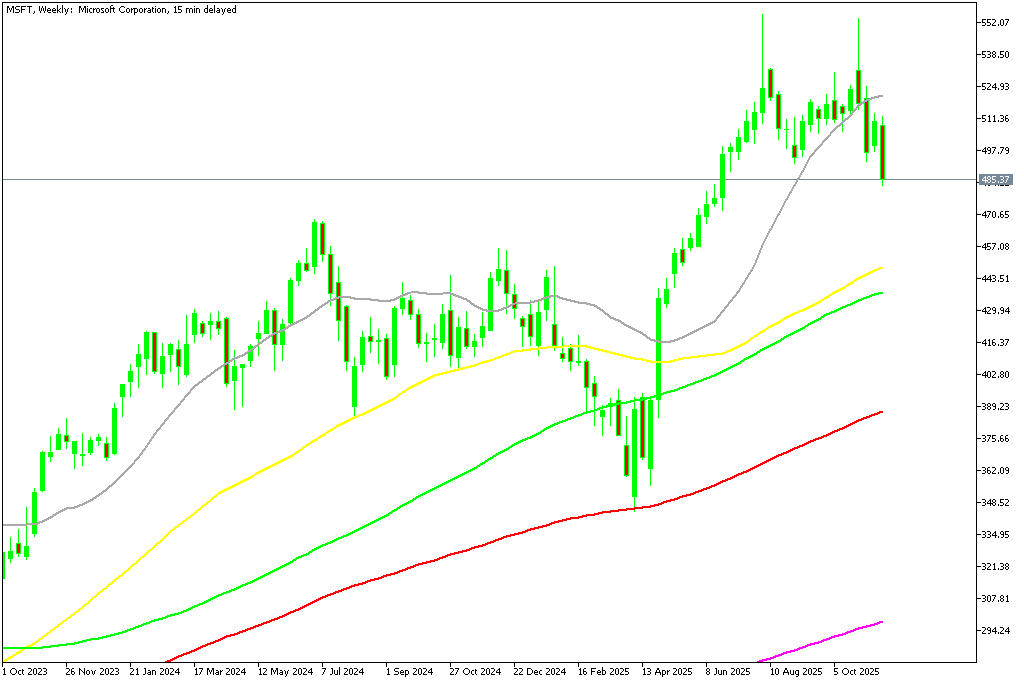
The bullish momentum that followed Microsoft’s impressive Q3 results has evaporated. Despite briefly pushing to new all-time highs, shares met stiff resistance at the $553–$555 range before reversing sharply. The stock tumbled below the 20-day and 50-day moving averages, signaling a meaningful shift in sentiment and positioning.
Traders are now watching the $468 support area, a key technical level that has historically halted deeper pullbacks. But with liquidity thinning and institutional flows turning defensive, even long-term Microsoft bulls acknowledge that the stock’s once-consistent uptrend is showing cracks.
Technical Weakness Deepens
The broader technical picture is deteriorating. Microsoft’s attempt to reclaim the 20-week simple moving average was quickly rejected, and the stock has once again retreated beneath it—a bearish development that often precedes multi-week corrections.
While there was a bounce off the 50-week SMA, the recovery lacked conviction. Sellers have since regained control, pulling the stock down toward the $480 region and reinforcing the narrative that Microsoft’s chart is weakening far faster than its fundamentals.
MSFT Chart Weekly – Diving Below the 20 SMA
Adding to the unease, Vice Chair and President Brad Smith unloaded over 30,000 shares, worth nearly $16 million. Though insider sales are common, the timing has fed the perception that senior leadership is bracing for a tougher period ahead.
Forbes has also urged investors to scale back exposure to MSFT stock, arguing that Microsoft’s valuation leaves little room for error. A decline toward $344—a level aligned with historical valuation multiples—cannot be ruled out if sentiment continues to sour.
AI Spending Becomes a Liability, Not a Catalyst
Even with Microsoft beating expectations last quarter, reporting $3.72 EPS on $77.67 billion in revenue, the conversation has shifted decisively toward the company’s soaring AI expenditures. Roughly $3.1 billion in costs tied to OpenAI weighed on profitability, erasing nearly forty cents per share.
CFO Amy Hood cautioned that spending pressures will continue well into 2025 and beyond, as Microsoft accelerates its AI capacity build-out. This has raised legitimate concerns about how long margins can remain resilient before elevated capital expenditures catch up with the bottom line.
Partnership Tensions Add Another Layer of Risk
The company’s strategic relationships have also grown more complicated. Microsoft and Nvidia expanded their collaboration through fresh investments in Anthropic, positioning Claude models deeper into the Azure ecosystem. While beneficial, the strategy further fragments Microsoft’s AI roadmap at a time when coherence is increasingly valued.
Meanwhile, Microsoft’s partnership with OpenAI appears strained. Reports indicate that OpenAI is exploring independent chip collaborations with Broadcom and potentially developing a platform that competes directly with LinkedIn. This has sparked questions about whether Microsoft is losing leverage in its most important AI alliance.
Operational and Ethical Challenges Widen
Microsoft’s challenges extend beyond cost overruns and competitive pressure. Recent internal AI-related data leaks have revived concerns about cybersecurity and oversight across its expanding AI infrastructure.
Additionally, Xbox continues to underperform, with hardware sales falling 29% year over year, reinforcing the view that the gaming division is losing ground in a highly competitive landscape.
On the cultural front, employee unrest is rising as protests intensify over Microsoft’s defense-oriented AI contracts and ongoing expansion into politically sensitive regions. The company’s $15 billion AI-driven data center partnership in the UAE has drawn backlash from both human rights groups and some institutional investors, adding reputational risk to its financial challenges.
A Company in Transition Faces a Less Clear Road Ahead
While Microsoft remains fundamentally strong and continues to dominate in cloud services and enterprise AI, the current environment is forcing a reassessment of expectations. The combination of steep investment costs, strained partnerships, technical breakdowns, and ethical controversies has reshaped the narrative around the stock.
For investors, the question is no longer whether Microsoft can lead the AI revolution—it’s whether the cost of leading it is becoming too high to justify its premium valuation.
- Check out our free forex signals
- Follow the top economic events on FX Leaders economic calendar
- Trade better, discover more Forex Trading Strategies
- Open a FREE Trading Account
- Read our latest reviews on: Avatrade, Exness, HFM and XM

Related Articles
Sidebar rates

Related Posts
 Save
Save