MSFT Stock Retests Support and Risks Breakdown as Expansion Rises Costs and Doubts
Microsoft’s stock remains under pressure as investors question whether the company’s aggressive AI and global expansion strategy is...
Quick overview
- Microsoft's stock has declined over 13% from its all-time highs as investors question the effectiveness of its AI and global expansion strategy.
- Recent regulatory scrutiny and warnings regarding AI risks have added to investor concerns, leading to increased selling pressure.
- A significant $23 billion investment plan in India raises questions about capital intensity and potential margin compression amid aggressive competition.
- Despite solid earnings, rising AI-related expenses are now seen as a potential drag on margins, shifting investor focus from growth to costs.
Live MSFT Chart
[[MSFT-graph]]
Microsoft’s stock remains under pressure as investors question whether the company’s aggressive AI and global expansion strategy is delivering returns fast enough to justify its rising costs.
Market Confidence Wavers After Record Highs
Microsoft’s share price has spent much of the past two months moving steadily lower, retreating more than 13% from its all-time highs above $555. While the stock has attempted brief rebounds, the overall trend reflects a clear shift in investor sentiment. What was once near-unquestioned confidence in Microsoft’s AI-led growth story has given way to caution, as markets reassess the scale, cost, and timing of the company’s ambitious plans.
The recent drop below the psychologically important $500 level marked a turning point. Investors appear increasingly reluctant to reward long-term AI investments without clearer near-term financial payoff. As enthusiasm cools across the broader technology sector, Microsoft is no longer immune to scrutiny over how much it is spending—and how soon those investments will translate into sustainable profits.
Short-Lived Rebounds Fail to Change the Narrative
Microsoft briefly found support after announcing a major new investment initiative, sparking a modest bounce in the stock. However, the rally quickly faded, reinforcing the view that optimism alone is no longer enough to lift shares. Each recovery attempt has stalled at lower levels, suggesting sellers remain firmly in control.
Rather than signaling renewed confidence, the rebound highlighted a growing belief that Microsoft’s expansion strategy may be nearing its practical limits. By the start of the new week, shares had already drifted back toward key support levels, underscoring how fragile sentiment has become.
Regulatory Scrutiny Returns to the Spotlight
Adding another layer of uncertainty, U.S. state attorneys general recently issued warnings to several major technology firms—including Microsoft—regarding potential risks tied to AI-powered chatbots. While the company has long experience navigating regulatory challenges, the renewed attention served as a reminder that Microsoft sits at the center of the AI governance debate.
The warnings triggered additional selling pressure, particularly among investors already wary of high-exposure AI stocks. At a time when the market is demanding clarity and discipline, regulatory headlines have amplified concerns that future oversight could slow innovation or increase compliance costs.
A Bold India Expansion Sparks Capital Spending Fears
In an effort to reaffirm its long-term growth vision, Microsoft unveiled a massive $23 billion investment plan focused on Asia, its largest commitment in the region to date. A significant $17.5 billion portion of that total is dedicated to expanding cloud infrastructure and AI capacity in India, a market widely seen as a future digital powerhouse.
While the announcement underscores Microsoft’s confidence in global demand, it also raised fresh questions about capital intensity. With Amazon planning a comparable $35 billion investment in India, analysts warn that hyperscalers may be entering a costly race for dominance. For investors, the concern is whether such aggressive spending will compress margins before meaningful revenue materializes.
Technical Signals Point to Growing Fragility
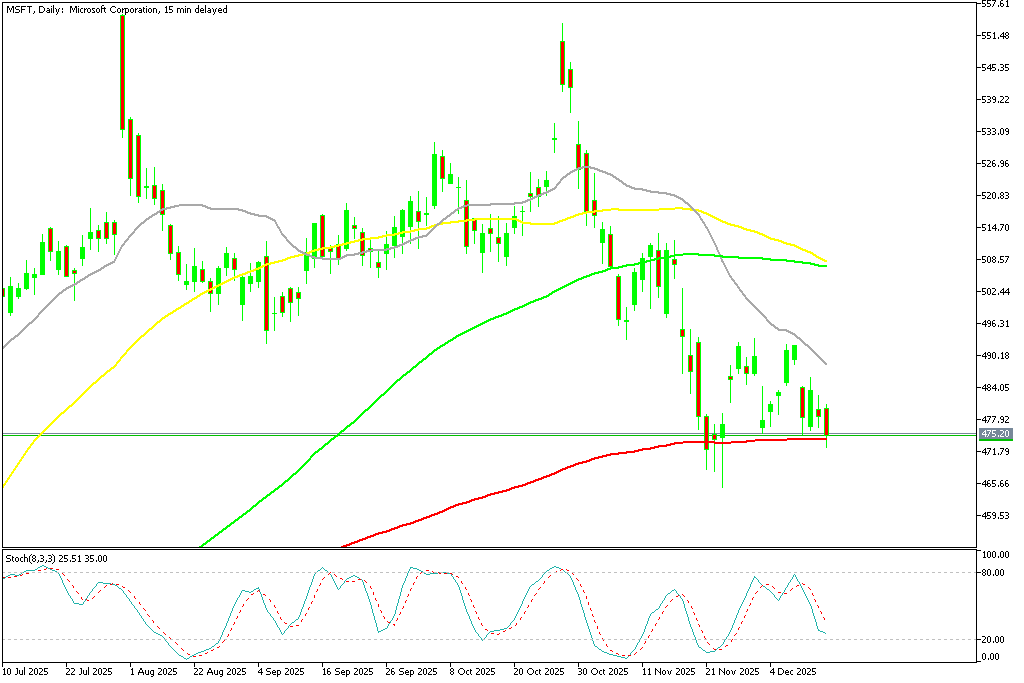
Recent trading patterns suggest Microsoft’s long-standing uptrend is weakening. After failing to sustain momentum near the $553–$555 range, the stock fell below its 50-day moving average and slid toward the 100-day average, where it has found temporary support multiple times. Each bounce, however, has been followed by renewed selling, increasing the likelihood of a breakdown.
MSFT Chart Daily – The 100 SMA Is Holding As Support
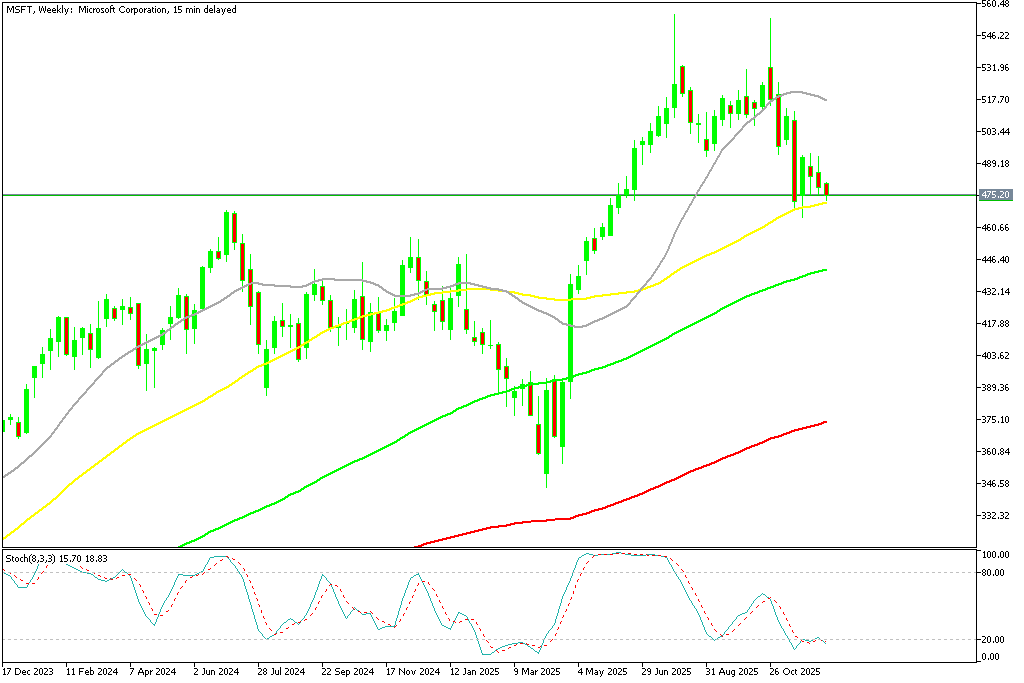
On a broader timeframe, Microsoft is now trading below its 20-week moving average, signaling a loss of medium-term momentum. Although longer-term support remains intact for now, traders are watching closely. A decisive break lower could open the door to a deeper correction, while the $500 level has become a critical hurdle that must be reclaimed to restore confidence.
MSFT Chart Weekly – Returning to the 20 SMA
Adding to unease, Vice Chair and President Brad Smith recently sold more than 30,000 shares. While insider sales are not uncommon, the timing has reinforced perceptions that executives may be preparing for increased volatility.
AI Investment Shifts From Advantage to Overhang
Despite posting solid quarterly results—$3.72 in earnings per share on $77.67 billion in revenue—the conversation around Microsoft has changed. Rather than celebrating performance, analysts are increasingly focused on the cost side of the equation. AI-related spending, particularly tied to OpenAI, shaved nearly forty cents per share from recent earnings, illustrating how quickly expenses are mounting.
Chief Financial Officer Amy Hood has cautioned that these pressures will intensify through 2025 as Microsoft expands data centers, GPU capacity, and AI integrations across its platforms. What once fueled optimism is now being scrutinized as a potential drag on margins, raising questions about how long investors will wait for AI investments to pay off.
Strategic Partnerships Grow More Complicated
Microsoft’s extensive web of AI partnerships was once viewed as a key strength, but it is becoming increasingly complex to manage. Collaborations with Nvidia and Anthropic broaden Azure’s AI offerings, yet they also dilute strategic focus at a time when investors want clearer direction.
More concerning are signs of strain in Microsoft’s relationship with OpenAI. Reports that OpenAI is exploring alternative chip partnerships and potentially expanding into services that overlap with Microsoft-owned platforms have fueled speculation that Microsoft’s influence over its most critical partner may be diminishing.
Operational and Reputational Pressures Mount
Beyond financial and strategic concerns, Microsoft is also grappling with operational and reputational challenges. Recent internal leaks related to AI development have reignited worries around data security and governance—key pillars of Microsoft’s enterprise reputation.
Meanwhile, underperformance in the Xbox division continues to weigh on sentiment, and employee criticism over defense-related AI contracts and politically sensitive data-center projects has grown louder. High-profile international partnerships, including multibillion-dollar agreements in the Middle East, have drawn scrutiny from human-rights groups and institutional investors, adding another layer of risk to Microsoft’s already complex outlook.
- Check out our free forex signals
- Follow the top economic events on FX Leaders economic calendar
- Trade better, discover more Forex Trading Strategies
- Open a FREE Trading Account


 Save
Save