Nvidia Stock NVDA Shows Emerging Downtrend as Market Reprices AI Expectations
After a brief lift from easing U.S. export rhetoric, Nvidia’s share price has resumed its decline as investors reassess valuation...
Quick overview
- Nvidia's share price has declined again as investors reassess its valuation and the sustainability of AI-driven growth after a brief boost from U.S. export policy changes.
- Despite initial optimism from President Trump's comments on semiconductor exports, uncertainty remains regarding the enforcement and clarity of these rules.
- Nvidia continues to deliver strong financial results and expand its ecosystem, but investors are now more cautious, demanding proof of sustained growth amid rising competition and geopolitical challenges.
- The company's partnership with Brookfield Asset Management signals a strategic shift towards AI infrastructure, introducing new complexities and risks.
Live NVDA Chart
[[NVDA-graph]]
After a brief lift from easing U.S. export rhetoric, Nvidia’s share price has resumed its decline as investors reassess valuation, geopolitics, and the sustainability of AI-driven growth.
A Policy Boost That Failed to Last
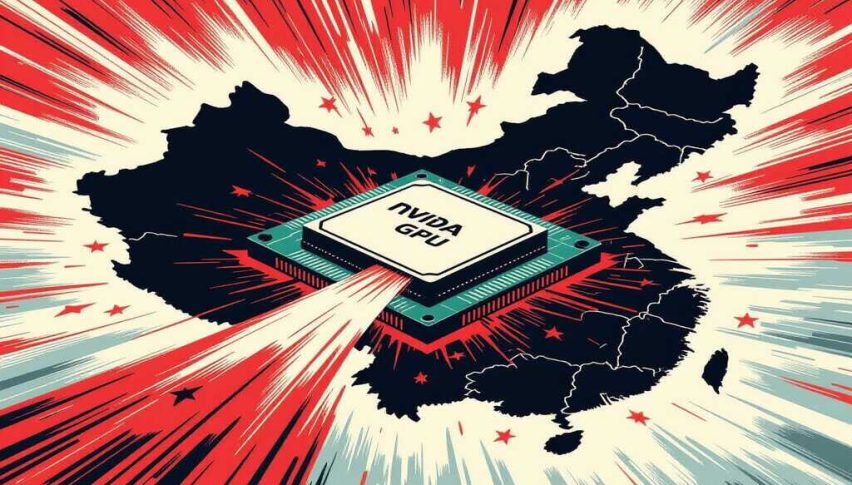
Nvidia began the month on stronger footing after U.S. President Donald Trump signaled a softer stance on semiconductor export restrictions, confirming that shipments of Nvidia’s H200 processors would be permitted to approved buyers in China. The announcement sparked a late-session rally and briefly improved sentiment across the chip sector.
That optimism has since faded. Nvidia shares are now down roughly 3.5% on the day and sit about 25% below their early-November highs, reflecting renewed pressure on semiconductor and quantum-related stocks. What initially looked like a meaningful policy shift has instead become a short-lived reprieve, as broader market forces reasserted themselves.
Washington Signals Flexibility, but Uncertainty Remains
President Trump’s comments left little room for interpretation. He stated that the U.S. would authorize H200 exports under a framework requiring a 25% payment to the federal government, presenting the policy as a balance between national security and economic competitiveness. He argued that prior export rules forced U.S. companies to produce downgraded chips that global customers did not want, undermining American leadership.
Importantly, Trump framed the policy as sector-wide, extending beyond Nvidia to include AMD, Intel, and other U.S. semiconductor leaders. That message initially lifted the entire industry, reinforcing hopes that China—one of the world’s largest AI and data-center markets—would remain accessible, albeit under tighter conditions.
Yet markets quickly recognized that flexibility does not equal clarity. Export rules remain subject to political negotiation, enforcement risk, and sudden revision. For investors, that lingering uncertainty continues to cap enthusiasm.
A Fragile Technical Picture Emerges
From a technical standpoint, Nvidia’s chart has deteriorated. The stock recently fell below its 20-week (gray) moving average, a level that historically provided support during pullbacks. That same average has now turned into resistance, rejecting price advances last week and signaling a potential shift in trend.
NVDA Chart Weekly – The 20 SMA Has Turned Into Resistance

Momentum indicators have weakened, and traders are increasingly discussing the possibility of a deeper correction toward the 50-week moving average (yellow). While long-term structure remains intact, near-term signals suggest that selling pressure has not yet fully exhausted itself.
Outstanding Performance Meets Lofty Expectations
Fundamentally, Nvidia continues to deliver exceptional results. The company’s latest earnings beat expectations by a wide margin, with revenue surging, margins expanding, and forward guidance reinforcing the scale of demand for AI accelerators, GPU clusters, and data-center platforms.
Nvidia’s pricing power remains unmatched, supported by its dominant software ecosystem and the rapid adoption of its newest architectures. Heavy investment in research and development reflects a company intent on extending its technological lead, not just defending it. Expansion into adjacent areas such as AI infrastructure, power-efficient computing, and full-stack data-center solutions further underscores Nvidia’s long-term ambition.
The challenge for investors is not execution, but valuation. Nvidia’s dominance is widely understood and heavily priced in. The market is no longer asking whether the company can grow, but whether it can grow fast enough to justify expectations that already assume extraordinary success.
The Brookfield Alliance and Infrastructure Ambitions
Nvidia’s evolving partnership with Brookfield Asset Management adds another dimension to the story. Plans to co-develop up to $100 billion in AI infrastructure mark a strategic shift from pure chip supplier toward deeper involvement in power, data-center capacity, and large-scale deployment.
This evolution could expand Nvidia’s addressable market and embed it even more deeply into the AI value chain. At the same time, it introduces new complexities, including capital intensity, execution risk, and exposure to infrastructure cycles that differ from Nvidia’s historically asset-light model.
Ecosystem Momentum Remains Strong
Despite near-term share price weakness, Nvidia’s ecosystem continues to expand globally. Cloud infrastructure provider Nebius recently launched AI Cloud 3.1, incorporating Nvidia’s next-generation Blackwell Ultra compute platforms. The company has become the first European provider to deploy both GB300 NVL72 and HGX B300 systems in production environments.
Such developments highlight the ongoing appetite for Nvidia’s most advanced hardware, even as broader market sentiment wavers. Demand from cloud providers, enterprises, and governments remains robust, reinforcing Nvidia’s central role in the AI buildout.
From Unquestioned Optimism to Higher Standards
The most significant shift surrounding Nvidia is psychological. For much of the AI boom, the stock benefited from near-perfect confidence, with investors willing to price in years of outsized growth with little hesitation. That era appears to be ending.
Today, Nvidia is still the cornerstone of the AI hardware landscape and one of the most profitable companies in modern history. But the market’s tone has changed. Investors now demand continued proof that growth can remain durable in the face of competition, regulation, and geopolitical friction.
Nvidia’s long-term story remains compelling. In the short term, however, its stock reflects a market no longer driven by faith alone, but by a far more demanding standard of justification.
- Check out our free forex signals
- Follow the top economic events on FX Leaders economic calendar
- Trade better, discover more Forex Trading Strategies
- Open a FREE Trading Account


 Save
Save