Oracle Valuation Collapses, but Tik-Tok Deal and Key Support Keep Hopes Up for the ORCL Stock
Oracle shares have stabilized following a substantial valuation reset, as investors reassess the rising costs associated with...
Quick overview
- Oracle shares have stabilized after a significant valuation drop, as investors reassess the financial implications of AI infrastructure costs.
- Concerns over Oracle's balance sheet and potential debt accumulation have heightened market caution, impacting broader tech stocks.
- A proposed acquisition of TikTok's U.S. operations provided a temporary boost to Oracle's stock, highlighting its strategic relevance in data governance.
- Overall, the market is shifting towards demanding tangible financial returns and disciplined capital management from tech companies involved in AI.
Live ORCL Chart
[[ORCL-graph]]
Oracle shares have stabilized following a substantial valuation reset, as investors reassess the rising costs associated with AI infrastructure and look for clearer indications of sustainable returns.
AI Cost Concerns Spill Into Broader Markets
U.S. equity markets grew increasingly cautious after Oracle’s latest earnings update reignited fears that the race to build artificial intelligence infrastructure may be advancing faster than corporate balance sheets can support. The reaction was particularly visible in technology-heavy indices, with the Nasdaq coming under renewed pressure even as more defensive segments of the market showed relative stability.
Oracle’s selloff became emblematic of a wider reassessment underway across Big Tech. The company’s valuation, which once approached the trillion-dollar mark on AI optimism, has now fallen dramatically, highlighting how quickly sentiment can shift when investment intensity collides with questions around cash flow and leverage.
From Near-Trillion Valuation to Abrupt Reset
In early September, Oracle appeared on the verge of joining the elite club of mega-cap technology leaders. Shares surged beyond $345, lifting the company’s market capitalisation close to $940 billion and placing it alongside the likes of Nvidia, Alphabet, and Amazon in investor discussions.
That enthusiasm has since evaporated. Oracle’s stock has suffered a sharp decline, cutting its market value to roughly $550 billion. The scale of the drawdown reflects not just disappointment with earnings, but a broader change in how markets are pricing AI exposure. Once viewed as a near-certain growth engine, AI infrastructure spending is now being evaluated through a much stricter financial lens.
Debt Fears Add Fuel to the Selloff
Concerns over Oracle’s balance sheet have compounded the pressure. Morgan Stanley has warned that Oracle could issue as much as $70 billion in additional debt by 2026 to support its expansion plans. While the company insists that such investments are necessary to compete in cloud and AI infrastructure, investors are increasingly uneasy about the pace at which leverage is rising.
The fear is not that AI demand will disappear, but that returns may arrive far later than expected—leaving companies exposed to elevated interest costs and constrained financial flexibility in the meantime.
TikTok Deal Offers a Surprise Stabiliser
After weeks of sustained losses, Oracle finally received a positive catalyst. Reports emerged that the company would be part of a consortium set to acquire TikTok’s U.S. operations, a move that helped stabilise the stock near technical support.
Under the proposed structure, Oracle is expected to partner with Silver Lake and Abu Dhabi-based MGX in a joint venture valued at approximately $14 billion. Each partner would reportedly hold a 15% stake, while ByteDance would retain a minority interest. Importantly, Oracle would take responsibility for U.S. data security, user data hosting, and algorithm oversight—key conditions aimed at satisfying national security concerns.
Although the deal still requires approval from Chinese regulators, it offered investors a reminder of Oracle’s strategic relevance in data infrastructure and governance, helping to halt the immediate slide in shares.
Earnings Fallout Spreads Unease Across Tech
Oracle’s earnings release did more than hit its own stock—it sent ripples across the technology sector. Investors interpreted the results as further evidence that the cost of scaling AI infrastructure may be outpacing near-term profitability, an issue that affects cloud providers industry-wide.
Shares weakened further when reports surfaced that funding for a major U.S. data centre project had stalled. The development reinforced fears that even well-capitalised companies are encountering resistance from financiers increasingly wary of AI’s capital intensity.
Data Centre Commitments Under Scrutiny
According to reporting by the Financial Times, Oracle’s primary financial backer declined to fund a planned $10 billion, one-gigawatt data centre facility in Michigan. The hesitation was reportedly linked to concerns about Oracle’s growing debt load and the sheer scale of its AI spending commitments.
This issue is not isolated. Bloomberg estimates suggest that major cloud players—including Oracle, Microsoft, and Meta—have collectively accumulated around $500 billion in future obligations related to data centre leases. These long-term commitments are now drawing heightened scrutiny from investors and policymakers alike, particularly as energy usage and infrastructure strain become politically sensitive topics.
Strong Revenue, Weak Cash Flow
Fundamentally, Oracle’s results painted a mixed picture. Revenue rose 14% year-on-year to $16.05 billion, while net income nearly doubled to $6.1 billion. Cloud services and applications revenue surged 34%, underscoring genuine demand for Oracle’s offerings.
However, the headline numbers masked a growing problem: free cash flow. Negative free cash flow expanded to more than $13 billion, intensifying concerns about how Oracle plans to finance its aggressive expansion without placing excessive strain on its balance sheet. For many investors, this overshadowed otherwise solid operational performance.
From AI Favourite to Market Skepticism
Earlier in the year, Oracle was embraced as a key beneficiary of the AI boom. Speculation around large cloud contracts and infrastructure partnerships drove repeated rallies. That narrative has now reversed.
Since late September, each rebound has been weaker than the last, reflecting a market that is no longer willing to assign premium valuations based on long-term AI potential alone. Investors are demanding visible progress on profitability, capital discipline, and return on investment.
Technical Structure Signals Fragility
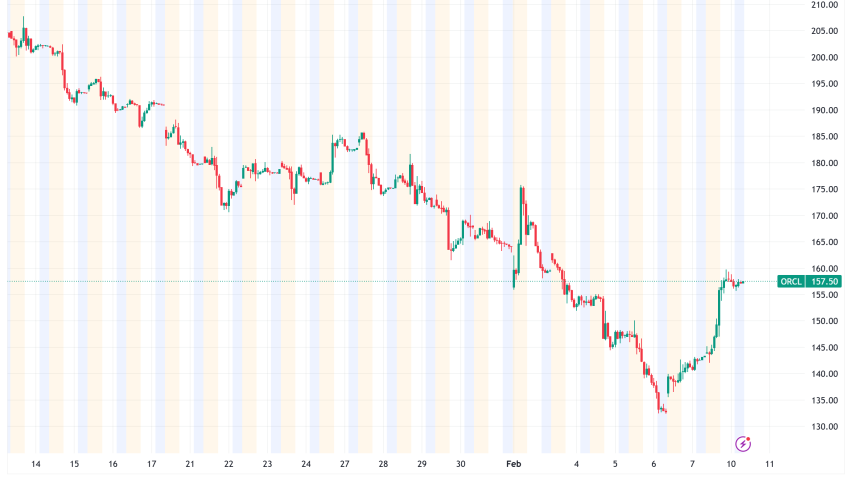
Technically, Oracle’s chart reflects the deteriorating sentiment. Shares have fallen considerably but the 20 moving average (gray) continues to hold as support, so there’s a chance of a recovery, especially if the Tik-Tok deal passes. A breakdown below long-term trend indicators has shifted trader focus toward lower support zones around $150, with deeper downside risk toward the April lows near $118 if selling pressure resumes.
ORCL Chart Monthly – Can the 20 SMA Hold Again?

The failure to reclaim critical technical levels has reinforced bearish momentum, creating a feedback loop where negative headlines accelerate technical weakness.
AI Headlines No Longer Enough
One of the most striking developments is how markets are responding to AI news. Announcements that once sparked immediate rallies are now being met with caution—or outright selling—unless accompanied by clear improvements in margins and cash generation.
For Oracle, this marks a turning point. Continued investment in AI infrastructure is no longer sufficient to restore confidence. The company must demonstrate that its strategy can deliver sustainable financial returns without excessive reliance on debt.
Conclusion: A Market Demanding Discipline
Oracle’s recent struggles highlight a broader shift in market psychology. The AI boom is not over, but it has entered a more disciplined phase. Investors are no longer rewarding ambition alone; they want evidence of execution, financial resilience, and credible paths to profitability.
For Oracle, the challenge is clear. The company remains strategically important, with strong cloud growth and a potentially transformative role in data security through deals like TikTok. Yet until concerns around cash flow and leverage are addressed, the stock is likely to remain under pressure.
Oracle’s experience now serves as a cautionary signal for the wider tech sector—reminding markets that in the next phase of AI, proof will matter more than promises.
- Check out our free forex signals
- Follow the top economic events on FX Leaders economic calendar
- Trade better, discover more Forex Trading Strategies
- Open a FREE Trading Account
- Read our latest reviews on: Avatrade, Exness, HFM and XM


 Save
Save