Oracle Stock Finds Support After Valuation Reset as Investors Assess AI Economics
After a significant valuation reset, Oracle's share price has stabilized as investors transition from AI excitement to a more disciplined...

Quick overview
- Oracle's share price has stabilized after a significant valuation reset, as investors shift focus to cash flow and long-term returns.
- The company's recent earnings report revealed strong revenue growth but raised concerns about free cash flow deficits and rising debt levels.
- Oracle's participation in a consortium to acquire TikTok's U.S. operations has provided a stabilizing catalyst, highlighting its strategic relevance.
- Overall, the market is evolving towards a more disciplined approach to AI investments, prioritizing sustainability and financial efficiency.
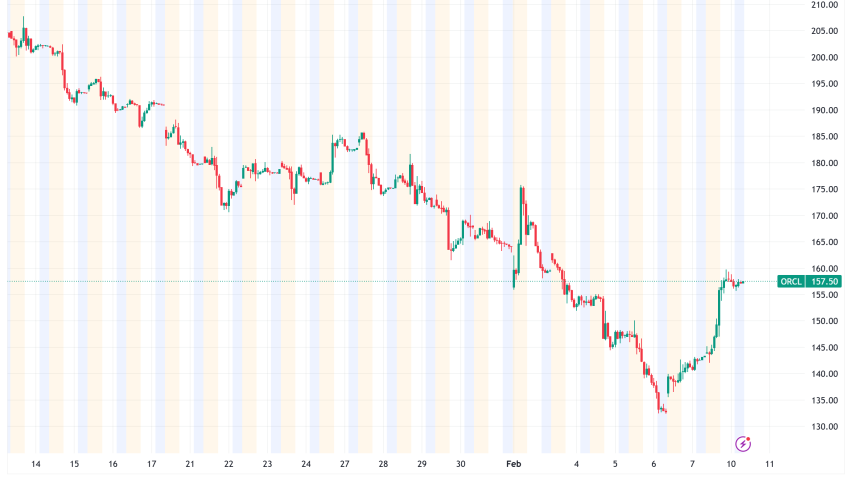
Live ORCL Chart
[[ORCL-graph]]
After a significant valuation reset, Oracle’s share price has stabilized as investors transition from AI excitement to a more disciplined focus on cash flow, balance sheet strength, and long-term returns.
Oracle Enters a Consolidation Phase After AI-Led Repricing
Oracle shares have entered a period of consolidation following one of the most pronounced valuation adjustments among large-cap technology companies this year. While the initial selloff was sharp, the subsequent stabilisation reflects a market that is no longer reacting emotionally, but instead reassessing Oracle’s long-term positioning with a more measured lens.
Rather than signaling a loss of relevance, the reset suggests a transition point. Investors appear to be recalibrating expectations as the artificial intelligence investment cycle moves from rapid expansion toward execution, efficiency, and financial sustainability.
AI Infrastructure Costs Prompt a Broader Market Pause
Oracle’s latest earnings update triggered a wave of caution across U.S. equity markets, particularly within technology-heavy indices. The concern was not about demand for AI services, but rather the pace at which capital is being deployed to support that demand.
Oracle disclosed that capital expenditures tripled year-on-year in its second fiscal quarter to $12 billion, prompting management to raise full-year guidance for capex to approximately $50 billion. While these investments are directed toward expanding data center capacity and cloud infrastructure, the scale of spending has led investors to question the near-term impact on free cash flow.
This reassessment has extended beyond Oracle, contributing to a more cautious tone across the broader technology sector as markets digest the true cost of building AI at scale.
From Near-Trillion Valuation to a More Grounded Framework
Just months ago, Oracle shares were trading above $345, pushing the company’s market capitalisation toward $940 billion and placing it firmly in the top tier of AI beneficiaries. That optimism has since moderated, with the valuation now closer to $550 billion.
While the magnitude of the adjustment is notable, it also reflects a healthier pricing environment. Investors are increasingly distinguishing between AI adoption and AI profitability, rewarding companies that demonstrate not only growth but also capital efficiency.
Oracle’s reset places it in a position where expectations are more achievable, potentially lowering the bar for future upside surprises.
Balance Sheet Concerns Temper Near-Term Enthusiasm
One of the key issues weighing on sentiment has been the outlook for leverage. Morgan Stanley has suggested Oracle may need to raise as much as $70 billion in additional debt by 2026 to support its infrastructure expansion.
Although management has framed this investment cycle as necessary to compete effectively in cloud and AI services, investors are understandably focused on how rising debt interacts with interest costs, financial flexibility, and shareholder returns.
Importantly, the concern is not about demand erosion, but timing. Markets are increasingly focused on when AI investments translate into consistent and visible free cash flow.
Selective Institutional Adjustments Reflect Portfolio Rebalancing
Recent regulatory filings show that some institutional investors have modestly trimmed exposure. R.H. Dinel Investment Counsel Inc., for example, reduced its Oracle stake by approximately 6.8% during the third quarter.
Such moves appear more reflective of portfolio rebalancing rather than outright loss of confidence. Many funds are adjusting weightings across the technology sector as volatility increases and valuation dispersion widens.
TikTok Consortium Deal Provides Strategic Validation
After weeks of sustained pressure, Oracle received an unexpected stabilising catalyst. Reports emerged that the company would participate in a consortium seeking to acquire TikTok’s U.S. operations, alongside Silver Lake and Abu Dhabi–based MGX.
Under the proposed structure, Oracle would play a central role in data hosting, user privacy protection, and algorithm oversight—functions that align directly with its core strengths in enterprise infrastructure and governance.
Although regulatory approvals are still pending, the announcement reminded investors of Oracle’s strategic relevance in managing sensitive, large-scale data environments, helping to arrest the stock’s downward momentum.
Earnings Reveal Strong Demand Beneath the Surface
Fundamentally, Oracle’s earnings painted a nuanced picture. Revenue grew 14% year-on-year to $16.05 billion, while net income nearly doubled to $6.1 billion. Cloud services and applications revenue surged an impressive 34%, confirming that customer demand remains robust.
However, these positives were overshadowed by a deterioration in free cash flow, which widened to a deficit of more than $13 billion. For many investors, this imbalance between growth and cash generation remains the key issue to resolve.
Still, the revenue trajectory suggests that Oracle’s products remain firmly embedded in enterprise and AI workloads.
Data Centre Economics Come Under Sharper Review
Investor caution intensified following reports that financing for a major $10 billion data centre project in Michigan had stalled. According to the Financial Times, concerns over debt levels and capital intensity contributed to hesitation from backers.
This development underscores a broader industry trend. Bloomberg estimates that major cloud providers collectively carry around $500 billion in future data centre lease obligations, bringing energy usage, infrastructure strain, and long-term returns into sharper focus.
For Oracle, the challenge will be balancing strategic scale with disciplined execution.
Technical Picture Reflects Fragility, Not Breakdown
From a technical standpoint, Oracle shares remain under pressure but have not fully broken down. The stock continues to find support near its 20-period moving average (gray), suggesting that selling momentum is slowing.
ORCL Chart Monthly – Can the 20 SMA Hold Again?

Attempts to reclaim the $200 level have so far been unsuccessful, but a sustained move above this zone could open the door toward $220. Conversely, a failure to hold long-term support would shift attention toward lower levels near $150, with deeper downside toward the $118 April lows.
At present, the chart reflects uncertainty rather than capitulation.
AI Narrative Evolves Toward Accountability
Perhaps the most significant shift is how markets now respond to AI-related headlines. Announcements that once triggered automatic rallies are increasingly being met with skepticism unless accompanied by evidence of improving margins and disciplined capital allocation.
For Oracle, this marks a maturation phase. The company’s AI ambitions remain intact, but investor confidence will increasingly depend on execution, transparency, and demonstrable returns.
Conclusion: A Reset That May Strengthen the Long-Term Case
Oracle’s recent performance highlights a broader evolution in market psychology. The AI boom has not ended—it has entered a more demanding stage. Investors are no longer rewarding scale alone; they are prioritising sustainability, cash flow, and balance sheet resilience.
Oracle remains strategically important, with strong cloud growth, expanding AI infrastructure, and a potentially transformative role in secure data management. If management can align investment intensity with financial discipline, the recent reset may ultimately prove constructive rather than damaging.
- Check out our free forex signals
- Follow the top economic events on FX Leaders economic calendar
- Trade better, discover more Forex Trading Strategies
- Open a FREE Trading Account
- Read our latest reviews on: Avatrade, Exness, HFM and XM



 Save
Save