Micron Raises Fears of a Crowded Trade – Reality Bites Mu Stock
Bulls were happy with Micron's spectacular surge above $300, but investors are now being forced to face how much optimism has already been..
Quick overview
- Micron Technology achieved a significant breakout above $300, but a recent sharp decline has raised concerns about overvaluation.
- The company's rally is supported by tangible improvements in earnings and supply constraints, distinguishing it from speculative AI stocks.
- Despite impressive earnings and a strong market position, Micron faces heightened expectations and a narrowing margin for error moving forward.
- The semiconductor sector's current supply tightness may be temporary, and Micron's focus on enterprise demand increases its vulnerability to market fluctuations.
Bulls were happy with Micron’s spectacular surge above $300, but investors are now being forced to face how much optimism has already been priced in due to the pace of the increase and a sudden reverse.
A Long-Awaited Breakout Arrives—Then Stalls Abruptly
Micron Technology finally achieved what had eluded it for years: a clean breakout above the psychologically important $300 level. The move came swiftly at the start of 2026, following a strong close to 2025, and initially appeared to confirm the company’s transformation from a cyclical laggard into a structural AI winner.
Shares surged as high as $346 midweek, capping a staggering run that saw the stock rise roughly 246% over the past year. However, the enthusiasm proved fragile. On Thursday, Micron shares dropped sharply—falling about 4%—a reminder that vertical rallies rarely go unchallenged.
The abrupt reversal has reopened a debate that had been largely ignored during the ascent: whether Micron’s valuation and expectations have sprinted too far ahead of reality.
A Rally Built on Real Progress—but Accelerating Too Fast
Unlike many speculative AI beneficiaries, Micron’s rally has been grounded in tangible improvement. While large portions of the semiconductor sector struggled through the second half of 2025 amid valuation fatigue and capital spending concerns, Micron continued to climb, supported by earnings execution, pricing power, and visible supply constraints.
That distinction matters. Micron is not trading on abstract promises—it is benefiting from real shortages, real contracts, and real margin expansion.
Yet even fundamentally driven rallies can become unstable when momentum accelerates too quickly. The move from below $300 to the mid-$340s happened in a matter of days, compressing months of expected upside into a single burst of enthusiasm.
Headlines Add Fuel—but Also Inflate Expectations
Micron has added its own stream of bullish headlines. The company announced plans to break ground on its massive $100 billion megafab in New York on January 16, a project it describes as the largest semiconductor manufacturing facility in U.S. history.
Management also unveiled new products, including the 3610 NVMe SSD—its first PCIe Gen5 G9 QLC drive aimed at mainstream PCs and ultra-thin laptops. While technologically impressive, QLC NAND comes with trade-offs, particularly around endurance, underscoring the constant balance between innovation and compromise in memory design.
These announcements reinforced the perception of momentum, but they also raised the stakes. Large-scale manufacturing commitments and aggressive product roadmaps amplify execution risk, especially late in a cycle.
CES Reignites Memory Mania
The rally gained further traction following comments from Nvidia CEO Jensen Huang at CES, where he highlighted a new layer of storage technology critical to future AI systems. The implication was clear: memory is becoming a bottleneck in AI infrastructure.
Markets responded enthusiastically. Memory and storage stocks surged, pushing the PHLX Semiconductor Index to a fresh all-time high, up nearly 8% in the first three sessions of 2026.
Micron stood at the center of that rotation. Long dismissed as a commodity player, it suddenly appeared indispensable—an uncomfortable position for an industry known for boom-and-bust cycles.
Supply Tightness Is Real—But Cycles Always Return
There is no denying the current supply environment. As manufacturers divert capacity toward high-bandwidth memory (HBM) used in AI data centers, conventional DRAM and NAND markets have tightened sharply.
TrendForce data shows DDR5 DRAM prices surging more than 300% year over year, with contract prices expected to rise another 55% to 60% in the current quarter. Micron, heavily exposed to these segments, is capturing the upside.
However, memory history offers a sobering lesson. Periods of extreme pricing power tend to sow the seeds of their own undoing. High margins invite capacity expansion, technological catch-up, and eventually oversupply. The timing is uncertain—but the pattern is well established.
A Rare Winner in a Cooling AI Landscape—For Now
Micron’s outperformance has been particularly striking given the broader cooling in AI-linked equities. Many infrastructure names stumbled late in 2025 as investors questioned valuation excess, capital intensity, and diminishing marginal returns.
Micron avoided that fate by sitting deeper in the supply chain. It sells components customers cannot do without, rather than betting on discretionary upgrades or future adoption curves.
But success has consequences. The market has noticed, capital has crowded in, and Micron is no longer a contrarian trade. It is now a consensus winner—often the most dangerous position late in a cycle.
Earnings Impress—but Expectations Reset Higher
Micron’s earnings validated much of the bullish narrative. Record profits, beats across key metrics, and confident guidance reinforced management credibility. The confirmation that all HBM output for 2026 is fully allocated under contract provided rare visibility in a historically opaque industry.
Yet the market’s reaction pulled future optimism forward. Shares surged through multiple resistance levels, effectively pricing in continued perfection.
At this point, strong execution is no longer a catalyst—it is a requirement just to sustain current levels.
Margins Improve, Capex Looms
Financially, Micron is stronger than it has been in years. Gross margins near 40%, EBITDA margins approaching 50%, and net margins above 20% mark a dramatic turnaround.
The balance sheet is conservative, with low leverage, but capital intensity remains high. Massive investments in advanced nodes and new fabs are necessary to compete—but they also raise the cost of being wrong.
If pricing momentum slows or demand softens, today’s margin structure could unwind quickly.
Technical Picture Shows Strength—and Excess
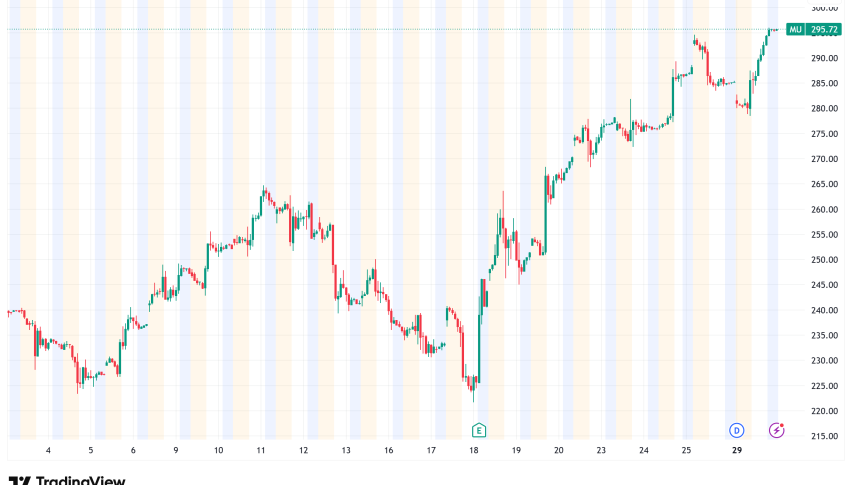
Technically, Micron remains in an uptrend, with moving averages still offering support. But the rally has become visibly stretched. After such a steep ascent, consolidation or a deeper pullback would be statistically normal.
MU Chart Daily – MAs Continuing to Support the Uptrend

Thursday’s sharp decline shifts attention back toward the $300 level as a critical test of sentiment. A failure there would raise the risk that momentum traders exit as quickly as they entered.
Strategic Focus Narrows the Risk Profile
Micron’s exit from the Crucial consumer memory business sharpens its focus on enterprise and AI-driven demand. While higher-margin and more predictable, this strategy increases dependence on a narrower set of customers and spending cycles.
Reduced diversification can amplify volatility when conditions turn.
Competition Is Quiet—But Not Gone
China’s CXMT and other emerging players remain longer-term threats. While not immediately disruptive, capacity expansion plans underscore an uncomfortable truth: today’s supply tightness is temporary.
Conclusion: Momentum Is Powerful—But the Margin for Error Is Shrinking
Micron’s surge into 2026 reflects genuine operational strength, disciplined execution, and a rare moment of pricing power in memory markets. But the speed of the rally has compressed future returns into the present.
With valuation stretched, expectations elevated, and cycles never abolished—only delayed—Micron now trades with a narrowing margin for error. The breakout may be real, but sustaining it will require near-flawless execution in an industry that rarely delivers it for long.
- Check out our free forex signals
- Follow the top economic events on FX Leaders economic calendar
- Trade better, discover more Forex Trading Strategies
- Open a FREE Trading Account


 Save
Save