CPU Demand Lifts AMD Stock Towards $265 Pre Earnings, Yet AI Doubts Linger
As confidence in server CPU demand returned, AMD shares rose well ahead of earnings despite unresolved concerns about AI leadership and...
Quick overview
- AMD shares surged 8.5% ahead of its earnings report, driven by renewed confidence in server CPU demand.
- Analysts expect AMD to beat revenue estimates, particularly due to strong demand for its server CPU lineup.
- Despite the positive earnings outlook, concerns about AMD's AI leadership and competitive positioning remain unresolved.
- Geopolitical factors and valuation sensitivity add complexity to AMD's market outlook as it approaches its earnings release.
Live AMD Chart
[[AMD-graph]]
As confidence in server CPU demand returned, AMD shares rose well ahead of earnings despite unresolved concerns about AI leadership and competitive positioning.
Earnings Anticipation Sparks a Sharp Rebound
Advanced Micro Devices shares surged roughly 8.5% on Wednesday after the company confirmed it will report fiscal fourth-quarter and full-year 2025 results on February 3, with a conference call scheduled later that evening. The announcement reignited optimism that AMD’s core data-center business may deliver stronger-than-expected results.
The rally reflects renewed confidence that AMD’s exposure to AI-driven infrastructure spending—particularly through server CPUs—could translate into upside surprises on revenue and guidance. Investors appear increasingly focused on whether AMD can sustain momentum in a market positioned between two major investment waves: cloud expansion and artificial intelligence.
The timing of the move is notable. AMD had recently endured heavy selling pressure, leaving the stock vulnerable to a relief rally once sentiment shifted.
Analysts Point to Server CPU Strength
KeyBanc analyst John Vinh has emerged as one of the more constructive voices on AMD’s near-term outlook. He expects the company to beat consensus revenue estimates and potentially raise forward guidance, driven largely by strong demand for its server CPU lineup.
According to Vinh, AMD is close to selling out its server CPU capacity for the year, particularly its latest-generation Turin data-center processors. Hyperscale customers, eager to secure reliable compute capacity, may be willing to accept price increases of 10% to 15% to lock in supply.
Earlier this month, Vinh projected that AMD’s server CPU segment could expand by at least 50% this year, underscoring the strategic importance of CPUs in AI data centers—even as GPUs dominate headlines.
Positioned Between Cloud and AI Spending Cycles
AMD occupies a unique position in the semiconductor ecosystem. While Nvidia commands the spotlight in AI accelerators, AMD plays a critical role supplying CPUs that anchor AI server infrastructure.
As AI workloads proliferate, demand for balanced systems—combining CPUs, accelerators, memory, and networking—has increased. That trend has benefited AMD’s data-center CPU business, which is less volatile than accelerator demand and often driven by longer procurement cycles.
Investors will be watching closely to see whether AMD can convert this structural advantage into sustained revenue growth and margin stability when earnings are released.
A Technical Bounce, Not a Trend Reversal—Yet
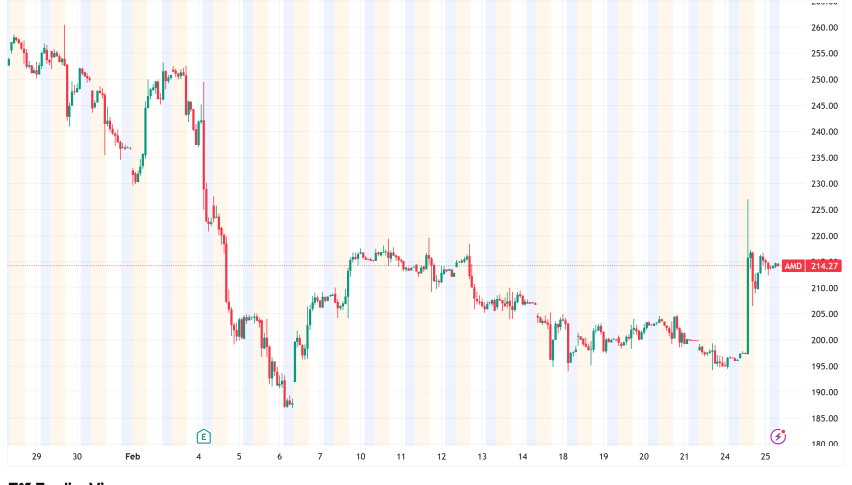
From a technical standpoint, the rebound was significant. AMD reclaimed its 50-day moving average, which has now flipped back into short-term support.
AMD Chart Daily – Buyers Overcame the 50 SMA

On higher timeframes, the 20-week moving average near $200 held firm, triggering aggressive dip-buying. That said, the bounce appears driven more by positioning and relief than by renewed long-term conviction. The stock remains well below recent highs, and overhead resistance levels have yet to be convincingly cleared.
AMD Chart Weekly – The 20 SMA Held As Support

The move improves the near-term setup, but it does not yet confirm a durable trend reversal.
CES Raised More Questions Than Confidence
The Consumer Electronics Show was widely expected to strengthen AMD’s standing in the AI hardware race. Instead, it highlighted the widening gap between market expectations and AMD’s current execution.
Following CES presentations, AMD shares slid more than 3%, extending a broader pullback that saw the stock fall nearly 15% in the prior week. Investors appeared underwhelmed by the scale and urgency of AMD’s messaging around AI acceleration.
Rather than signaling acceleration, CES reinforced concerns that AMD’s roadmap may not match the immediacy demanded by hyperscalers racing to deploy AI infrastructure today.
Nvidia’s Dominance Sets an Unforgiving Benchmark
CES also underscored Nvidia’s commanding position. CEO Jensen Huang detailed the company’s next-generation “Vera Rubin” platform, confirmed production readiness, and showcased a flagship server configuration featuring 72 GPUs and 36 CPUs.
The contrast was stark. Nvidia is delivering fully integrated systems at scale, supported by a mature software ecosystem and deep customer lock-in.
AMD’s announcements—centered on MI455 processors and MI440X accelerators—were framed as competitive alternatives, particularly for on-premise deployments. However, they lacked the ecosystem depth, software maturity, and deployment scale that hyperscalers increasingly require.
Strong Results Haven’t Been Enough
By traditional metrics, AMD’s most recent earnings were impressive. Revenue climbed 36% year over year to $9.25 billion, non-GAAP EPS reached $1.20, and forward revenue guidance approached $9.6 billion.
The data-center segment remained robust, and the PC business showed signs of cyclical recovery. In a different market environment, such results might have propelled the stock higher.
Instead, gains faded quickly. Investors are no longer rewarding growth alone—they are demanding clear leadership in AI platforms, sustainable margins, and defensible ecosystems. On those measures, AMD is increasingly perceived as lagging the market leader.
Valuation Leaves Little Room for Error
AMD’s valuation had previously priced in sustained AI momentum and accelerating market-share gains. As sentiment around AI spending has cooled, that premium has become increasingly fragile.
Once key technical levels broke, selling intensified. Momentum-driven investors exited swiftly, turning what looked like consolidation into a sharper correction. In today’s market, richly valued companies without clear dominance are being repriced first.
The recent bounce offers relief, but it does not erase valuation sensitivity heading into earnings.
Export Restrictions Add Margin Pressure
Geopolitical factors continue to complicate AMD’s outlook. The company has confirmed it can ship certain MI308 chips to China under a licensing framework, but the arrangement requires a 15% payment to the U.S. government, directly impacting margins.
While this preserves some access to the Chinese market, it offers limited upside and exposes AMD to future policy tightening. Management appears focused on maintaining continuity rather than challenging the framework, a pragmatic but margin-dilutive approach.
OpenAI Partnership Loses Its Halo Effect
Earlier excitement surrounding AMD’s partnership with OpenAI has faded. While the relationship initially fueled hopes of large-scale accelerator adoption, analysts now point to uncertain volumes, unclear revenue visibility, and concentration risks.
At the same time, hyperscalers are increasingly developing custom silicon, while Nvidia continues to deepen its moat through software, networking, and developer tools. Against that backdrop, the OpenAI deal no longer looks transformative.
Conclusion: Relief Rally, Not Resolution
AMD’s sharp rebound reflects renewed confidence in server CPU demand and anticipation of a solid earnings report. That strength is real and meaningful—but it exists alongside unresolved concerns about AI leadership, competitive intensity, and valuation risk.
As earnings approach, the focus will be on execution, guidance, and margins. For now, AMD has found relief—but the broader debate over its role in the AI hierarchy remains far from settled.
- Check out our free forex signals
- Follow the top economic events on FX Leaders economic calendar
- Trade better, discover more Forex Trading Strategies
- Open a FREE Trading Account
- Read our latest reviews on: Avatrade, Exness, HFM and XM

Related Articles

Sidebar rates

Related Posts
 Save
Save