Intel INTC Stock Rebounds Off Support as Nvidia Foundry Deal Rekindles Hopes, CFO Buys
Reports that Nvidia might use Intel's foundry services for upcoming GPUs caused a sharp increase in Intel's stock price. This allayed long..
Quick overview
- Intel shares rebounded sharply after reports that Nvidia will use Intel's foundry services for future GPUs, alleviating concerns from cautious early-2026 guidance.
- Insider buying by Intel's CFO added confidence to the market, signaling management's belief in the company's value post-guidance sell-off.
- Despite a strong fourth-quarter performance, Intel's conservative outlook for early 2026 led to a significant market sell-off, with shares dropping roughly 18%.
- Overall, while short-term guidance disappointed, improvements in operational performance and external validation suggest a more promising long-term trajectory for Intel.
Reports that Nvidia might use Intel’s foundry services for upcoming GPUs caused a sharp increase in Intel’s stock price. This allayed long-standing worries brought on the cautious early-2026 projections.
Nvidia Foundry News Changes the Narrative
Sentiment shifted again after reports emerged that Nvidia plans to use Intel Foundry Services for components of its next-generation “Feynman” GPU, expected to launch in 2028. According to DigiTimes, the chips may be produced using Intel’s advanced 18A or 14A processes.
Apple is also reportedly involved in low-volume production runs, with all three companies maintaining parallel relationships with TSMC. Crucially, the arrangement helps satisfy U.S. semiconductor manufacturing requirements while positioning Intel as a credible alternative for advanced-node production.
The news reignited optimism around Intel’s foundry strategy and triggered a sharp rebound in the stock.
Insider Buying Adds Confidence
Adding to the positive shift, Intel CFO David Zinsner disclosed a purchase of 5,882 shares at $42.50 in late January. Insider buying at these levels sent a reassuring signal to the market, reinforcing confidence that management sees value after the post-guidance sell-off.
Technical Levels Back in Play
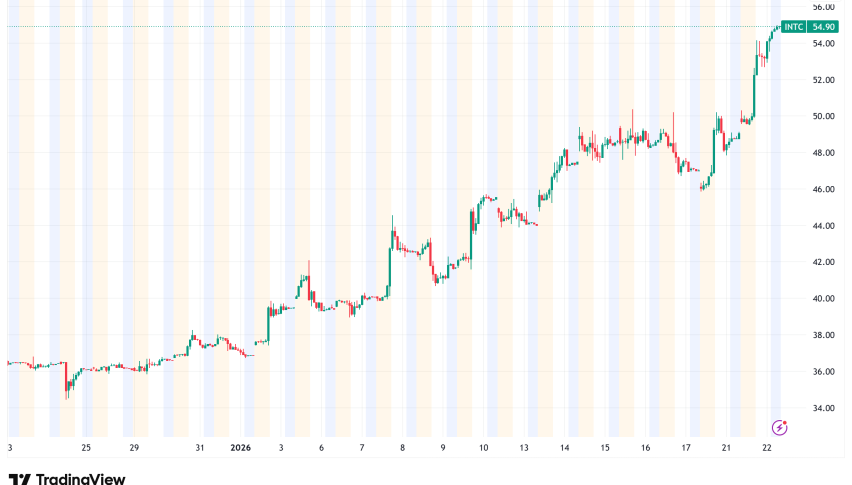
From a technical standpoint, Intel’s guidance-driven drop erased a recent breakout above $54. Shares slid toward $42.50, a key support zone that coincides with the October highs. That level held firmly, and today’s rally—up roughly 12%—has pushed the stock back toward the $50 area.
INTC Chart Daily – Bouncing Off $42.50 Support

The rebound restores focus on whether Intel can stabilise above former resistance and rebuild upside momentum.
Earnings Strength Overshadowed by Forward Caution
Intel’s fourth-quarter results delivered a clear operational beat, but the market’s focus quickly shifted to what lies ahead. While earnings, revenue, and margins exceeded expectations, management’s conservative outlook for early 2026 triggered a sharp reassessment of near-term growth prospects.
Adjusted earnings per share came in at $0.15, comfortably ahead of consensus forecasts, while revenue reached $13.67 billion. The results offered tangible evidence that Intel’s restructuring efforts and tighter cost discipline are beginning to translate into improved financial performance after several challenging years.
Still, the relief proved short-lived as guidance took centre stage.
Margins Show Real Progress
One of the most constructive takeaways from the quarter was margin performance. Adjusted gross margin climbed to 37.9%, beating expectations, while adjusted operating margin improved to 8.8%. These figures suggest Intel is starting to regain control over cost structures despite continued heavy investment in manufacturing and product development.
After a prolonged period of margin compression, the upside surprise reinforced confidence that Intel’s operational reset is gaining traction—an important milestone for a company still deep in turnaround mode.
Segment Performance Sends Mixed Signals
Intel’s business lines painted a nuanced picture of demand conditions.
- Datacenter & AI revenue rose to $4.74 billion, beating expectations and highlighting resilient demand for compute infrastructure despite fierce competition.
- Intel Foundry revenue reached $4.51 billion, also topping forecasts, offering early validation of Intel’s long-term ambition to become a meaningful contract manufacturer.
- Client Computing, however, lagged slightly, with revenue of $8.19 billion reflecting ongoing softness in the global PC market.
While not uniform, the results underscored progress in strategic growth areas, particularly foundry services.
Guidance Triggers a Sharp Market Reset
The earnings beat was ultimately overshadowed by Intel’s outlook for the March quarter. Management guided to breakeven adjusted EPS and projected revenue between $11.7 billion and $12.7 billion, below market expectations. Gross margin was also expected to dip to 34.5%, signalling renewed near-term pressure.
That guidance sparked an aggressive sell-off, with Intel shares falling roughly 18% as investors recalibrated expectations for the pace of recovery.
Conclusion: Volatility, But a Clearer Long-Term Path
Intel’s latest earnings cycle highlighted the tension between short-term caution and long-term ambition. While near-term guidance disappointed, operational progress, insider confidence, and the Nvidia foundry reports have materially improved the narrative.
The stock remains volatile, but the combination of improving execution and rising external validation suggests Intel’s turnaround story is far from over—and may be entering a more credible phase.
- Check out our free forex signals
- Follow the top economic events on FX Leaders economic calendar
- Trade better, discover more Forex Trading Strategies
- Open a FREE Trading Account
- Read our latest reviews on: Avatrade, Exness, HFM and XM



 Save
Save