South African Reserve Bank Repo Rate Decision to Hold Rates Sends USD/ZAR Toward R15
South Africa’s central bank opted for continuity over change, signaling caution as inflation dynamics, currency strength, and global...
Quick overview
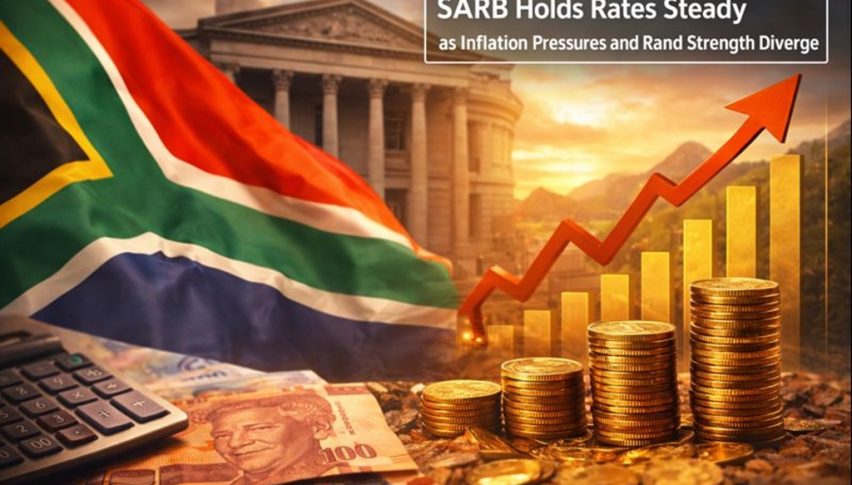
- The South African Reserve Bank (SARB) maintained the repo rate at 6.75%, prioritizing stability amid evolving inflation dynamics and global uncertainty.
- Headline inflation rose to 3.6% in December, slightly above the SARB's target but within the acceptable tolerance band, with a projected average inflation rate of 3.2% for 2025.
- Economic growth forecasts remain unchanged at 1.4% for 2026 and 1.9% for 2027, while inflation pressures are attributed to administrative price increases rather than demand.
- The South African rand has strengthened significantly against the US dollar, currently trading around R15.70, with potential for further gains if the trend continues.
South Africa’s central bank opted for continuity over change, signaling caution as inflation dynamics, currency strength, and global uncertainty continue to evolve.
SARB Maintains Repo Rate
The South African Reserve Bank (SARB) concluded its policy meeting on Thursday, 29 January, by keeping the repo rate unchanged at 6.75%, a decision that was widely anticipated by markets. As a result, the prime lending rate remains steady at 10.25%. The Monetary Policy Committee (MPC) emphasized the need to preserve stability while monitoring both domestic inflation trends and external risks.
Inflation Trends Remain Contained
Headline inflation edged up to 3.6% in December from November, placing it slightly above the central bank’s 3% target but still comfortably within its one-percentage-point tolerance band. SARB Governor Lesetja Kganyago highlighted that the projected 2025 average inflation rate of 3.2% remains close to the bank’s preferred midpoint, reinforcing the decision to leave rates unchanged.
Growth and Inflation Outlook
The central bank left its economic growth forecasts unchanged, projecting growth of 1.4% in 2026 and 1.9% in 2027. Inflation forecasts were modestly adjusted, with headline inflation now expected to average 3.3% in 2026 and 3.2% in 2027. Importantly, the bank acknowledged that current inflation pressures are largely driven by administrative and arbitrary price increases rather than overheating demand—suggesting that higher interest rates would do little to curb inflation while increasing borrowing costs for households and businesses.
Rand Strength Continues
Meanwhile, the South African rand has extended its strong run, gaining significantly against the US dollar since April 2025, when USD/ZAR traded near R20. The pair now sits around the R15.70 level, partly supported by broader US dollar weakness. If the trend persists, a move toward R15 appears likely, where market behavior will be closely watched.
- Check out our free forex signals
- Follow the top economic events on FX Leaders economic calendar
- Trade better, discover more Forex Trading Strategies
- Open a FREE Trading Account
- Read our latest reviews on: Avatrade, Exness, HFM and XM




 Save
Save