Micron Technology Surges 5.5% on AI Memory Boom, But Technical Signals Urge Caution
As artificial intelligence continues to transform the semiconductor industry, Micron Technology (NASDAQ: MU) has emerged as one of the most
Quick overview
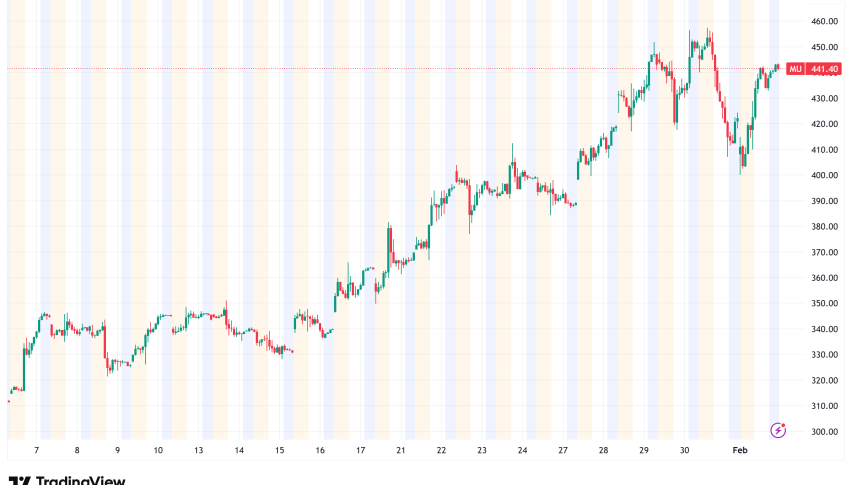
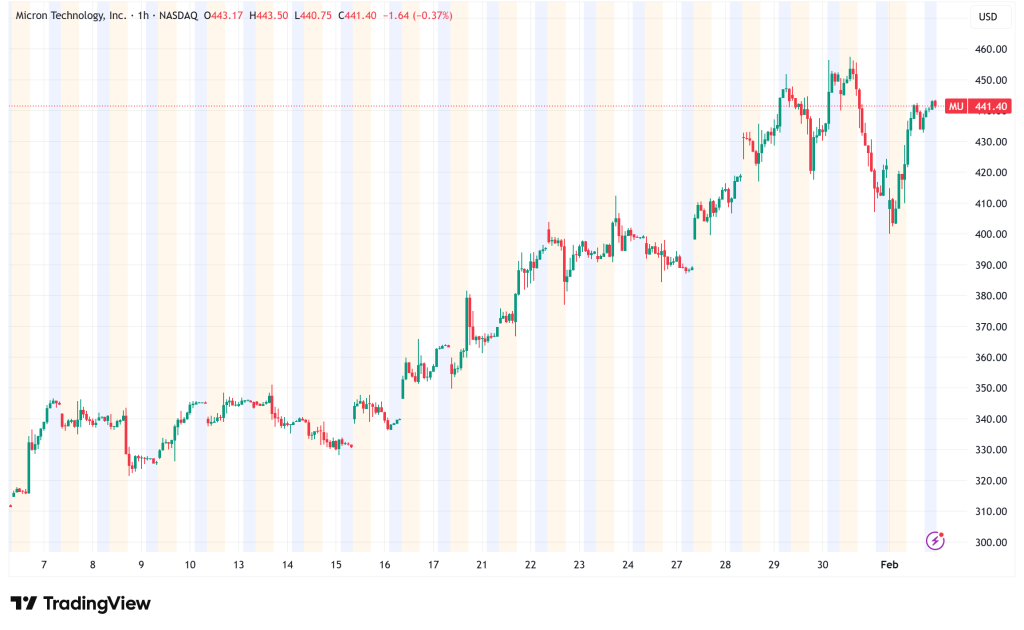
- Micron Technology has seen significant stock gains, closing at $437.80 with a market cap of nearly $467 billion, driven by the rising demand for memory in AI applications.
- Experts predict a potential price increase for DRAM and NAND chips, which could benefit Micron as it leads in high-bandwidth memory crucial for AI data centers.
- Despite its rapid growth, Micron's stock remains undervalued compared to peers, with 88% of analysts expressing bullish sentiments.
- However, technical indicators suggest caution, as Micron's stock is trading significantly above its historical averages, raising concerns about a potential market correction.
As artificial intelligence continues to transform the semiconductor industry, Micron Technology (NASDAQ: MU) has emerged as one of the most keenly watched firms on Wall Street. The memory-chip giant closed Monday at $437.80, gaining 5.52% — marking its fourth record close in the past five trading sessions and its 13th record close of the year. Micron, which currently has a market capitalization of almost $467 billion, is riding a wave of euphoria that some experts think might propel it even farther, while others are raising the alarm.
A New Bottleneck Emerges in AI
For the past three years, Nvidia has been the poster child of the AI revolution, its market valuation exploding from $345 billion at the time of ChatGPT’s public introduction to a breathtaking $4.6 trillion today. But as AI infrastructure advances, a new constraint is emerging – one that could turn the attention squarely onto memory.
The demands on memory and storage from next-generation AI applications, such as robotics, autonomous technologies, and agentic systems, are significantly higher than what general-purpose GPUs can handle on their own. According to research firm TrendForce, prices for dynamic random access memory (DRAM) and NAND chips might jump as much as 60% and 38%, respectively, in the coming months. That kind of pricing power is a big tailwind for Micron, which is an industry leader in high-bandwidth memory (HBM) — a vital component of modern AI data center stacks.
The broader trend is being fueled by increasing capital expenditure from the tech industry’s major companies. Given that Meta Platforms alone is predicting up to $135 billion in AI infrastructure spending this year, Goldman Sachs’ estimate that AI hyperscalers might spend about $500 billion on capital expenditures in 2026 is already regarded by some analysts as cautious.
Micron (MU) Stock Valuation: Strikingly Affordable, For Now
Despite its rapid ascent — Micron’s market cap has surged nearly tenfold over the past three years, with all of that gain concentrated in just the previous six months — the stock remains shockingly cheap by the standards of its peers. Micron trades at a forward price-to-earnings ratio of about 14, roughly half or perhaps a third of the multiples offered by comparable AI chip and data center businesses. That value disparity has led some investors to draw analogies between Micron and Nvidia in its earlier AI-driven ascension.
An overwhelming 88% of analysts surveyed by FactSet who follow Micron are bullish on the stock, showing that confidence in the company’s growth trajectory remains high.
A Warning From the Charts
Yet not everyone is that sanguine. Micron’s stock is “historically stretched,” trading 147% above its 200-day moving average, a commonly monitored long-term trend indicator, according to BTIG technical analyst Jonathan Krinsky. That disparity eclipses any prior reading in the stock’s history, surpassing even the spreads reported during the dot-com bubble of early 2000 and the Windows 95-fueled frenzy of 1995.
The historical precedents are grim. After the 200-day moving average spread peaked at 98% during the dot-com era, Micron’s stock plunged 65% within three months. Following a similar rise in September 1995, the stock sank 42% in three months and 77% over the following year.
Krinsky’s message is moderate but pointed: despite the solid underlying argument underpinning Micron’s gain, “good news is priced in.” The danger is not that the story has changed — it hasn’t — but rather that the market may have already moved to reflect it.
The Bottom Line
Micron Technology stands at an inflection point. The secular trend toward AI-driven memory demand is true, the company’s competitive position in HBM is formidable, and its valuation remains low relative to its growing peers. But investors would be prudent to measure those tailwinds against the technical caution lights presently flashing – a reminder that even the most enticing storylines can be fully baked into a stock’s price.
- Check out our free forex signals
- Follow the top economic events on FX Leaders economic calendar
- Trade better, discover more Forex Trading Strategies
- Open a FREE Trading Account
- Read our latest reviews on: Avatrade, Exness, HFM and XM

Related Articles
Sidebar rates

Related Posts
 Save
Save
