BTC Price Prediction: Whales Buy and Positive Bitcoin ETF Flows Signal an Inflection Point
Bitcoin is beginning to stabilize after falling below $60,000 as institutional inflows and whale accumulation subtly reestablish....

Quick overview
- Bitcoin has shown early signs of stabilization after briefly falling below $60,000, supported by institutional inflows and whale accumulation.
- Recent data indicates a shift back to positive net inflows for U.S. spot Bitcoin ETFs, suggesting renewed institutional interest.
- Whale accumulation has increased significantly, with large holders buying approximately 53,000 BTC, indicating confidence in the market.
- Strong network fundamentals and the behavior of long-term holders suggest that Bitcoin is in a consolidation phase, potentially setting the stage for future growth.
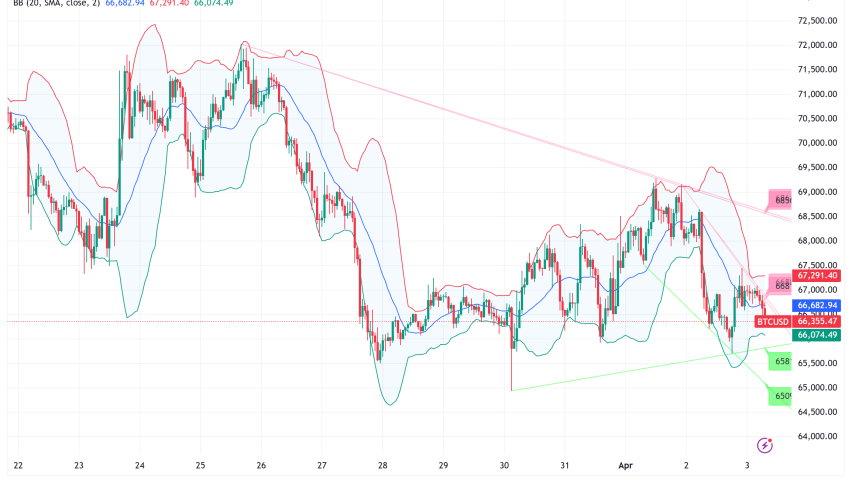
Live BTC/USD Chart

Bitcoin is beginning to stabilize after falling below $60,000 as institutional inflows and whale accumulation subtly reestablish the groundwork for a possible rebound.
Early-2026 Pressure Gives Way to Stabilization
Bitcoin entered 2026 under notable pressure, briefly falling below the $60,000 mark amid broader risk-off sentiment and macro uncertainty. The drop rattled short-term traders and triggered renewed debate about whether the prior rally had peaked.
However, as prices stabilized back above the $70,000 region, underlying data began to tell a more constructive story. While volatility remains elevated, the combination of renewed ETF inflows, whale accumulation, and resilient network fundamentals suggests the correction may be evolving into consolidation rather than collapse.
ETF Flows Flip Back to Positive
One of the most closely watched indicators—U.S. spot Bitcoin ETF flows—has shifted back into net inflow territory.
On February 14, spot Bitcoin ETFs recorded approximately $15.1 million in net inflows after several sessions of outflows. Fidelity Investments’ FBTC led with roughly $12 million in fresh capital. VanEck’s HODL and WisdomTree’s BTCW added approximately $1.9 million and $3.6 million, respectively. These inflows partially offset a $9.4 million outflow from BlackRock’s IBIT.
While the magnitude of flows remains modest compared to peak periods, the directional shift is significant. After days of consistent outflows during the sell-off, renewed inflows suggest institutional investors are stepping back in as prices stabilize.
ETF demand has become a structural pillar of Bitcoin’s market dynamics. Even moderate net inflows can absorb meaningful supply over time, particularly during consolidation phases.
Technical Structure Defines the Next Inflection Point
From a technical perspective, Bitcoin’s price behavior early in 2026 reflects a classic consolidation phase following an extended rally. At the start of January, BTC had recovered strongly from late-2025 volatility, climbing toward the $100,000 level after rebounding from the 100-week moving average.
BTC/USD Chart Weekly – The 200 SMA Held the Decline

That recovery, however, proved temporary. Selling accelerated later in the month, pushing Bitcoin decisively below the 100-week moving average for the first time since 2023 and signaling that the market had entered a corrective phase. The decline ultimately stabilized near the 200-week moving average around $60,000, reinforcing the importance of that level as long-term structural support.
As long as this zone holds, the broader bullish trend remains technically intact. A sustained break below it could open the door to deeper downside toward the psychologically important $50,000 region. Conversely, continued stability above the $60,000–$70,000 range increases the probability of a gradual recovery toward $100,000 and, over time, the $120,000–$126,000 region.
Whale Accumulation Signals Confidence
Beyond ETF flows, on-chain data reveals a notable increase in whale accumulation. Wallets holding more than 1,000 BTC reportedly accumulated approximately 53,000 BTC over the past two weeks—equivalent to roughly $3.7–$3.8 billion at current prices.
This marks the largest wave of whale buying since November and indicates that larger holders are using price weakness to increase exposure rather than distribute into strength.
Historically, sustained whale accumulation during downturns has often preceded medium-term recoveries. Large holders tend to operate with longer time horizons and greater capital flexibility, making their behavior a useful signal of underlying conviction.
The combination of ETF inflows and whale buying strengthens the case that institutional and large-holder demand is re-engaging beneath the surface.
Network Fundamentals Remain Strong
Bitcoin’s network metrics continue to reinforce its long-term value proposition.
Throughout 2025, mining difficulty and hashrate climbed to new records, reflecting sustained investment in infrastructure and miner confidence. The seven-day average hashrate surpassed one zettahash per second before rising toward approximately 1.15 ZH/s.
Rising hashrate increases network security and production costs, reinforcing the scarcity narrative that underpins Bitcoin’s design. As mining becomes more capital-intensive, direct market acquisition often becomes more attractive relative to production, subtly supporting accumulation by institutions and long-term investors.
These structural metrics suggest that the network itself remains robust despite short-term price volatility.
Long-Term Holders Resume Accumulation
Another key indicator—the Hodler Net Position Change—turned positive in late December for the first time in several months. This metric tracks wallets holding Bitcoin for more than 155 days and serves as a proxy for long-term investor behavior.
The shift back into accumulation mode indicates that seasoned holders view current levels as attractive for strategic positioning rather than distribution.
Historically, long-term holders tend to accumulate during consolidation phases and reduce exposure near cycle highs. Their renewed buying, combined with institutional ETF participation, supports the view that structural demand remains intact.
Institutional Participation Reshapes Market Structure
Institutional ownership continues to redefine Bitcoin’s market “DNA.” Corporate treasuries, ETFs, pension funds, and sovereign entities now hold a significant share of circulating supply.
MicroStrategy remains one of the largest corporate holders of Bitcoin, maintaining a substantial long-term position. Deeply capitalized institutions are structurally less prone to panic-driven liquidation, which can dampen extreme downside volatility compared to earlier retail-dominated cycles.
As a result, Bitcoin increasingly behaves like a hybrid macro asset—sensitive to global liquidity and monetary conditions but supported by long-term strategic allocation.
The Road Ahead: Consolidation Before Expansion?
In the near term, macroeconomic catalysts—including employment data, inflation readings, and Federal Reserve communications—will influence liquidity conditions and risk appetite.
Yet beneath the surface, constructive signals are emerging. ETF inflows have resumed, whales are accumulating aggressively on dips, long-term holders are rebuilding positions, and network fundamentals remain strong.
The defense of the $60,000 region suggests that structural demand continues to absorb supply during periods of stress.
While volatility is unlikely to disappear, Bitcoin’s current phase appears less like capitulation and more like recalibration. If institutional inflows persist and accumulation trends continue, the recent pullback may ultimately be remembered as a foundation-building period—laying the groundwork for the next major advance.
- Check out our free forex signals
- Follow the top economic events on FX Leaders economic calendar
- Trade better, discover more Forex Trading Strategies
- Open a FREE Trading Account
- Read our latest reviews on: Avatrade, Exness, HFM and XM

Related Articles

Sidebar rates

Related Posts
 Save
Save