Intel’s Transformation Accelerates as INTC Sock Positions for Long-Term Upside
Intel Corporation is reinforcing its AI and manufacturing roadmap with fresh investments and improving operational signals, even as share...
Quick overview
- Intel is investing at least $100 million in SambaNova Systems to accelerate its AI roadmap while maintaining financial flexibility.
- Despite recent stock volatility, Intel's long-term positioning is strengthening with improvements in data-center demand and market share stabilization.
- The upcoming Core Ultra 9 290K Plus processor shows promising performance gains, indicating renewed product momentum.
- Intel's latest quarterly results exceeded expectations, reinforcing operational stabilization and suggesting potential for long-term growth.
Live INTC Chart
[[INTC-graph]]
Intel Corporation is reinforcing its AI and manufacturing roadmap with fresh investments and improving operational signals, even as share price volatility continues in the short term.
Share Volatility Masks Strategic Progress
Intel’s stock has experienced a choppy start to the year, recently dipping below $50 after a pullback of more than 6%. Concerns about competitive pressures, execution consistency, and margin normalization have weighed on sentiment.
Yet beneath the volatility, the company’s long-term positioning appears to be strengthening. Intel is steadily reinforcing two critical pillars of its future growth:
- Artificial intelligence acceleration
- Data-center and foundry expansion
Rather than standing still amid industry disruption, Intel is actively reshaping its strategy to regain leadership across multiple semiconductor segments.
$100 Million SambaNova Investment Signals AI Commitment
Intel is reportedly preparing to invest at least $100 million in SambaNova Systems, a private AI chip and systems company. The move signals a pragmatic approach to accelerating Intel’s AI roadmap without overextending capital resources.
Instead of pursuing a full acquisition, Intel appears positioned to take a strategic minority stake within a broader funding round potentially reaching $500 million. This structure offers flexibility while providing exposure to advanced AI architectures and domain-specific silicon innovation.
The broader industry trend is clear: developing competitive AI accelerators and custom ASIC solutions internally has grown increasingly complex. Strategic partnerships allow faster integration into evolving AI ecosystems.
While AI remains a competitive and capital-intensive space, Intel’s measured investment strategy demonstrates discipline. It reflects confidence in long-term AI demand while preserving financial optionality.
Technical Structure Shows Buyers Stepping In
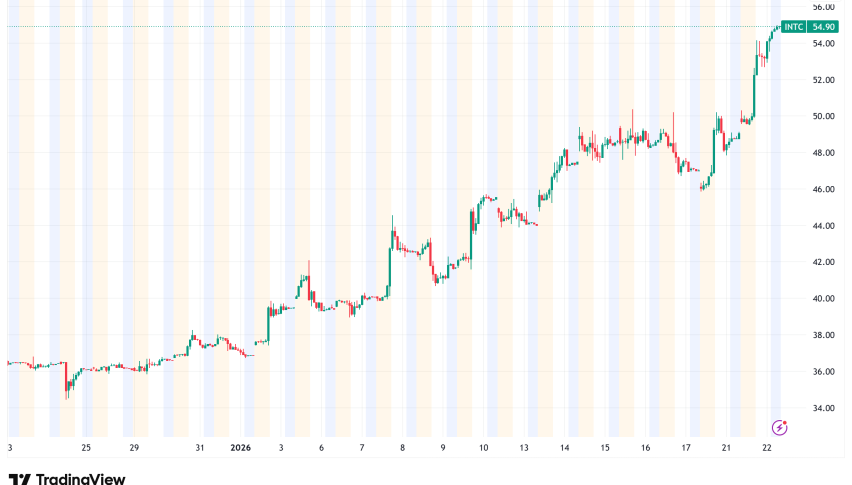
From a technical perspective, Intel’s price action suggests that downside pressure is being absorbed constructively.
Following a post-earnings retracement that drove shares toward the $42.50 region, buyers defended that level decisively. The zone—previously resistance—successfully converted into support. The 20-day simple moving average has since acted as a short-term floor.
Key technical observations:
- Strong defense of $42.50 support
- Rapid rebound back above $50
- Higher lows forming after the correction
The speed of the bounce indicates that investors are increasingly willing to accumulate shares at perceived value levels. While sustained upside momentum will require further confirmation, the structure has improved meaningfully.
INTC Chart Daily – Bouncing Off $42.50 Support

With broader semiconductor sentiment stabilizing, Intel’s long-term trend still points toward a potential move toward the $70 region if execution remains consistent.
Data-Center Demand Remains Firm
Encouragingly, Intel is seeing resilience in its data-center business. Reports suggest supply tightness in parts of its server processor portfolio, particularly in China, where lead times have extended and pricing has firmed.
Given that China represents over 20% of Intel’s revenue base, this strength is notable. Rising pricing power and inventory drawdowns suggest that AI-driven infrastructure demand is also supporting traditional compute segments.
This dual demand dynamic—AI acceleration plus conventional data-center growth—provides a stabilizing force during Intel’s broader transformation.
Execution will remain critical, but signs of demand firmness reinforce the idea that Intel’s core franchise remains highly relevant.
Market Share Stabilization Encourages Confidence
In the CPU segment, Intel’s market share has edged up to 56.64%, marking a modest but symbolically important improvement. After months of competitive pressure from Advanced Micro Devices, Inc., stabilization suggests that erosion may be slowing.
While incremental, this development matters. Rebuilding confidence in Intel’s foundational PC and server franchises lays the groundwork for successful AI integration and foundry growth.
Even small gains signal that product competitiveness is improving.
Product Momentum Returns
Excitement is building around Intel’s upcoming Core Ultra 9 290K Plus processor. Early benchmark leaks indicate performance gains of approximately 10–11% over the prior generation, driven by higher clock speeds and enhanced thermal management.
Preliminary comparisons suggest competitive positioning against premium offerings from AMD, including strong showings versus Ryzen-class processors in select scenarios.
Although independent verification is still pending, renewed product momentum is a positive signal after several uneven cycles. Sustained innovation in client computing remains essential to maintaining ecosystem strength.
Foundry Strategy Gains Optionality
Intel’s foundry ambitions are increasingly viewed with renewed interest. Speculation suggests that Apple Inc. and NVIDIA Corporation may explore limited future manufacturing collaborations.
While still preliminary, even exploratory engagement reflects growing recognition of Intel’s packaging technologies and process roadmap. The foundry unit is no longer being dismissed outright—a notable shift in perception.
If Intel can secure anchor customers over time, the foundry division could become a powerful diversification engine.
Solid Results Support the Rebuild
Intel’s latest quarterly results exceeded expectations:
- Adjusted EPS of $0.15
- Revenue of $13.67 billion
- Data Center and AI revenue of $4.74 billion
- Foundry revenue of $4.51 billion
Although near-term guidance remained measured, the earnings beat reinforces operational stabilization. Conservative outlooks can also provide room for upside surprises if execution improves.
Conclusion: Momentum Building With Long-Term Upside
Intel’s transformation is no longer theoretical—it is progressing across AI partnerships, core CPU stabilization, data-center resilience, and foundry optionality.
Execution will remain the determining factor, and AI competition is intense. However, the pieces of a broader recovery are increasingly visible. For patient investors, the combination of strategic investment, improving fundamentals, and strengthening technical structure suggests that Intel’s long-term upward trajectory remains intact.
The rebuilding phase is advancing—and momentum appears to be quietly accumulating.
- Check out our free forex signals
- Follow the top economic events on FX Leaders economic calendar
- Trade better, discover more Forex Trading Strategies
- Open a FREE Trading Account
- Read our latest reviews on: Avatrade, Exness, HFM and XM


 Save
Save