Bitcoin Holds $67K Amid Record Bollinger Band Compression and Growing Options Market Bearishness
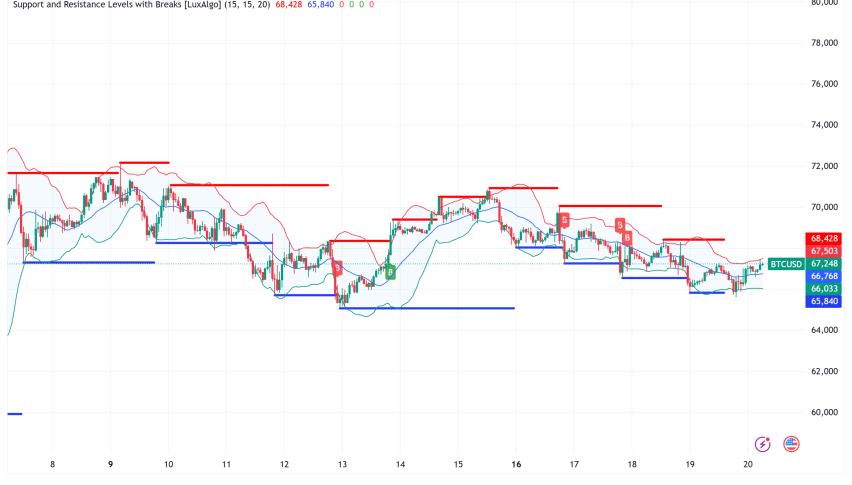
At $67,000, Bitcoin (BTC) is up about 1% in the last day. Despite maintaining important support levels, there is growing indication from the
•
Last updated: Friday, February 20, 2026
Quick overview
- Bitcoin is currently trading at $67,000, showing a slight increase of about 1% in the last day, but traders remain cautious amid bearish signals.
- The options market indicates institutional apprehension, with put options trading at a 13% premium over call options, suggesting a preference for downside protection.
- Recent Bitcoin ETF outflows totaling $910 million signal a retreat from institutional demand, contrasting with rising gold prices and a stable S&P 500.
- Technical indicators suggest a potential retest of the $60,000 level before any recovery, with a possibility of reaching $80,000 to $90,000 by mid-year if conditions improve.
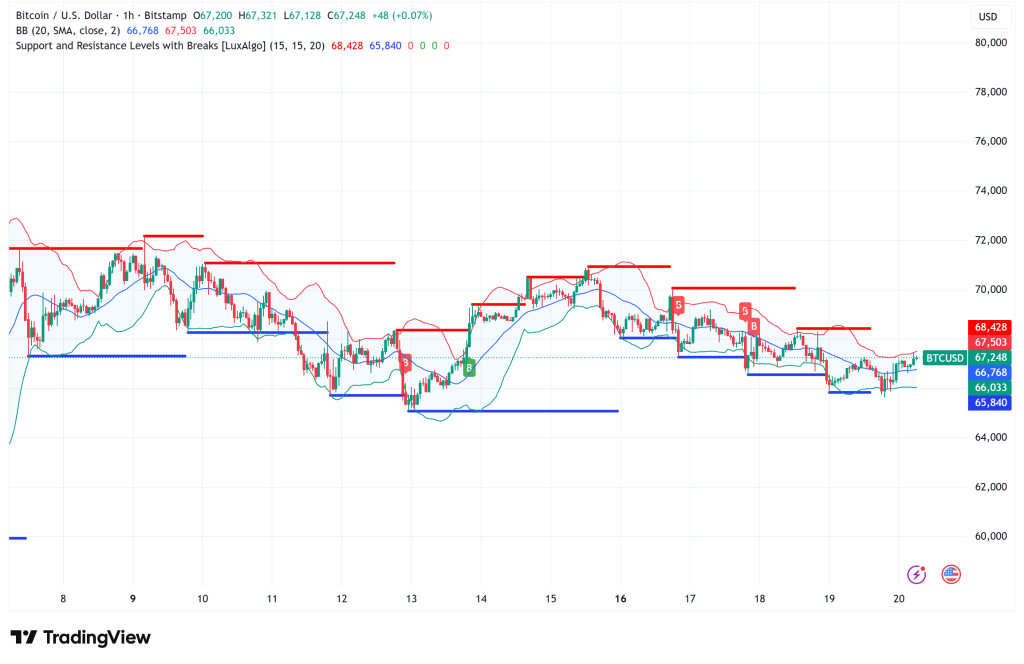
The market is navigating a difficult mix of bearish technical signs and historical patterns that have preceded significant rallies. At $67,000, Bitcoin BTC/USD is up about 1% in the last day. Despite maintaining important support levels, there is growing indication from the options market, ETF flows, and on-chain data that traders are still extremely cautious. As a result, it is not impossible that $60,000 will be retested.
Options Market Flashes Red: Professional Traders Are Paying a 13% Premium for Downside Protection
The options market for Bitcoin is the most obvious indication of institutional apprehension. On the derivatives exchange Deribit, put (sell) options are currently trading at a 13% premium over call (buy) instruments, which is well outside of the neutral range of -6% to +6%. For four weeks in a row, this high delta skew has remained, indicating that experienced traders are actively hedging against additional declines rather than just exercising caution.
Over the last 48 hours, the bear diagonal spread, short straddle, and short risk reversal have been the most frequently used strategies on Deribit. The latter shows that traders are prepared to take on asymmetric risk in exchange for downside exposure because it has limitless upward potential but makes money on price decreases with less initial outlay.
$910 Million in Bitcoin ETF Outflows Signal Institutional Retreat
After spot Bitcoin ETFs were approved, institutional demand, which was formerly a major bullish pillar, has clearly showed signs of weakness. Since February 11, net outflows of $910 million have occurred from US-listed Bitcoin ETFs, which is a concerning departure from the general market’s strength. Gold has risen 15% in two months to be close to $5,000 per ounce, while the S&P 500 is only 2% below its peak. In contrast, Bitcoin is still 47% below its peak.
In the meantime, stablecoin demand in China, which is a good indicator of the mood of the Asian cryptocurrency market, is 0.2% lower than the USD/CNY exchange rate. It still indicates modest net outflows from the cryptocurrency ecosystem, although being an improvement above the 1.4% discount seen earlier this week.
Historic Losing Streak Raises Alarm, But History Suggests a Reversal May Be Near
The longest losing run since 2018 would occur if Bitcoin were to close its fifth straight red monthly candle. When this last occurred, Bitcoin was starting a protracted bear market after reaching its peak in 2017. However, a 316% gain over the next five months was also made possible by that bear phase.
Bitcoin has now printed five red candles in a row on a weekly basis, which is the second-longest run ever. A similar nine-week losing streak in 2022 saw Bitcoin plummeting from $46,800 to $20,500, serving as a warning to bulls expecting for a speedy rebound.
But according to seasoned analyst Sykodelic, the new configuration is “fundamentally different.” Without initially hitting the severe overbought conditions typical of a bull cycle top, the monthly RSI has already reached levels observed at the bear market lows of 2015 and 2018. This implies that rather than being a sign of a complete bear market, the present dip might be corrective.
Tightest Bollinger Bands on Record: A Coiled Spring Ready to Release
The Bollinger Bands for Bitcoin on the monthly chart have compressed to its narrowest level ever seen, making this one of the most remarkable technical occurrences. In the past, strong directional movements, usually to the upside, have come before such intense compression.
In 2022, however, a similar arrangement resulted in a breakdown from $20,000 to $16,000. Analysts point out that the macroenvironment and RSI structure today differ significantly from those of that era.
An impending death cross on the three-day chart, where the 50-period SMA is headed below the 200-period SMA, counterbalances this bullish indication. This pattern has resulted in around 50% drawdowns over one to six months during the last three occurrences. If the pattern repeats, a bottom between $33,000 and $36,000 between March and August might be inferred.
Furthermore, 72% of retail accounts under observation now have long positions into a downward trendline. This is a risky situation that exposes the market to a cascade of liquidations in the event that the price declines.
BTC/USD
Bitcoin Price Prediction: $60K Retest Before a Potential $80K+ Recovery
The short-term risk obviously favors the downside, based on the evidence that is now available. With weak ETF flows, fragile retail long exposure, and persistently bearish options posture, a retest of the $60,000–$62,000 range seems more likely.
$70,000 is the crucial resistance level to keep an eye on in the upward direction. Every advance above this level since early February has stalled, according to Glassnode statistics, when net realized earnings surpass $5 million per hour, a ceiling that has continuously blocked any attempt at recovery.
Key support is located between $58,700 and $60,200, which also happens to be Binance’s average cost basis and the flash-crash bottom from February 6. A clear breach below this range would hasten losses in the direction of the $50,000–$55,000 range.
On the plus side, the Sharpe ratio for Bitcoin has fallen to -38.38, which is comparable to readings last saw at the cycle lows in 2015, 2019, and late 2022, all of which came before significant multi-month rallies. BTC may realistically reach $80,000 to $90,000 by mid-year if past trends continue and a reversal starts in April as some analysts anticipate, especially if ETF inflows restart and macro conditions stay favorable.
- Check out our free forex signals
- Follow the top economic events on FX Leaders economic calendar
- Trade better, discover more Forex Trading Strategies
- Open a FREE Trading Account
- Read our latest reviews on: Avatrade, Exness, HFM and XM
ABOUT THE AUTHOR
See More

Arslan Butt
Lead Markets Analyst – Multi-Asset (FX, Commodities, Crypto)
Arslan Butt serves as the Lead Commodities and Indices Analyst, bringing a wealth of expertise to the field. With an MBA in Behavioral Finance and active progress towards a Ph.D., Arslan possesses a deep understanding of market dynamics.
His professional journey includes a significant role as a senior analyst at a leading brokerage firm, complementing his extensive experience as a market analyst and day trader. Adept in educating others, Arslan has a commendable track record as an instructor and public speaker.
His incisive analyses, particularly within the realms of cryptocurrency and forex markets, are showcased across esteemed financial publications such as ForexCrunch, InsideBitcoins, and EconomyWatch, solidifying his reputation in the financial community.



 Save
Save