Bitcoin Price Forecast: BTC Buy Signal on Whale-Exchange Accumulation and ETF Inflows
Following a precipitous decline near $60,000, Bitcoin is beginning to stabilize as institutional inflows and large-holder accumulation...

Quick overview
- Bitcoin is stabilizing after a drop to $60,000, with institutional inflows and whale accumulation rebuilding confidence.
- ETF flows have turned positive again, indicating renewed demand and support for Bitcoin's price discovery.
- On-chain data shows significant whale accumulation, suggesting that large holders are positioning for a medium-term recovery.
- Bitcoin's network fundamentals remain strong, with record mining difficulty and long-term holders resuming accumulation.
Live BTC/USD Chart

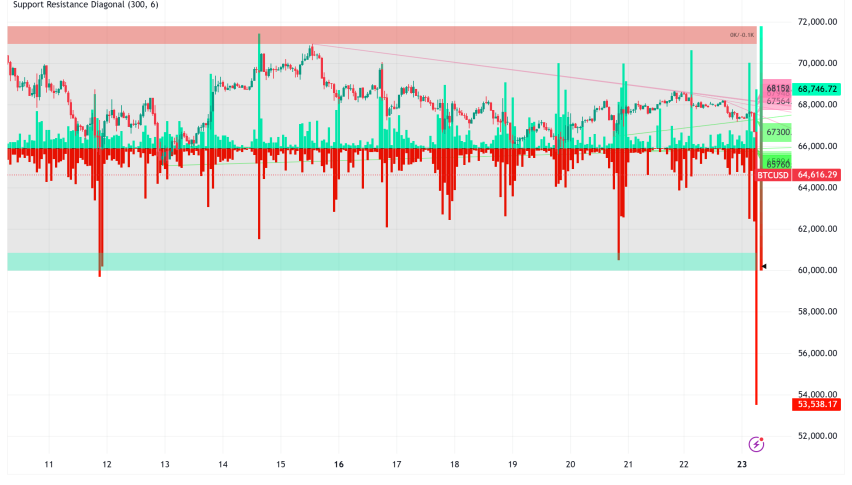
Following a precipitous decline near $60,000, Bitcoin is beginning to stabilize as institutional inflows and large-holder accumulation start to restore confidence below the surface.
Early-2026 Pressure Gives Way to Stabilization
Bitcoin entered 2026 under significant pressure, briefly slipping below the $60,000 level amid broader macro uncertainty and risk-off sentiment across financial markets. The decline unsettled short-term traders and reignited debate about whether the previous rally had reached exhaustion.
However, as prices rebounded toward and above the $70,000 region, the narrative began to shift. While volatility remains elevated, the broader structure increasingly resembles consolidation rather than systemic breakdown. Beneath headline price swings, capital flows and on-chain data suggest a gradual rebuilding of demand.
Exchange Accumulation
Approximately 3 million BTC currently sit on centralized exchanges, reflecting the growing complexity of the crypto ecosystem. Exchanges now offer yield generation, derivatives collateralization, and lending services, requiring substantial Bitcoin reserves to maintain liquidity.
Distribution remains concentrated among major platforms. Binance controls roughly 30% of Bitcoin stored on centralized exchanges, followed by Bitfinex at nearly 20%. Robinhood and South Korea’s Upbit each account for about 8%, while Kraken, OKX, and Gemini hold between 5% and 7%.
ETF Flows Turn Positive Again
A key stabilizing factor has been the reversal in U.S. spot Bitcoin ETF flows. After multiple sessions of net outflows during the sell-off, ETFs recorded net inflows of approximately $15 million on February 14.
Fidelity’s FBTC led the rebound, with additional contributions from VanEck and WisdomTree, partially offsetting outflows from BlackRock’s IBIT. While modest compared to peak inflow periods, the directional change carries significance.
ETF demand has become a structural pillar of Bitcoin’s price discovery. Even moderate net inflows can absorb substantial supply over time, particularly during periods of consolidation when selling pressure eases.
Technical Structure Defines the Next Inflection Point
From a technical perspective, Bitcoin’s price behavior early in 2026 reflects a classic consolidation phase following an extended rally. At the start of January, BTC had recovered strongly from late-2025 volatility, climbing toward the $100,000 level after rebounding from the 100-week moving average.
BTC/USD Chart Weekly – The 200 SMA Held the Decline

That recovery, however, proved temporary. Selling accelerated later in the month, pushing Bitcoin decisively below the 100-week moving average for the first time since 2023 and signaling that the market had entered a corrective phase. The decline ultimately stabilized near the 200-week moving average around $60,000, reinforcing the importance of that level as long-term structural support.
As long as this zone holds, the broader bullish trend remains technically intact. A sustained break below it could open the door to deeper downside toward the psychologically important $50,000 region. Conversely, continued stability above the $60,000–$70,000 range increases the probability of a gradual recovery toward $100,000 and, over time, the $120,000–$126,000 region.
Whale Accumulation Signals Conviction
On-chain data further reinforces the stabilization thesis. Wallets holding more than 1,000 BTC accumulated approximately 53,000 BTC over two weeks—worth nearly $4 billion at current prices.
This marks the largest whale accumulation wave since November. Historically, such behavior has often preceded medium-term recoveries, as large holders with longer investment horizons take advantage of price weakness to build positions.
The combination of ETF inflows and whale buying suggests institutional and deep-pocketed participants are re-engaging.
Network Strength and Long-Term Holders
Bitcoin’s network fundamentals remain robust. Mining difficulty and hashrate reached record levels throughout 2025, with the seven-day average surpassing one zettahash per second and climbing toward 1.15 ZH/s. Rising hashrate enhances network security and increases production costs, reinforcing scarcity dynamics.
At the same time, long-term holders—defined as wallets holding BTC for over 155 days—have resumed accumulation. The Hodler Net Position Change turned positive in late December, signaling renewed strategic positioning rather than distribution.
Institutional Ownership Reshapes the Market
Institutional participation continues to redefine Bitcoin’s structure. Corporate treasuries, ETFs, pension funds, and sovereign entities now hold a meaningful portion of circulating supply. Companies such as MicroStrategy maintain large long-term allocations, reducing the likelihood of panic-driven liquidations.
Bitcoin increasingly behaves as a hybrid macro asset—sensitive to liquidity cycles yet supported by structural allocation.
Conclusion: While short-term volatility remains, the underlying data suggests Bitcoin’s recent correction may represent consolidation rather than the end of the cycle. ETF inflows, whale accumulation, strong network fundamentals, and institutional participation collectively indicate that the foundation for a potential rebound is quietly being rebuilt.
- Check out our free forex signals
- Follow the top economic events on FX Leaders economic calendar
- Trade better, discover more Forex Trading Strategies
- Open a FREE Trading Account
- Read our latest reviews on: Avatrade, Exness, HFM and XM



 Save
Save