Oracle Stock Heads to $100 as Stargate Doubts, Legal Risk and Leverage Cloud the Outlook
Oracle’s early-2026 rebound is fading rapidly as renewed doubts around the Stargate AI project, mounting leverage, and legal challenges...

Quick overview
- Oracle's recovery in early 2026 is faltering due to doubts surrounding the Stargate AI project and rising leverage concerns.
- A recent report questions the credibility of the Stargate initiative, revealing operational issues and partner disagreements.
- Investor anxiety is heightened by Oracle's plans to raise up to $50 billion, which may strain its balance sheet and dilute existing shareholders.
- Legal challenges and deteriorating cash flow further complicate Oracle's ambitious AI expansion strategy, leading to increased skepticism among investors.
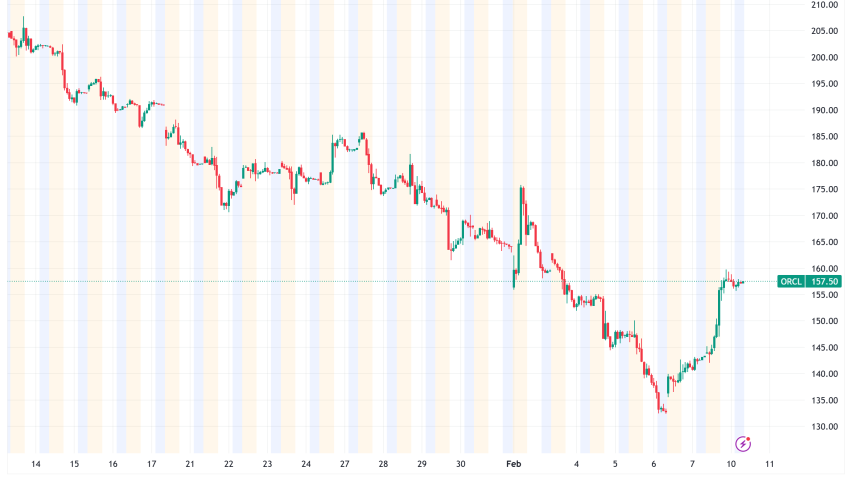
Live ORCL Chart
[[ORCL-graph]]
Oracle’s early-2026 rebound is fading rapidly as renewed doubts around the Stargate AI project, mounting leverage, and legal challenges rattle investor confidence.
Oracle (ORCL) began 2026 attempting to stabilize after a volatile prior year, but that recovery is quickly losing momentum. Shares dropped more than 5% on Monday, pressured by broader tech weakness and a troubling report questioning the credibility of the much-publicized $500 billion Stargate AI initiative.
Stargate Doubts Resurface
The weekend report suggested that the Stargate joint venture — announced in January 2025 with Oracle Corporation, OpenAI, and SoftBank Group Corp. as partners — operates with minimal staffing and does not directly control data centers. That portrayal sharply contrasts with the bold projections that accompanied the original announcement.
Instead of appearing as a transformative AI infrastructure consortium, Stargate now looks structurally fragmented. According to the report, disagreements emerged almost immediately after launch, with partners clashing over governance and operational responsibilities. OpenAI reportedly attempted to pursue independent data center builds before lenders balked at the capital intensity and unproven business economics.
If accurate, these details weaken the narrative that once justified Oracle’s aggressive AI spending. Investors are left questioning whether Stargate was more promotional than practical.
Technical Signals Reflect Deteriorating Sentiment
From a technical perspective, Oracle’s price action reinforces the fundamental unease. On longer-term charts, the stock has slipped below the 20 monthly moving average (gray) that previously acted as support, increasing the risk of deeper pullbacks first to the April 2025 low of $118 and then to $100 and below. On shorter timeframes, rebounds have consistently failed near resistance levels, forming a clear pattern of lower highs.
ORCL Chart Monthly – Can the 20 SMA Is Under Attack

On the daily chart we saw a rebound off the 200 SMA (purple) in early January but the 50 SMA (yellow) rejected the price and now the 200 SMA has been broken. This structure suggests that sellers remain in control with the 20 SMA (gray) acting as resistance and pushing the stock lower. A sustained break below current support levels would shift attention toward the $100 area now, with further downside risk.
ORCL Chart Daily – The Highs Keep Getting Low

Massive Capital Raise Rekindles Leverage Fears
Investor anxiety intensified after Oracle outlined plans to raise between $45 billion and $50 billion in gross proceeds during calendar year 2026. The funding is earmarked for accelerating Oracle Cloud Infrastructure (OCI) expansion to meet demand from high-profile customers.
The financing strategy involves a combination of debt issuance and equity-linked instruments, along with common stock sales. While management frames the move as a proactive growth investment, markets see dilution risk and balance-sheet strain.
In an environment where funding costs remain elevated, raising tens of billions is not a neutral event. Borrowing more increases leverage, while equity issuance pressures existing shareholders. Either route carries consequences, especially when free cash flow is already under pressure.
The optics are particularly problematic as the stock drifts lower. Investors tend to tolerate large capital raises when shares are strong and momentum is intact. When shares are sliding, such plans look defensive rather than visionary.
Deepening Exposure to OpenAI Raises Counterparty Risk
Oracle’s expanding relationship with OpenAI has become a focal point of concern. Reports of a potential $300 billion computing agreement tie Oracle’s capital commitments to a partner widely expected to remain unprofitable for years.
While OpenAI’s growth ambitions are substantial, its cash burn is equally striking. Estimates suggest that OpenAI may require more than $200 billion to sustain its trajectory. That backdrop introduces counterparty risk — an uncomfortable dynamic when Oracle itself is funding large-scale infrastructure on borrowed capital.
Adding to the uncertainty, Nvidia previously signaled major investment intentions toward OpenAI before walking back those expectations. For investors, that retreat reinforced doubts about the durability of AI-related financial commitments across the ecosystem.
Oracle’s strategy effectively places a massive infrastructure bet on the assumption that OpenAI’s demand projections materialize and remain stable. If those projections falter, Oracle could be left with excess capacity and mounting debt.
Legal Challenges Cloud Transparency
The situation worsened with the emergence of a proposed bondholder class action lawsuit filed in New York state court. The complaint alleges that Oracle misled investors regarding the funding requirements associated with its AI expansion.
Specifically, plaintiffs argue that the company failed to sufficiently disclose the likelihood of additional borrowing after issuing approximately $18 billion in bonds shortly following the OpenAI agreement announcement.
While the legal outcome remains uncertain, the reputational implications are significant. For a company increasingly dependent on capital markets access, even the perception of incomplete disclosure can elevate financing costs and intensify scrutiny.
In today’s market, transparency lapses are punished swiftly. Legal overhang adds another layer of uncertainty at a time when investors are already reassessing risk exposure.
Cash Flow Deterioration Becomes Hard to Ignore
On the surface, Oracle’s revenue growth remains respectable. Quarterly revenue rose 14% year over year, with cloud services expanding more than 30%. However, beneath the top-line strength lies a troubling cash flow picture.
Free cash flow has plunged deeper into negative territory, reportedly exceeding negative $13 billion as capital expenditures surge. Growth at any cost is no longer a winning formula in equity markets that now prioritize balance-sheet discipline and capital efficiency.
The imbalance between rising revenue and accelerating spending raises a central question: when will these AI investments generate sustainable returns? Without a clear timeline to positive cash flow inflection, skepticism will likely intensify.
Dividend Offers Little Cushion
Oracle’s quarterly dividend of $0.50 per share provides limited reassurance. With a forward yield near 1%, income support is minimal relative to the risks of dilution, leverage expansion, and project execution uncertainty.
In prior cycles, Oracle’s mature cash-generating profile helped anchor investor confidence. Today, that profile appears increasingly stretched.
Conclusion: Oracle’s ambitious AI-driven expansion has shifted from a growth narrative to a risk narrative. Questions surrounding the Stargate initiative, aggressive capital-raising plans, deep exposure to OpenAI, and emerging legal challenges have collectively undermined investor confidence.
As leverage rises and free cash flow deteriorates, the stock faces mounting pressure. Unless Oracle can restore credibility around its AI strategy and demonstrate a clear path to sustainable returns, the shares risk continuing their slide toward the psychologically important $100 level.
- Check out our free forex signals
- Follow the top economic events on FX Leaders economic calendar
- Trade better, discover more Forex Trading Strategies
- Open a FREE Trading Account
- Read our latest reviews on: Avatrade, Exness, HFM and XM


 Save
Save