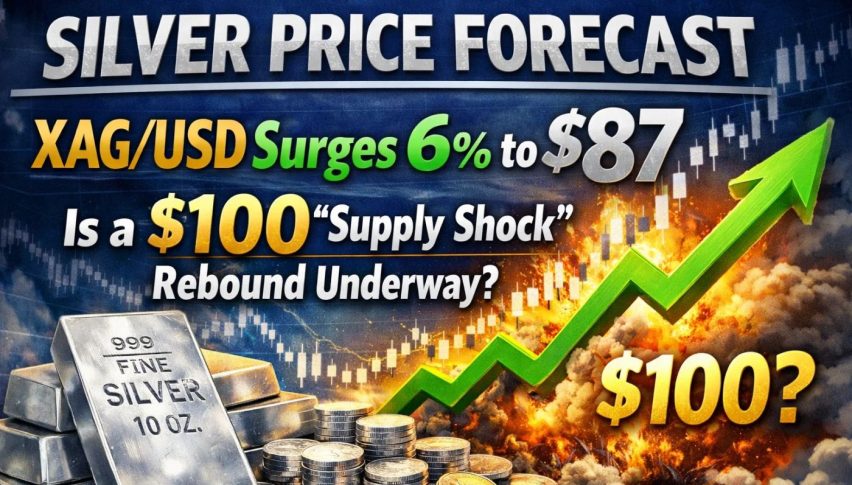
Silver Price Forecast: XAG Targets $100+ Again as Tariffs and Geopolitics Revive Demand in New Week
As fresh geopolitical tensions and dollar weakness rekindle recovery momentum, silver is recovering following one of the most severe...

Quick overview
- Silver is stabilizing after a sharp selloff, driven by geopolitical tensions and a weakening dollar.
- The metal experienced a dramatic 40% price drop in January, triggering forced liquidations across markets.
- Recent policy changes and rising industrial demand, particularly in solar energy, are providing structural support for silver.
- Despite volatility, conditions are aligning for a potential recovery, with silver rebounding above $87 and targeting the $100 level.
Live SILVER Chart

As fresh geopolitical tensions and dollar weakness rekindle recovery momentum, silver is recovering following one of the most severe selloffs in its history.
A Historic Rally Meets a Brutal Reality Check
Silver entered early 2026 in spectacular fashion, extending a powerful rally that pushed prices above $120. The surge was fueled by speculative momentum, leveraged positioning, and strong narratives around industrial demand and supply constraints.
However, the advance proved unsustainable. In the final days of January, silver suffered a dramatic reversal. Within a single session, prices plunged more than 40%, briefly collapsing below $64. It was one of the steepest one-day declines ever recorded for the metal.
The move triggered widespread forced liquidations across futures markets, options, and leveraged exchange-traded products. What began as a technical correction rapidly cascaded into a full-scale deleveraging event. Silver’s naturally higher volatility compared to gold amplified the selloff, underscoring how quickly overcrowded trades can unwind, but the price rebounded strongly las week.
Tariffs, Geopolitics and Dollar Weakness
Last week’s developments provided a fresh catalyst. The U.S. Supreme Court ruled against certain country-specific tariffs, but President Donald Trump followed with a 15% universal global tariff over the weekend.
The new tariffs contributed to renewed trade uncertainty and weakened the U.S. dollar over the past two trading sessions. A softer dollar typically supports precious metals by making them more attractive to non-dollar buyers.
At the same time, rising U.S.–Iran tensions reintroduced a geopolitical risk premium into markets. Investors sought safety in traditional safe-haven assets, with silver benefiting alongside gold.
As trading opened Monday, February 22, silver was already climbing, reflecting the combined impact of geopolitical risk and dollar softness.
Technical Structure Signals Buyer Resilience
From a technical perspective, silver’s broader uptrend has not been invalidated. The break below $64 was significant, but the decline was ultimately contained by key moving averages. Support first emerged near the 50-day simple moving average, followed by stronger buying interest around the 200-day (purple) on the H4 chart.
Silver Chart H4 – The 200 SMA Held As Support

That support held after several attempts. Buyers stepped in decisively, and silver rebounded sharply, climbing back above $87 early in the new week. This behavior suggests that longer-term participants remain engaged, using pullbacks to rebuild exposure rather than abandoning the market altogether.
Silver Chart Weekly – The 20 SMA Held As Support

Key resistance levels now sit near $100, followed by the prior highs around $117–$121. On the downside, initial support is defined by the recent lows near $69 and $64.
Policy Moves and Market Stabilization
Volatility earlier in the year was compounded by policy and margin adjustments. The CME Group raised margin requirements on Comex gold and silver futures at the height of turbulence, increasing the cost of leveraged exposure. Such measures often accelerate short-term selling but can contribute to longer-term stability by curbing speculative excess.
Meanwhile, China temporarily suspended trading in certain commodity-linked funds to dampen volatility. While these steps intensified the immediate correction, they may ultimately support a more balanced market structure.
This week, traders will monitor key macro indicators, including U.S. Producer Price Index data, consumer confidence figures, weekly jobless claims, and the People’s Bank of China’s lending rate decision. These releases could influence the direction of precious metals in the near term.
Industrial Demand Remains the Anchor
Unlike gold, silver benefits from substantial industrial usage, which provides structural support. Solar energy production remains a major driver, as photovoltaic panels require significant silver inputs. Growth in electric vehicles, electronics, and global electrification efforts continues to underpin baseline demand.
Reports of elevated physical premiums in Shanghai suggest tight supply conditions and resilient physical buying despite the recent price shock.
Conclusion: Silver’s violent correction marked the end of an overheated rally but not the end of its broader cycle. With leverage reduced, geopolitical tensions rising, and the dollar softening under renewed tariff uncertainty, conditions are aligning for a potential sustained recovery. While volatility remains a defining feature, the metal now appears to be rebuilding toward a more stable advance—potentially reopening the path toward the $100 level.
- Check out our free forex signals
- Follow the top economic events on FX Leaders economic calendar
- Trade better, discover more Forex Trading Strategies
- Open a FREE Trading Account
- Read our latest reviews on: Avatrade, Exness, HFM and XM



 Save
Save