MSTR Stock Rebounds After Forming Support Above $100 – Is the Fall Over?
After a brutal six-month slide, MicroStrategy Incorporated is showing tentative signs of stabilisation as Bitcoin recovers, though the stock

Quick overview
- MicroStrategy shows signs of stabilization as Bitcoin recovers, with stock support near the $100 level after a significant downtrend.
- The company's recent earnings report exceeded revenue expectations but revealed a widening loss, highlighting the impact of its Bitcoin strategy on financial performance.
- MicroStrategy continues to accumulate Bitcoin, raising capital through share sales to fund purchases, while its stock remains closely tied to Bitcoin's price movements.
- Analysts express cautious optimism, with some maintaining a Buy rating, but emphasize that the company's future hinges on Bitcoin's long-term stability and market conditions.
Live BTC/USD Chart

After a brutal six-month slide, MicroStrategy Incorporated is showing tentative signs of stabilisation as Bitcoin recovers, though the stock remains firmly in high-risk territory.
A Tentative Base After a Punishing Downtrend
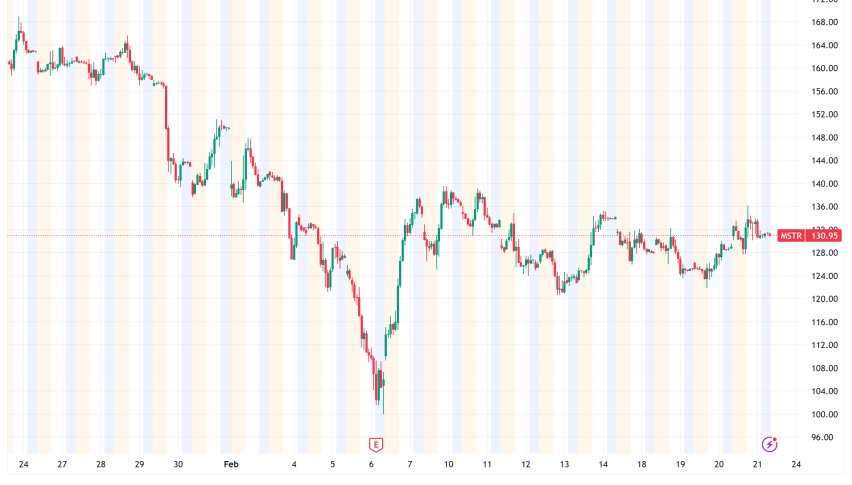
Following nearly six consecutive months of relentless selling, MicroStrategy appears to have found at least temporary support near the psychologically important $100 level. The decline marked one of the most severe drawdowns in the company’s history, erasing substantial market value and testing investor conviction.
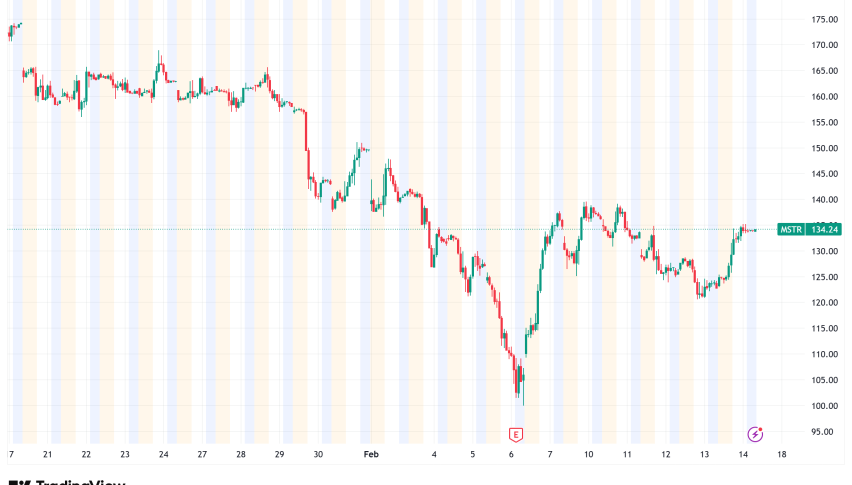
Last week offered early signs of stabilisation. The stock briefly traded close to $100 before staging a sharp intraday reversal, ultimately bouncing roughly 30% from its lows. Although shares finished the week only modestly changed, the violent rebound suggests that forced liquidation and panic-driven selling may have eased in the near term.
Volatility, however, remains elevated. While the balance between buyers and sellers appears to be improving, the broader trend has not yet decisively turned. For now, the move looks more like a technical stabilisation than a confirmed structural recovery.
Earnings Provide Partial Reassurance
The company’s latest quarterly report helped steady sentiment at a critical moment. MicroStrategy posted revenues of $122.99 million for the quarter ended December 2025, exceeding expectations and improving slightly from the $120.7 million reported a year earlier. It marked the third revenue beat in the past four quarters, reinforcing the resilience of the company’s legacy analytics software business.
Yet the headline stability in revenue contrasts sharply with the bottom line. The firm reported an adjusted quarterly loss of $42.93 per share. While narrower than projected, the figure represented a significant deterioration from the $3.20 per share loss recorded a year earlier.
The widening losses highlight a structural shift: MicroStrategy’s financial profile is now dominated by its Bitcoin strategy rather than its traditional operating business. As a result, reported earnings are increasingly influenced by cryptocurrency price movements and related accounting impacts, amplifying volatility in both fundamentals and sentiment.
Technical Picture Shows Early Signs of Stabilisation
From a technical perspective, MicroStrategy’s recent price action suggests a potential exhaustion of selling pressure. The sharp dip to $100 appeared to flush out remaining weak hands, triggering aggressive dip-buying and a swift rebound.
MSTR Chart Weekly – Rebounding Off the 200 SMA

The stock had been clinging to its 100-week simple moving average since late November, but that level finally gave way during this week’s sell-off. Crucially, however, buyers stepped in near the 200-week moving average, forming a new support zone and setting the stage for a possible recovery.
While this does not confirm a durable trend change, it does improve the near-term technical backdrop—particularly if Bitcoin continues to stabilise or extend its rebound.
Continued Bitcoin Accumulation
The company’s strategy remains unchanged. According to a recent regulatory filing, MicroStrategy sold 297,940 Class A shares, raising $39.7 million, and promptly used the proceeds to acquire an additional 592 bitcoin at an average price of $67,286.
The company’s total holdings now stand at 717,722 bitcoin, acquired for $54.56 billion at an average purchase price of $76,020. Importantly, MicroStrategy retains significant capital-raising flexibility, with approximately $7.84 billion in remaining common stock capacity and roughly $37.35 billion available under various at-the-market programs.
This structure allows management to continue issuing shares opportunistically to fund additional bitcoin purchases. However, it also underscores the degree to which shareholder dilution and balance-sheet leverage remain intertwined with the company’s long-term thesis.
Bitcoin’s Recovery Drives the Equity Rebound
MicroStrategy’s share price remains tightly correlated with Bitcoin, effectively functioning as a leveraged proxy for the digital asset. After a recent sell-off, Bitcoin found support near its long-term moving averages and stabilised above $60,000, later recovering toward the $70,000 level.
As Bitcoin regained traction, MicroStrategy followed almost mechanically. The relationship is both an advantage and a vulnerability. During crypto rallies, the stock often outperforms. During corrections, the downside can be amplified.
This dynamic means that MicroStrategy’s stabilisation is less a standalone equity story and more a reflection of broader digital asset sentiment. If Bitcoin’s recovery proves durable, the equity could continue to recover. If volatility resumes, downside risks may quickly re-emerge.
Analyst Optimism Amid Heavy Damage
Despite the severity of the recent drawdown, some analysts remain constructive. For example, Benchmark Company recently reiterated a Buy rating with a $705 price target, implying substantial upside from current levels.
The bullish argument rests largely on two assumptions: first, that the roughly 60% correction from summer highs left the stock deeply oversold; and second, that Bitcoin’s long-term trajectory remains upward, supported by growing institutional participation.
However, such targets assume continued strength in digital assets and stable access to capital markets—conditions that cannot be taken for granted.
Management’s Long-Term Bitcoin Commitment
Executive Chairman Michael Saylor continues to frame MicroStrategy as a long-duration Bitcoin investment vehicle, emphasising a time horizon measured in decades rather than quarters. That message has remained consistent even through sharp market corrections.
In a nuanced development, CEO Phong Le acknowledged that Bitcoin sales could theoretically occur under extreme conditions—specifically if the company’s share price fell below the value of its bitcoin holdings and capital market access deteriorated. Though described as highly unlikely, the admission represents a rare recognition of downside contingencies.
Le later reaffirmed that the company has no intention of selling its bitcoin before at least 2065, underscoring management’s conviction in the long-term thesis.
Institutional Backing Adds Credibility, Not Certainty
MicroStrategy has also sought innovative funding avenues, including the issuance of euro-denominated Series A Perpetual Stream Preferred Shares offering a 10% yield to institutional investors in Europe and the UK.
Institutional interest appears to be expanding. California State Teachers’ Retirement System (CalSTRS) recently disclosed a $133 million stake, lending additional credibility to the company’s unconventional strategy.
Still, credibility does not eliminate risk. MicroStrategy’s fortunes remain closely tied to Bitcoin’s price trajectory. While the recent rebound offers relief after months of selling pressure, stabilisation should be viewed cautiously. As long as digital asset volatility persists, so too will uncertainty around the company’s valuation and financial resilience.
- Check out our free forex signals
- Follow the top economic events on FX Leaders economic calendar
- Trade better, discover more Forex Trading Strategies
- Open a FREE Trading Account
- Read our latest reviews on: Avatrade, Exness, HFM and XM


 Save
Save