Putin Signs Bitcoin Confiscation Law: Kremlin Eyes $650M Daily Crypto Flows as Telegram Founder Faces Terror Charges
Russia is taking decisive steps to centralize its digital economy. This week, President Vladimir Putin signed a major law that lets...
Quick overview
- Russia is centralizing its digital economy by classifying cryptocurrencies as 'intangible property' for legal seizure.
- The government aims to control the $650 million in daily crypto trading and reduce the $15 billion annual fees paid to foreign exchanges.
- A criminal case against Telegram founder Pavel Durov highlights tensions over free speech and government surveillance in the crypto space.
- Experts predict a shift to regulated domestic platforms by July 2026, with potential blocking of unlicensed foreign exchanges.
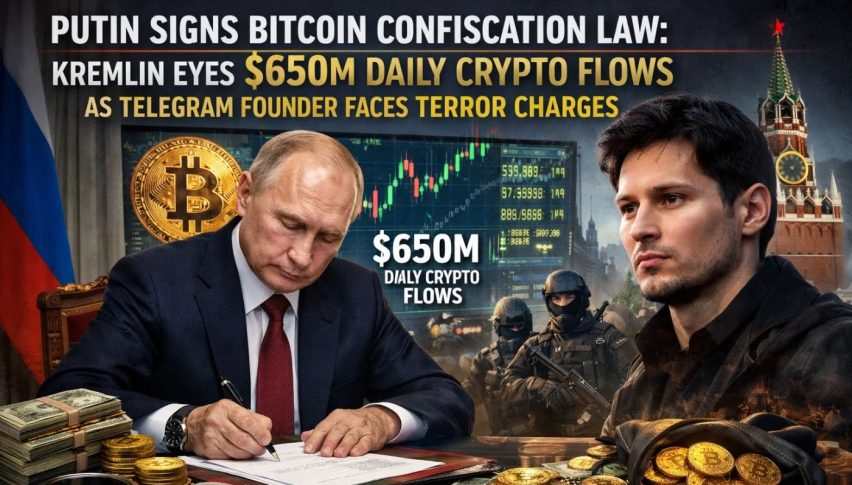
Russia is taking decisive steps to centralize its digital economy. This week, President Vladimir Putin signed a major law that lets Russian courts seize cryptocurrency. At the same time, the government has started a criminal terrorism case against Telegram founder Pavel Durov.
About 10% of Russians trade digital assets, and for them, the message is clear: the days of unregulated crypto are ending. Russians move about $650 million in crypto daily, and the government wants to control these large money flows.
New Law: Crypto Now “Intangible Property” for Seizure
The new law, signed on February 24, 2026, changes the Russian Criminal Code. Now, Bitcoin and other cryptocurrencies are considered ‘intangible property,’ which clears up the legal confusion that made enforcement difficult before.
What This Means for the Market:
- Mandatory Disclosure: Police and prosecutors now have to specify the exact token type, amount, and wallet addresses in any request to confiscate crypto.
- Government Custody: Seized cryptocurrencies can now be legally moved into government-controlled master wallets.
- Institutional Signal: Deputy Justice Minister Elena Ardabyeva said this law gives the government a clear legal way to work with foreign exchanges. It could force these platforms to share Russian user data or risk being blocked in Russia.
Russian President Vladimir Putin Signs Law Allowing Crypto Confiscation
Russian President Vladimir Putin has signed a new law formally granting courts and law enforcement agencies the authority to seize cryptocurrency assets such as Bitcoin during criminal investigations. pic.twitter.com/OFVVLLn8ax
— 🥞C4B Freedom🥞 (@Crypto4bailout) February 25, 2026
The $15 Billion “Fee Leak”: Moscow’s Push for Domestic Exchanges
This crackdown is not only about fighting crime; it is also about money. Sergey Shvetsov, Chairman of the Moscow Exchange (MOEX), recently revealed that Russian traders pay about $15 billion each year in fees to foreign platforms like Binance and Bybit.
To stop this capital leaving the country, the Kremlin has set a regulatory deadline for July 1, 2026. Experts think the government will use DNS blocking and AI traffic monitoring to block access to any foreign exchange without a physical office or local license in Russia.
The goal is to move the $650 million in daily crypto trading to regulated Russian platforms or to a system like Belarus uses, with approved local brokers.
Pavel Durov and the “Telegram Terrorism” Case
Tensions are rising as Russian authorities have started a criminal investigation into Pavel Durov. According to state media, using information from the FSB, Telegram is accused of being a main tool for sabotage and terrorist acts, such as arson and political killings.
https://www.kommersant.ru/doc/8460083/
Durov has called the charges a ‘sad spectacle.’ He says the government is making up reasons to limit free speech and push users to MAX, the state-run super app built for surveillance. Critics believe this is an attempt to get Telegram’s encryption keys so the government can watch the crypto transactions it now wants to control.
Technical & Market Impact: What Analysts are Watching
| Metric | Current Status | Forecast (2026-2027) |
| Daily Trading Volume | ~$650 Million (USD) | Transition to domestic MOEX spot desks. |
| Annual Fee Leak | $15 Billion (USD) | Goal to capture 70% for the state budget. |
| Legal Status | Intangible Property | Full integration with Tax Code by July. |
| Platform Access | “Throttled” | Potential 100% block on unlicensed sites by Summer. |
The Analyst’s Verdict: A Double-Edged Sword
With more than ten years as a financial analyst, I see this as a turning point. Russia is Europe’s biggest crypto market, with over $376 billion coming in each year. By allowing seizures and requiring domestic trading, the Kremlin is building a digital fortress to get around Western sanctions.
- Check out our free forex signals
- Follow the top economic events on FX Leaders economic calendar
- Trade better, discover more Forex Trading Strategies
- Open a FREE Trading Account
- Read our latest reviews on: Avatrade, Exness, HFM and XM



 Save
Save