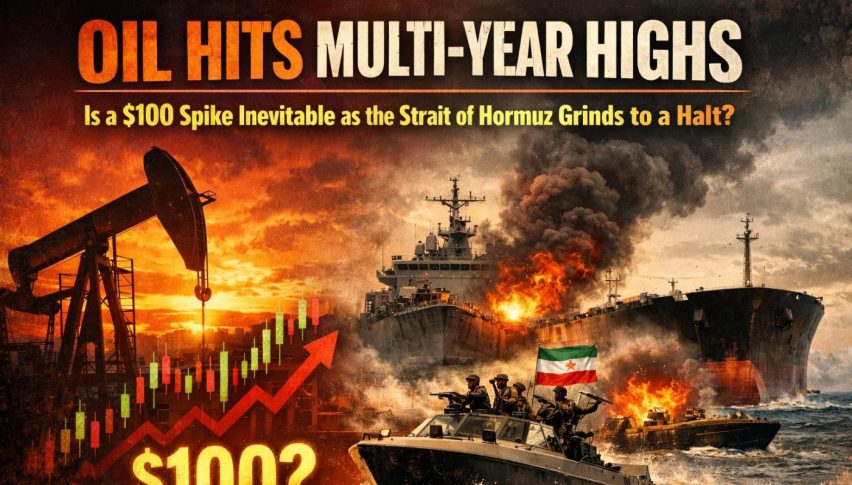
Oil Hits Multi-Year Highs: Is a $100 Spike Inevitable as the Strait of Hormuz Grinds to a Halt?
The US-Israel-Iran war situation has reached a really precarious point where the global energy market is sitting on a knife edge....
Quick overview
- The US-Israel-Iran conflict has significantly impacted the global energy market, causing oil prices to surge past $82.
- The Strait of Hormuz is facing potential closure, with over 150 tankers currently avoiding the passage due to insurance issues.
- If military operations conclude quickly, oil prices may stabilize around $80, but a prolonged blockade could push prices to $120-$150.
- Traders are advised to watch for pullbacks to $72.60 for buying opportunities, while being cautious of sudden market shifts.
The US-Israel-Iran war situation has reached a really precarious point where the global energy market is sitting on a knife edge. As of March 3 2026, the price of oil has taken a vicious leap upwards with Brent briefly blitzing $82 – its highest level since the early days of 2025 – before settling into a very volatile state.
The “Risk Premium” is no longer just a theoretical calculation – it’s a harsh reality that’s biting now as tankers are dropping anchor and the lifeblood of the world’s energy supply is starting to get blocked.
The Strait of Hormuz – On the Brink of Being Closed
The reason behind this week’s 9-13% single session price surges is the intensifying threat to the Strait of Hormuz. This 21 mile wide waterway is the most critical chokepoint that handles 20% of the world’s oil & a massive amount of global Liquefied Natural Gas (LNG).
- The Standoff: There are currently over 150 tankers drifting in open waters, refusing to pass through the strait after the insurance companies dropped them from their coverage.
- The Retaliation: Following attacks by US-Israel on Iranian leadership that reportedly decimated some key top officials, Iran has signalled it’s not going to let oil leave the region. There have been reports of a Honduran-flagged tanker getting hit by drones which sent shipping costs soaring.
- The Spillover: The conflict has spilled over beyond Iran’s borders. QatarEnergy paused LNG production after getting attacked by drones at the Ras Laffan and Mesaieed sites, sending European gas prices shooting up a whopping 38-41% in 48 hours.
WTI Crude’s Bullish Breakout – The Charts Are Looking Good
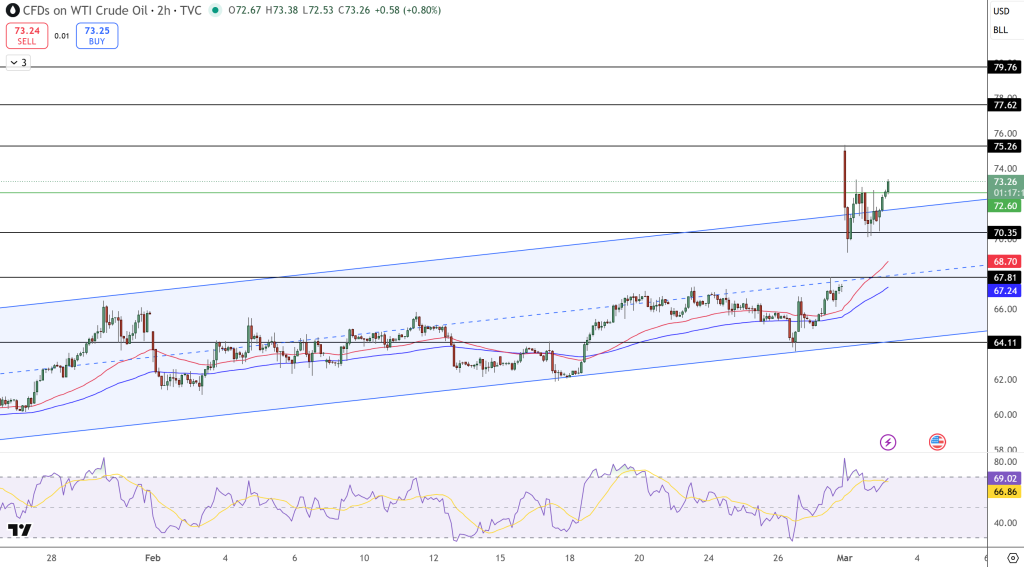
When you take a closer look at the charts for WTI (West Texas Intermediate) we can see a textbook ‘momentum breakout’ on both the 2 hour and 4 hour timeframes.
What the Charts Are Telling Us
The price of oil has managed to break through a critical resistance level at $72.60 & convert it into a level of support. Oil is currently hovering around $73.26 firmly entrenched within an ascending channel that started in late February.
- Support Levels: If the price takes a dip, immediate support comes in at $72.60, then a deeper “Safety Net” is at $70.35.
- Resistance Targets: The next major hurdle for the bulls is $75.26. If the situation in the Middle East worsens we can expect a fast move up towards $77.62.
- Momentum Check: The RSI is currently at 69 which puts it perilously close to being “overbought” – so we can expect a brief pullback or correction before the next leg up.
Fundamental Outlook: What Happens If The Price of Oil Hits $100?
While the underlying supply-demand balance was soft for 2026, the war has essentially “broken” the traditional fundamental model.
2 Scenarios For 2026
- The Tactical Strike (Base Case): If military operations remain targeted & conclude within 2 – 4 weeks, analysts at Goldman Sachs & Bernstein expect prices to stabilize around $80.
- The Prolonged Blockade (Worst Case): A full & sustained closure of the Strait of Hormuz could trigger a “price mania”. In this scenario, J.P. Morgan & Rystad Energy are warning of a price spike towards $120 – $150 which could send the global economy into a recession & push US gas prices to over $4 a gallon.
Professional Traders: What To Do
In a “hot war” environment like this, volatility is your biggest risk & your biggest opportunity.
- The Buy: Look out for pullbacks to the $72.60 zone – where institutional ‘buy-the-dip’ orders are expected to cluster.
- The Target: Aim for $75.20 as a primary take profit, with a secondary target of $77.50 if the situation shows no signs of de-escalating.
- The Risk: If you get in on the trade, be prepared for a sudden announcement of a ceasefire or diplomatic breakthrough – which could trigger a $5 – $10 gap down. Use a hard stop loss below $70.30.
The Bottom Line: We are no longer trading on inventories & OPEC quotas, we are trading on whether the Strait of Hormuz stays open or not. As long as the strait remains off-limits, the path of least resistance for oil is up.
- Check out our free forex signals
- Follow the top economic events on FX Leaders economic calendar
- Trade better, discover more Forex Trading Strategies
- Open a FREE Trading Account
- Read our latest reviews on: Avatrade, Exness, HFM and XM




 Save
Save