Oracle Stock ORCL Jumps 10% Pre-Earnings, but Can Buyers Outweigh AI Spending and Job Cuts?
Oracle shares have rebounded sharply this week, but rising debt, legal scrutiny, and growing skepticism around the ambitious Stargate...
Quick overview
- Oracle shares have rebounded approximately 10% this week, despite ongoing concerns about rising debt and legal scrutiny.
- The company plans to cut thousands of jobs and pause hiring in its cloud unit to manage costs associated with its AI infrastructure investments.
- Investor skepticism is growing around the Stargate AI project, which may not be as operationally developed as initially claimed.
- Despite strong revenue growth, Oracle's cash flow has weakened significantly due to heavy capital expenditures on data centers.
Live ORCL Chart
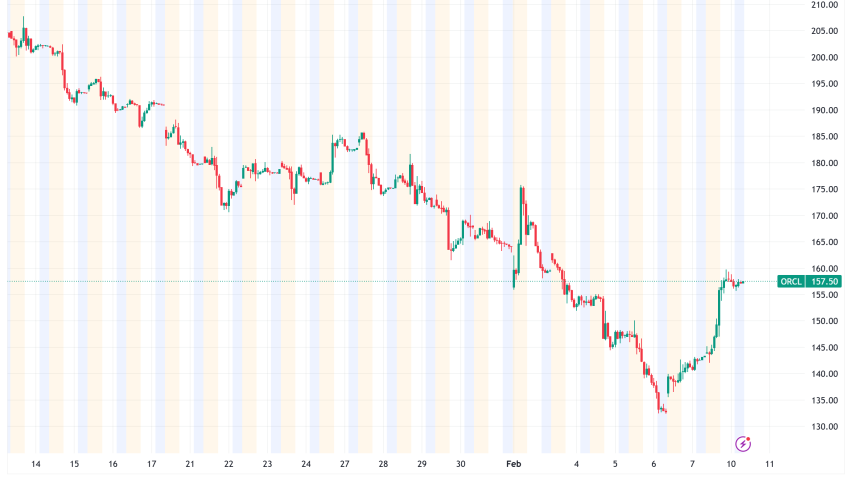
[[ORCL-graph]]
Oracle shares have rebounded sharply this week, but rising debt, legal scrutiny, and growing skepticism around the ambitious Stargate AI project continue to cast a cautious shadow over the company’s long-term outlook.
Oracle Shares Rebound After Weak Start to 2026
Oracle began 2026 under pressure as investor confidence weakened amid concerns about rising leverage, legal challenges, and the company’s aggressive artificial intelligence infrastructure investments. However, sentiment improved this week, with Oracle stock climbing roughly 10% as traders positioned ahead of the company’s upcoming fiscal third-quarter results.
The rebound began on Monday despite broader weakness across the technology sector. By Thursday, Oracle shares were moving higher even as U.S. equity markets declined, suggesting that investors are increasingly focused on the company’s earnings outlook and AI-driven growth strategy.
Still, the rally has done little to erase deeper concerns surrounding Oracle’s ambitious spending plans and the long-term economics of its artificial intelligence initiatives.
Reports of Job Cuts Highlight Financial Pressures
A new report from Bloomberg added to the uncertainty surrounding Oracle’s financial position. According to people familiar with the matter, the company plans to cut thousands of jobs across multiple divisions as it attempts to manage the rising costs associated with its AI infrastructure build-out.
The report also suggested that Oracle’s cloud unit has paused hiring, an indication that management may be tightening spending after committing substantial capital to data center expansion.
While cost-cutting measures can improve efficiency, the timing of the reported layoffs underscores growing pressure on Oracle’s balance sheet as it scales its Oracle Cloud Infrastructure (OCI) platform to compete in the rapidly expanding AI computing market.
Stargate AI Project Faces Renewed Doubts
Another major source of investor concern revolves around the Stargate AI initiative, a high-profile joint venture announced in January 2025 involving Oracle, OpenAI, and SoftBank.
Initially promoted as a transformative $500 billion AI infrastructure project, Stargate was expected to accelerate the development of massive data centers designed to power next-generation artificial intelligence systems.
However, a weekend report suggested the project may be far less operationally developed than originally portrayed. According to the report, Stargate reportedly operates with minimal staffing and does not directly control data center assets, raising questions about its structure and governance.
The report also indicated that disagreements emerged early among partners regarding management responsibilities and strategic direction. OpenAI reportedly explored independent data center builds before lenders raised concerns about the immense capital requirements and uncertain business economics.
If these claims prove accurate, the revelations could weaken the narrative that previously justified Oracle’s aggressive AI spending strategy.
Technical Signals Reflect Deteriorating Sentiment
From a technical perspective, Oracle’s price action reinforces the fundamental unease. On longer-term charts, the stock has slipped below the 20 monthly moving average (gray) that previously acted as support, increasing the risk of deeper pullbacks first to the April 2025 low of $118 and then to $100 and below. On shorter timeframes, rebounds have consistently failed near resistance levels, forming a clear pattern of lower highs, so we’ll see where this week’s rebound will end.
ORCL Chart Monthly – Can the 20 SMA Is Under Attack

On the daily chart we saw a rebound off the 200 SMA (purple) in early January but the 50 SMA (yellow) rejected the price and now the 200 SMA has been broken. However, the 20 SMA (gray) which was acting as resistance and pushing the stock lower has been broken now and might turn into support. On the other hand, a sustained break below current support levels would shift attention toward the $100 area now, with further downside risk.
ORCL Chart Daily – The Highs Keep Getting Low

Massive Capital Raise Raises Leverage Concerns
Investor anxiety intensified after Oracle disclosed plans to raise between $45 billion and $50 billion in funding during 2026 to accelerate the expansion of its cloud infrastructure.
The capital raise could involve a mix of debt issuance, equity-linked instruments, and common stock sales, a strategy that introduces both leverage and dilution risks.
In an environment where borrowing costs remain elevated, large-scale financing efforts can significantly affect investor sentiment. Additional debt increases balance sheet leverage, while issuing new shares could dilute existing shareholders.
The optics become even more challenging when a company’s stock is under pressure, as capital raises during periods of weakness are often interpreted as defensive rather than opportunistic.
Analysts have already begun expressing caution. RBC Capital Markets recently lowered its price target on Oracle to $160 from $195, citing uncertainty about the company’s ability to fund its AI expansion commitments.
As of the second quarter of fiscal 2026, Oracle reported total debt of $131.7 billion, negative levered free cash flow of $13.2 billion, and capital expenditures of roughly $12 billion.
Growing Dependence on OpenAI Raises Counterparty Risk
Oracle’s expanding partnership with OpenAI has also become a focal point for investors assessing long-term risk.
Reports of a potential $300 billion computing agreement tie Oracle’s infrastructure investments closely to OpenAI’s future growth. While demand for AI computing power is surging, OpenAI itself is widely expected to remain unprofitable for several years.
Estimates suggest the company could require more than $200 billion in capital to sustain its development trajectory. That dynamic introduces counterparty risk, particularly as Oracle finances its own infrastructure expansion with borrowed capital.
For investors, the concern is straightforward: if projected demand from AI partners fails to materialize, Oracle could be left with excess data center capacity and rising debt obligations.
Legal Challenges Add Another Layer of Uncertainty
Oracle’s situation has become even more complicated following the filing of a proposed bondholder class action lawsuit in New York state court.
The complaint alleges that Oracle misled investors regarding the funding requirements associated with its AI expansion strategy. Specifically, plaintiffs claim the company failed to adequately disclose the likelihood of additional borrowing after issuing approximately $18 billion in bonds shortly after announcing its OpenAI partnership.
Although the case remains in its early stages, the legal overhang introduces additional reputational risk. For companies relying heavily on capital markets to finance growth, questions around disclosure and transparency can increase scrutiny from both investors and regulators.
Revenue Growth Remains Strong but Cash Flow Weakens
Despite the mounting concerns, Oracle’s underlying business continues to generate solid revenue growth.
Quarterly revenue recently increased 14% year over year, while the company’s cloud services segment expanded more than 30%, driven by demand for AI-related workloads and large enterprise cloud contracts.
However, the surge in capital spending has significantly impacted cash flow. Free cash flow has reportedly fallen deeper into negative territory, exceeding negative $13 billion as Oracle accelerates investments in data centers and computing infrastructure.
This growing imbalance between rising revenue and heavy capital expenditure has become a key issue for investors focused on capital efficiency and balance-sheet discipline.
Investors Await Critical Earnings Update
Market attention is now turning to Oracle’s upcoming earnings release.
Analysts expect the company to report adjusted earnings per share of approximately $1.71, representing about 16% year-over-year growth. Revenue is projected to reach around $16.9 billion, a roughly 20% increase from the same quarter last year.
However, Oracle has delivered mixed earnings surprises in recent years, missing analyst estimates in four of the past nine quarters.
As a result, investors will likely focus less on the headline numbers and more on management’s commentary around AI demand, cloud growth, and capital spending plans.
Updates on data center construction timelines and the pace of infrastructure investment could ultimately determine whether Oracle’s recent stock rebound proves sustainable—or merely temporary.
- Check out our free forex signals
- Follow the top economic events on FX Leaders economic calendar
- Trade better, discover more Forex Trading Strategies
- Open a FREE Trading Account
- Read our latest reviews on: Avatrade, Exness, HFM and XM


 Save
Save