Brent and WTI Crude Oil Prices Jump at the Open as Energy CEOs Warn of Crisis but Retreat
At the beginning of the week, rising tensions in the Strait of Hormuz rekindled concerns about supply disruptions and prompted key U.S...
Quick overview
- Global Brent Crude and West Texas Intermediate oil prices surged due to escalating tensions around the Strait of Hormuz, raising fears of supply disruptions.
- U.S. energy executives have warned that continued instability in the region could lead to extreme volatility in oil markets and higher prices.
- The U.S. government is considering emergency measures, including easing sanctions on Russia and releasing oil from strategic reserves, to stabilize markets.
- The upcoming Federal Reserve meeting is crucial as rising energy prices and slowing job growth complicate the economic outlook.
Live USOIL Chart

At the beginning of the week, rising tensions in the Strait of Hormuz rekindled concerns about supply disruptions and prompted key U.S. energy executives to warn of a worsening global energy crisis, which caused global Brent Crude and West Texas Intermediate oil prices to spike.
Oil Prices Jump at the Market Open
Energy markets started the new trading week with sharp gains as geopolitical tensions continued to dominate sentiment.
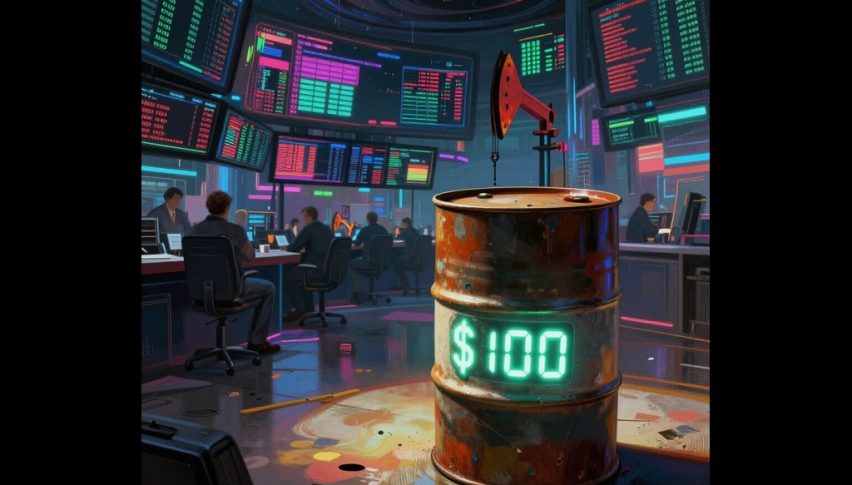
U.S. oil futures surged during early trading, with West Texas Intermediate briefly touching the $100 per barrel level before pulling slightly lower. Meanwhile, international benchmark Brent crude jumped to around $106.50, remaining firmly above the $105 mark.
WTI Futures Chart Daily – Trading Close to $100

The surge reflects growing investor concern that disruptions to oil shipments through the Strait of Hormuz could severely impact global supply. Roughly one-fifth of the world’s oil and liquefied natural gas flows through the strategic waterway, making it one of the most critical energy chokepoints in the world.
As a result, even the threat of disruption has been enough to inject significant volatility into energy markets.
Energy Executives Warn of Worsening Crisis
Senior leaders from some of the largest U.S. oil companies have warned that the situation could deteriorate further.
According to reports, executives from Exxon Mobil, Chevron, and ConocoPhillips recently raised concerns during discussions with officials in the White House.
The executives reportedly met with Chris Wright, the U.S. Energy Secretary, and Doug Burgum, the Interior Secretary, to outline risks facing global energy markets.
Industry leaders warned that continued instability around the Strait of Hormuz could sustain extreme volatility in oil markets, potentially driving prices even higher in the coming weeks.
Executives also cautioned that speculative trading and potential shortages of refined petroleum products could amplify the price surge.
Hormuz Disruptions Keep Markets on Edge
The Strait of Hormuz remains the focal point of the global energy crisis.
Escalating conflict involving the United States, Iran, and Israel has raised fears that shipping traffic through the narrow waterway could be disrupted or blocked entirely.
In response, the U.S. government is reportedly preparing a multinational naval coalition to escort tankers through the strait in an effort to keep the shipping corridor open.
However, energy industry leaders have warned that such measures may not be sufficient if instability in the region continues.
Even minor disruptions in tanker traffic could tighten global oil supplies and push prices significantly higher.
Washington Considers Emergency Measures
In an attempt to stabilize markets, the administration of President Donald Trump is evaluating several policy options.
These include easing sanctions on Russia to allow additional oil exports, expanding crude flows between Venezuela and the United States, and potentially releasing up to 400 million barrels from strategic petroleum reserves.
Such measures are designed to increase global supply and reduce pressure on energy markets.
However, many energy executives remain skeptical that these steps alone can offset disruptions if the Strait of Hormuz remains unstable.
Geopolitical Tensions Continue to Drive Market Volatility
Escalating tensions in the Middle East remain a major factor shaping global financial markets.
Reports indicate that the United States is preparing a multinational naval coalition to escort ships through the Strait of Hormuz, a critical global energy shipping route. The move reflects growing concerns about potential disruptions to oil supply linked to tensions involving Iran.
President Donald Trump has also reportedly urged several countries, including China, to assist in maintaining safe passage through the strategic waterway.
Despite these developments, precious metals have struggled to maintain upward momentum as investors increasingly shift toward the U.S. dollar during periods of global uncertainty.
Oil at $100 Complicates the Economic Outlook
Energy markets have added another layer of complexity to the global economic environment.
Prices for West Texas Intermediate crude oil have surged above $100 per barrel, raising concerns that inflation pressures could remain elevated.
Higher energy costs tend to feed through to transportation and production expenses, potentially keeping inflation above central bank targets.
At the same time, the latest labor market data shows signs of weakening economic momentum. The February jobs report indicated that the U.S. economy lost around 92,000 jobs, pushing unemployment to 4.4%.
Meanwhile, core inflation remains near 2.5%, still high enough to complicate the Federal Reserve’s policy outlook.
This unusual combination of rising energy prices, slowing job growth, and persistent inflation has created a difficult environment for policymakers.
The Federal Reserve Meeting Takes Center Stage
The upcoming Federal Open Market Committee meeting on March 18 is expected to be the most important event for precious metals markets this week.
Investors will closely analyze the Federal Reserve’s updated economic projections and the widely watched “dot plot,” which outlines policymakers’ expectations for future interest rate moves.
This meeting is particularly significant because it will be one of the final policy gatherings chaired by Jerome Powell before the end of his term in May.
Silver’s relationship with monetary policy is closely tied to interest rates and the strength of the U.S. dollar.
Lower interest rates generally weaken the dollar and reduce real yields, which tends to support precious metals. In contrast, higher interest rates or hawkish policy signals typically strengthen the dollar and increase real yields, creating headwinds for silver.
Outlook: Oil markets now appear highly sensitive to geopolitical developments.
While emergency policy actions could provide temporary relief, analysts warn that prolonged disruptions to shipping in the Strait of Hormuz could drive crude prices significantly higher, potentially pushing energy markets into a prolonged period of volatility.
If supply risks intensify, oil prices could climb further above the $100 level, raising fuel costs globally and increasing the risk of broader economic disruption.
- Check out our free forex signals
- Follow the top economic events on FX Leaders economic calendar
- Trade better, discover more Forex Trading Strategies
- Open a FREE Trading Account
- Read our latest reviews on: Avatrade, Exness, HFM and XM

Related Articles

Sidebar rates

Related Posts
 Save
Save