Gold Price Forecast: Holds Steady Near $4,650 as Trump’s Iran Deadline on Strait of Hormuz Looms – Safe Haven Surge or Sharp Drop Ahead?
Gold is trading in a pretty narrow range $4,650-$4,680 on April 7, 2026, showing hardly any movement or volatility to speak of.
Quick overview
- Gold is trading in a narrow range of $4,650-$4,680, showing little volatility amid geopolitical tensions.
- A stronger US dollar and rising Treasury yields are currently hindering gold's performance despite high oil prices.
- Traders are cautious ahead of President Trump's deadline for Iran regarding the Strait of Hormuz, which could impact gold's safe-haven demand.
- Long-term forecasts for gold remain positive, with potential targets around $5,400 by year-end due to inflation risks and ongoing geopolitical uncertainties.
Gold is trading in a pretty narrow range $4,650-$4,680 on April 7, 2026, showing hardly any movement or volatility to speak of. The precious metal has been going back and forth between roughly $4,616 and $4,694, with June futures opening near $4,678.
This cautious mood ahead of President Trump’s ultimatum to Iran regarding safe passage through the Strait of Hormuz has a lot of the usual hallmarks of a “wait and see” approach getting ready for a Presidents deadline.
Why is gold just stuck near $4,650 despite all these geopolitical tensions?
Gold normally does well in times of crisis as people seek safe havens, but right now a stronger US dollar (currently trading near 100) and rising Treasury yields are basically creating headwinds for gold and making it harder for it to get any kind of traction. Even though oil is trading at a whopping $110 per barrel, this is basically capping the upside for gold right now.
Geopolitical Deadline Keeps Safe Haven Demand in Check
President Trump has been warning Iran about strikes on Iranian infrastructure if the Strait of Hormuz isn’t reopened by the deadline, which is this evening. Iran has basically pushed back, saying they want permanent solutions and they expect to get paid for using the shipping route. The Strait of Hormuz is really important because it carries about one fifth of all the oil and gas that gets transported around the world, so a prolonged disruption would be no good at all and would drive up prices.
Any prolonged disruption to the Strait of Hormuz would also give a boost to energy markets as a whole. While there’s no doubt that the current situation supports gold as a safe haven, right now we’ve also got a stronger US dollar and rising Treasury yields getting in the way. High oil prices above $110 per barrel raise inflation concerns, which can give gold a boost over the longer term, but for now they’re actually putting a bit of pressure on gold by raising the prospect of the Federal Reserve cutting interest rates less aggressively than people had hoped.
Some traders have even been shifting their money towards the US dollar as an alternative safe haven in the last few days – which has basically been contributing to some profit-taking. Gold has pulled back about 9-10% since its highs above $5,500, but is still up more than 55% over the course of the year. And that’s a pretty impressive performance, especially when you consider the volatility it’s had to put up with.
Technical Analysis: Gold Range Tightens with Trendline Support in Focus
On the charts, gold is just consolidating between a rising trendline that’s been providing support on dips and resistance around $4,700. The 200-period simple moving average is also clustered around that same price level, which is basically creating resistance for now.
The 50-period moving average is still offering short-term support and the Relative Strength Index (RSI) is hovering near neutral levels, which is basically just saying that nobody really has a lot of conviction either way. A clean break above $4,700 could get gold moving towards $4,800 or higher if the escalation headlines get worse.
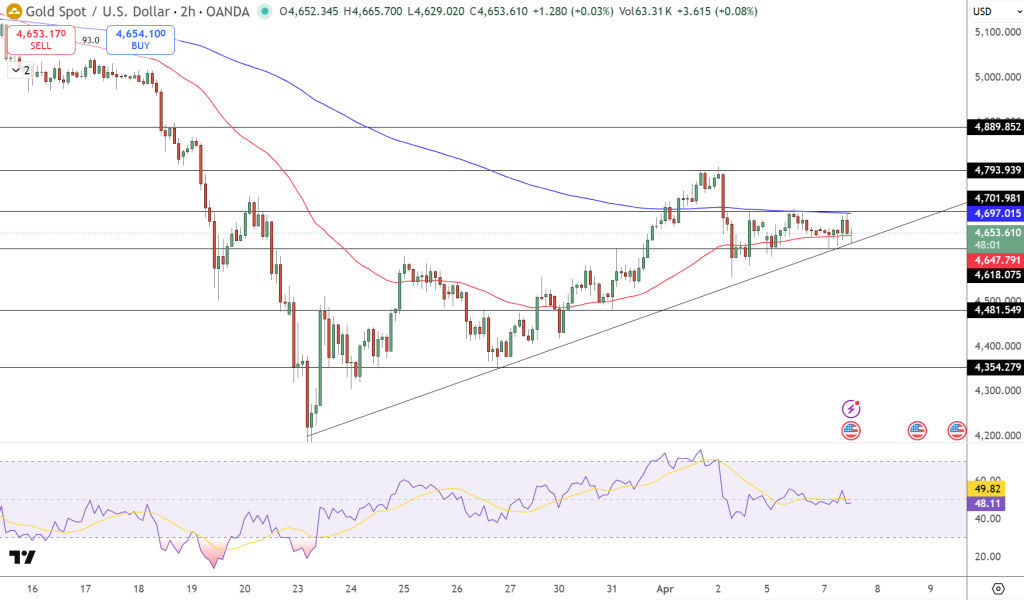
A break below $4,620 might expose some deeper support around $4,580-$4,600, especially if there are any positive developments on the diplomatic front. The overall pattern is still showing higher lows, which keeps the broader structure pretty much intact for now – even if gold can’t seem to break through the upper levels it’s been stuck at.
Three Critical Developments Traders Should Be Keeping Track of Today
- What Iran says in response to President Trump’s deadline, or any updates on that front.
- Any shifts in US dollar strength and Treasury yields tied to oil price moves.
- What’s happening with safe-haven flows across commodities and risk assets.
Short-Term Caution Dominates While Longer-Term Support Remains Strong
Short-term outlook is pretty bleak, with limited upside today and a high risk of sharp price swings once the deadline passes depends on whether the escalation signals, military threats, or de-escalation hopes emerge. Analysts keep on saying that monetary policy repricing is weighing on non-yielding assets like gold, even as central bank buying and diversification trends continue to provide structural backing.
Longer-term, most forecasts are still pretty constructive, with targets towards $5,400 by year-end driven by persistent inflation risks from energy shocks, portfolio shifts away from the dollar and gold’s role during periods of uncertainty. And yes, gold has already shown its resilience in multiple volatility episodes, so if the Hormuz disruptions keep going on, that could quickly reignite buying interest again.
- Check out our free forex signals
- Follow the top economic events on FX Leaders economic calendar
- Trade better, discover more Forex Trading Strategies
- Open a FREE Trading Account
- Read our latest reviews on: Avatrade, Exness, HFM and XM

Related Articles

Sidebar rates

Related Posts
 Save
Save
