AMZN Stock Gains 10% as Andy Jassy’s Letter Tries to Calm AI Bubble Fears after $200B Bet
Amazon shares are rebounding as CEO Andy Jassy’s annual letter reassures investors on long-term strategy, even as massive spending plans...

Quick overview
- Amazon shares have rebounded over 10% following CEO Andy Jassy's reassuring letter to shareholders about the company's long-term strategy.
- Jassy emphasized the importance of heavy investments in next-generation technologies and AWS, despite concerns about capital efficiency and market pressures.
- The company's planned $200 billion capital expenditure has raised questions about its ability to sustain aggressive expansion without impacting margins.
- Amazon faces increasing competition in e-commerce and ongoing regulatory scrutiny, complicating its ambitious growth plans.
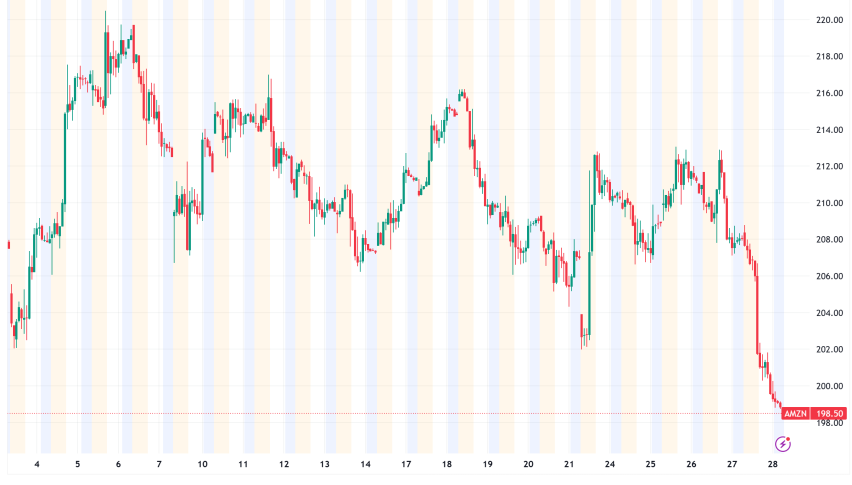
Live AMZN Chart
[[AMZN-graph]]
Amazon shares are rebounding as CEO Andy Jassy’s annual letter reassures investors on long-term strategy, even as massive spending plans keep risks in focus.
Jassy’s Letter Reframes the Narrative
Shares of Amazon have gained strong momentum this week, rising more than 10% as investors responded positively to CEO Andy Jassy’s annual letter to shareholders.
In the letter, Jassy directly addressed growing concerns around excessive spending and fears of a potential bubble in next-generation technologies. He pushed back firmly, arguing that while periods of heavy investment often attract skepticism, the long-term payoff remains compelling.
Jassy emphasized that these technologies will reshape nearly every customer experience, reinforcing Amazon’s conviction to remain aggressive in its investment strategy rather than pulling back.
AWS and Government Infrastructure Take Center Stage
A major pillar of Amazon’s long-term vision is the continued expansion of Amazon Web Services (AWS), particularly into government-backed infrastructure.
The company has committed tens of billions of dollars toward building high-security cloud environments tailored for public sector clients. These projects are expected to significantly expand AWS capacity, including regions designed for sensitive and classified workloads.
Strategically, this aligns Amazon with national priorities around digital infrastructure and data sovereignty, strengthening its position in a segment with high barriers to entry and long-term contract visibility.
However, the scale of these commitments has also raised questions about capital efficiency and return timelines.
$200 Billion Spending Plan Raises Stakes
Amazon’s planned capital expenditure—expected to reach around $200 billion—has become a central focus for investors.
While the spending is aimed at expanding both cloud capacity and core infrastructure, it comes at a time when markets are increasingly sensitive to large-scale investment cycles. Rising costs, uncertain returns, and macroeconomic pressures have made investors more cautious about long-duration bets.
Jassy acknowledged these concerns but maintained that, for Amazon, the returns on invested capital will justify the scale of spending over time.
Still, the market debate has shifted toward whether the company can sustain such aggressive expansion without pressuring margins or balance sheet flexibility.
A Cautious and Unsettled Start to 2026
Amazon entered 2026 hoping to rebuild confidence after a volatile finish to the prior year, but the opening weeks instead reinforced investor unease as AMZN fell below $200. But the 100 weekly SMA (green) held as support. Shares have climbed for two consecutive weeks, pushing above the 50 weekly SMA (yellow) and gaining roughly 16% as sentiment improves and tech stocks rebound.
AMZN Chart Weekly – Undoing Last Week’s Gains

Valuation and Discipline Back in Focus
Amazon’s valuation has historically been supported by strong growth expectations, particularly from AWS. However, as capital expenditure rises and visibility on returns becomes less clear, that premium is being reassessed.
Some market participants are beginning to question whether the current valuation fully reflects the risks associated with prolonged heavy investment. In a higher-rate environment, patience for long-term payoffs has become more limited.
This shift has placed capital discipline back at the center of the investment narrative.
Competition Intensifies in E-Commerce
At the same time, Amazon is facing growing competition in its core retail business. Emerging platforms are rapidly gaining ground, particularly in cross-border commerce, challenging Amazon’s historical dominance.
Changes in global trade rules, including tighter regulations on low-value imports, are also expected to introduce new friction into the system. These developments could pressure margins in already competitive product categories.
While Amazon’s logistics network and ecosystem remain strong, the competitive landscape is clearly evolving.
Regulatory Pressures Add Complexity
Legal and regulatory challenges continue to add another layer of uncertainty. Amazon is navigating ongoing antitrust scrutiny in multiple regions, including Europe, where recent rulings have resulted in significant fines.
Although some penalties have been reduced, the broader issue of regulatory oversight remains unresolved. These challenges require ongoing attention and resources, complicating the company’s already ambitious expansion plans.
AWS Economics Under the Microscope
Beyond company-specific issues, the broader economics of cloud infrastructure are being re-evaluated across the industry.
As competition intensifies, pricing power may come under pressure, particularly if alternative models—such as direct infrastructure leasing—gain traction. This raises important questions about how quickly Amazon can convert its investments into sustainable profitability.
For AWS, the challenge is no longer just growth, but efficient monetization at scale.
Strong Retail Base Offers Stability
Despite these concerns, Amazon’s core retail operations remain resilient. Demand has held steady, supported by its logistics capabilities, automation, and the strength of its Prime ecosystem.
However, this stability has not been enough to fully offset investor anxiety סביב AWS spending and capital intensity. The market’s focus has shifted decisively toward long-term returns rather than near-term performance.
A Long-Term Bet Meets a More Demanding Market
Jassy’s letter has helped restore some confidence by clearly articulating Amazon’s long-term vision. The message is straightforward: heavy investment today is necessary to secure leadership tomorrow.
Yet the market environment has changed. Investors are demanding clearer timelines, stronger returns, and greater discipline.
For Amazon, the path forward will depend not only on executing its ambitious strategy but also on proving that its massive investments can translate into durable and profitable growth.
- Check out our free forex signals
- Follow the top economic events on FX Leaders economic calendar
- Trade better, discover more Forex Trading Strategies
- Open a FREE Trading Account
- Read our latest reviews on: Avatrade, Exness, HFM and XM

Related Articles


Sidebar rates

Related Posts
 Save
Save