Bitcoin Fades Below $71K as Ceasefire Rally Cools: Fibonacci Rejection and Derivatives Reset Signal Consolidation Ahead
Rejected at the 23.6% Fibonacci level and drifting below its 7-day moving average, Bitcoin retreats 1.2% following a geopolitically-driven
Quick overview
- Bitcoin retreats 1.2% to $70,849 after being rejected at the 23.6% Fibonacci level, indicating near-term selling momentum.
- The recent geopolitical truce between the U.S. and Iran has led to a temporary spike in Bitcoin, but high energy prices and inflationary pressures continue to limit risk appetite.
- Technical indicators suggest potential weakness, with Bitcoin falling below its 7-day moving average and a significant drop in futures open interest.
- The market's short-term direction hinges on geopolitical developments, with critical support levels at $70,052 and $70,582 that could dictate future price movements.
Rejected at the 23.6% Fibonacci level and drifting below its 7-day moving average, Bitcoin BTC/USD retreats 1.2% following a geopolitically-driven spike as traders balance a precarious U.S.-Iran truce against ongoing inflation and waning regulatory momentum.
A Relief Trade, Not a Trend Change
The minor 1.15% decrease in Bitcoin to $70,849 on Wednesday is indicative of a wider retreat in the cryptocurrency market, with total market capitalization falling 1.26%. This is a logical reaction to Tuesday’s dramatic 6% increase. News of a two-week ceasefire between the United States and Iran sparked that rally, sending stock futures and risk assets skyrocketing and causing a $280 million liquidation event in Bitcoin futures markets.
But there are already restrictions on the catalyst. The truce was referred to as a “fragile” accord by U.S. Vice President JD Vance, and Brent crude oil prices were still close to $95 per barrel, significantly higher than the $72 level observed in late February. A limitation on risk appetite is maintained by high energy prices, which also maintain inflationary pressure and limit the Federal Reserve’s ability to lower interest rates.
Watch: Before the shaky truce expires on April 22, any decline in ceasefire negotiations or a new surge in oil prices might rekindle selling pressure.
Fibonacci Rejection and Moving Average Breakdown Confirm Near-Term Weakness
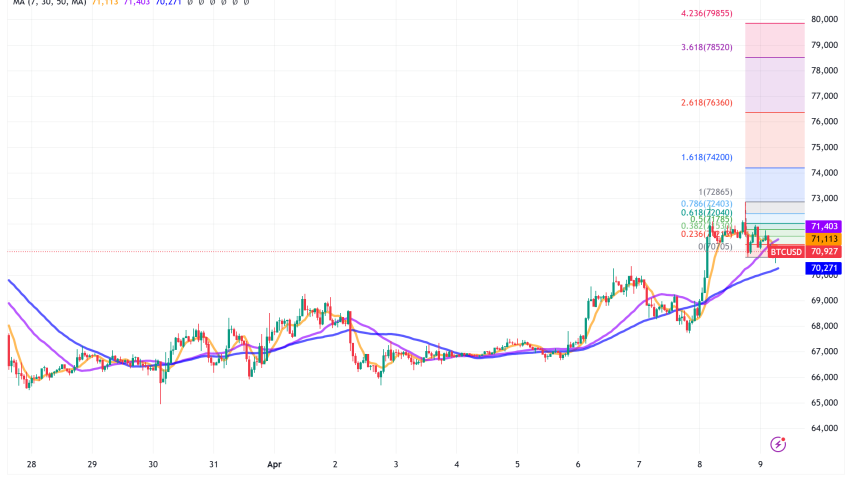
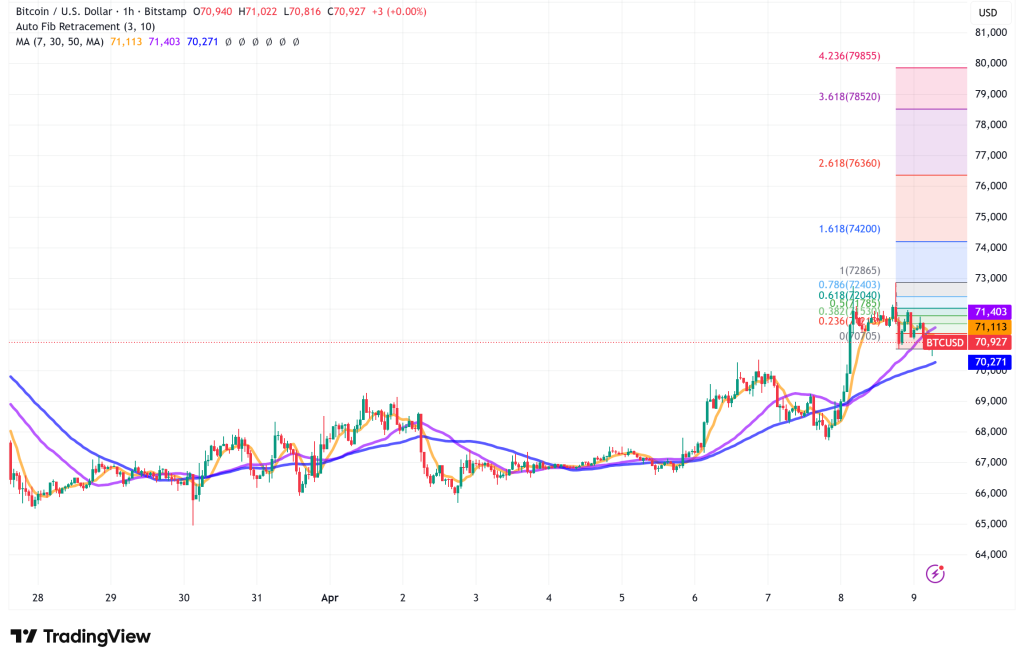
The cautious tone is further reinforced by the technical image. During Tuesday’s surge, Bitcoin was rejected from the 23.6% Fibonacci retracement level at $71,766. Since then, it has fallen below its 7-day moving average at $71,342, a combination that theoretically indicates near-term selling momentum. This is supported by the futures market, where total open interest dropped 4.25% in a single day, continuing a wider deleveraging trend that has seen a roughly 50% reduction in total futures open interest since October 2025.
Importantly, since late January, the 2-month BTC futures annualized premium has remained below the neutral 4% level, at just 3%. This indicates that leveraged participants are not making any new bullish demands. Although put-to-call skew has decreased from the high panic levels noted on March 26, options markets are still gloomy, with put (sell) premiums surpassing calls at Deribit.
Important levels to keep an eye on include the 7-day moving average ($71,342) and the 23.6% Fibonacci retracement ($71,766); the 50% Fibonacci level ($70,582) and the 61.8% level ($70,052); a break below opens the way to the most recent swing low at $68,338.
Regulatory Headwinds Add Pressure to an Already Cautious Market
Beyond the macro, a series of policy setbacks confront Bitcoin bulls. The industry’s requested tax exemptions for modest Bitcoin payments and deferred capital gains for cryptocurrency mining were not included in the most recent draft of the PARITY Act. A significant pro-crypto voice was eliminated from the administration when David Sacks left his position as White House AI and crypto czar in late March. Although no specific proposal has surfaced, U.S. Treasury Secretary Scott Bessent has frequently suggested “budget neutral” ways to amass Bitcoin for a strategic reserve without imposing additional taxes.
The news of the ceasefire has not alarmed bears. Despite the $280 million in forced liquidations, which make headlines but account for less than 1% of the $42 billion total BTC futures position and have happened five more times in the last ninety days alone, derivatives data reveals no significant change in short positioning.
Watch: Compared to derivatives positions alone, spot ETF flow data in the next 48 hours will provide a clearer indication of institutional conviction.
Bitcoin Price Prediction: Consolidation Zone with a Binary Outcome
The short-term course is binary and closely related to geopolitics. The market may consolidate and even attempt a comeback toward $72,000 if Bitcoin stays inside the $70,052–$70,582 support range, which is characterized by the 61.8% and 50% Fibonacci retracement levels. That argument would be strengthened by a consistent daily closure above the 7-day moving average at $71,342.
But a clear break below $70,000 opens the door to the previous swing low at $68,338, especially if it is accompanied by worsening ceasefire news or an increase in oil prices. Participants in the derivative market have little buffer to absorb abrupt declines since leverage is still unwinding.
- Check out our free forex signals
- Follow the top economic events on FX Leaders economic calendar
- Trade better, discover more Forex Trading Strategies
- Open a FREE Trading Account
- Read our latest reviews on: Avatrade, Exness, HFM and XM

Related Articles
Sidebar rates

Related Posts
 Save
Save
