JSE Shares that Pay Dividends Monthly

We have compiled an overview of JSE Shares that Pay Dividends Monthly, alongside the top Shares to buy on the JSE, highlighting stocks to watch in 2026. This guide highlights established market leaders across technology, finance, and resources, alongside consistently performing companies known for dependable cash generation, earnings strength, and long-term expansion potential. Using analyst commentary and market trends, these selections represent some of the most promising income and growth ideas on the JSE (2026).
Note: This article and the JSE Shares listed are subject to change, as the information reflects conditions at the time of publication in **February 2026.
** (Dividend dates can change when companies declare results.)
10 Best JSE Shares that Pay Dividends Monthly (2026)
- Tharisa (JSE: THA) – Interim dividend paid in March following a February ex-dividend date.
- Greencoat Renewables (JSE: GREEN) – Quarterly dividend distributed with a March payment date.
- South32 (JSE: S32) – Interim dividend historically paid in early April.
- JSE Limited (JSE: JSE) – Annual dividend typically paid during April.
- Anglo American (JSE: AGL) – Final dividend commonly paid in May after full-year results.
- British American Tobacco (JSE: BTI) – Regular dividend payment often made in May.
- Vodacom Group (JSE: VOD) – Interim dividend usually paid in June.
- Spear REIT (JSE: SPE) – Property distribution historically paid mid-year.
- Capitec Bank (JSE: CPI) – Final dividend is often paid in July following annual results.
- Shoprite Holdings (JSE: SHP) – Annual dividend typically paid in July.
Dividend payments depend on the company’s declarations, earnings, and board approval.
This list reflects published dividend calendars and long-term payment patterns, not guarantees.
10 Best Forex Brokers – Globally
Pros and Cons of Trading Shares on the JSE – Key Advantages and Disadvantages
| ✓ Pros | ✕ Cons |
| Access to South Africa’s leading companies with strong growth potential (Naspers, Prosus, FirstRand). | Market volatility can cause rapid price swings. |
| Chance to receive dividends from well-established blue-chip and resource stocks. | Some stocks have lower liquidity, making large trades more difficult. |
| Diversified exposure to both defensive and growth sectors, including retail, banking, and resources. | Currency fluctuations for international investors can impact returns. |
| A transparent market regulated by the Johannesburg Stock Exchange. | Selecting top-performing stocks requires research and expertise. |
| Potential for long-term wealth creation through capital appreciation and reinvested dividends. | Brokerage fees and transaction costs can reduce overall returns. |
Investors on the JSE can access South Africa’s top companies within a secure, regulated marketplace that ensures transparent trading rules and robust protections.
1. Tharisa (JSE: THA)
Tharisa is an integrated resource group delivering PGMs and chrome concentrates with global reach. Using innovation and technology, the company focuses on sustainable mining, carbon reduction, and operational efficiency, while generating shareholder value and supporting local communities through responsible and ethical practices.
| Feature | Details | 2025 Performance | Key Focus Area |
| Employees | Tharisa Group Total | 3,066 | Workforce development |
| Mining Output | Reef mined | 5.35 Mt | Underground mining transition |
| Chrome Production | Chrome concentrates | 1.56 Mt | Operational efficiency |
| PGM Production | 5PGE + AU | 138.3 koz | Market demand supply |
| Safety | LTIFR (Tharisa Minerals) | 0.03 | Worker protection |
| Operations | Number of companies | 8 | Mining, beneficiation, logistics |
 | Minimum Deposit: $100 Regulated by: CBI, BVI, FSC, ASIC, FSCA, JFSA, FFAJ Crypto: Yes |
Frequently Asked Questions
What does Tharisa produce and sell?
Tharisa mines, processes, and markets platinum group metals (PGMs) and chrome concentrates. Their products include metallurgical-grade and specialty-grade concentrates, sold to customers globally through direct sales or agency agreements, supporting both industrial and commercial applications.
How does Tharisa contribute to sustainability?
Tharisa aims to reduce carbon emissions by 30% by 2030 and achieve net carbon neutrality by 2050. The company invests in solar energy, energy storage, and methane reduction projects while prioritising safe, responsible, and environmentally conscious mining operations.
| Minimum Deposit: $100 Regulated by: CBI, BVI, FSC, ASIC, FSCA, JFSA, FFAJ Crypto: Yes |
Pros and Cons
| ✓ Pros | ✕ Cons |
| Integrated mining, processing, and beneficiation operations. | Commodity prices can be volatile. |
| Strong commitment to sustainability and carbon reduction. | Operational costs can fluctuate with mining complexity. |
| Global sales network for PGMs and chrome concentrates. | Resource extraction carries environmental risk. |
| Focused on shareholder value and long-term growth. | Expansion projects require significant capital. |
| Innovation-driven approach with R&D initiatives. | Market demand for PGMs and chrome may vary. |
Our Insights
Tharisa stands out as a low-cost, strategic commodities producer committed to sustainable mining, innovation, and community upliftment. Investors benefit from its operational efficiency, strong ESG focus, and diversified product portfolio, making it a forward-looking player in the global transition to clean energy and responsible resource use.
2. Greencoat Renewables (JSE: GREEN)
Greencoat Renewables plc is a listed renewable energy infrastructure company that invests in, owns, and operates cash-generative European renewable energy assets. The company delivers progressively growing annual dividends while expanding its portfolio through disciplined asset management and long-term value creation.
| Feature | Details | 2025 Performance | Key Focus Area |
| Capacity | Total generation capacity | 1.5 GW | Wind and solar infrastructure |
| Assets | Number of assets managed | 40 | Diversified renewable portfolio |
| Carbon Avoided | Tonnes of CO2 avoided | 1.4 million | EU emissions reduction |
| Investment Strategy | Portfolio growth | Progressive dividends | Operational efficiency |
| Market Position | Listed company | Since 2017 | European renewable energy |
 | Minimum Deposit: $50 Regulated by: AUSTRAC, BAFIN, CIMA, ESCA, CySEC, FSC, FMA, MAS, TFG, VFSC Crypto: Yes |
Frequently Asked Questions
What types of assets does Greencoat Renewables manage?
Greencoat focuses on wind and solar generation assets across Europe, with 1.5GW of total capacity and 40 operating assets. The company manages the full asset life cycle, including generation, storage, and operational optimization to maximize both income and capital growth.
How does Greencoat contribute to sustainability and the energy transition?
Greencoat avoids over 1.4 million tonnes of CO2 emissions across its European portfolio by replacing fossil fuel generation. Its investments support the EU’s Net Zero targets while enabling companies to access clean, reliable energy through structured agreements such as PPAs.
| Minimum Deposit: $50 Regulated by: AUSTRAC, BAFIN, CIMA, ESCA, CySEC, FSC, FMA, MAS, TFG, VFSC Crypto: Yes |
Pros and Cons
| ✓ Pros | ✕ Cons |
| Stable, cash-generative European renewable energy portfolio. | Dividend growth depends on electricity market conditions. |
| Progressive annual dividends for long-term investors. | Exposure to regulatory and policy changes in Europe. |
| Supports the EU energy transition and Net Zero goals. | Renewable assets can be affected by weather variability. |
| Diversified across multiple wind and solar assets. | Expansion into new technologies may require significant capital. |
| Experienced management team with multi-disciplinary expertise. | Limited exposure outside Europe may reduce global diversification. |
Our Insights
Greencoat Renewables combines a high-yielding, diversified portfolio with a prudent risk approach and a strong balance sheet. Investors benefit from a low-risk path to participate in Europe’s energy transition, enjoy stable dividend returns, and support sustainable infrastructure with measurable environmental impact.
3. South32 (JSE: S32)
South32 is a globally diversified mining and metals company producing aluminium, copper, manganese, coal, and other critical minerals. Operating across six countries, it focuses on sustainable resource development, operational efficiency, and responsible community engagement while generating shareholder value and supporting the energy transition.
| Feature | Details | FY24 Performance | Key Focus Area |
| Operations | Countries | 6 | Americas Australia Southern Africa |
| Commodities | Produced | 8 | Aluminium copper manganese coal others |
| Revenue | Underlying EBITDA | US$1.802 billion | Financial performance |
| Employees | Total workforce | ~40,000 | Workforce management and safety |
| Sustainability | Emissions reduction | Scope 1 GHG below FY15 baseline | Net zero by 2050 |
 | Minimum Deposit: $25 Regulated by: CySEC, MISA, FSCA, FSC Crypto: Yes |
Frequently Asked Questions
What does South32 produce and where?
South32 operates mines across the Americas, Australia, and Southern Africa. Key products include aluminium at Mozal in Mozambique, copper at Sierra Gorda in Chile, and manganese, coal, and other metals across its global portfolio. Its operations span eight commodities in nine locations.
How does South32 promote sustainability and safety?
South32 implements climate action, decarbonisation, and tailings management programs while prioritising worker safety. The company has committed to net-zero Scope 1 and 2 emissions by 2050 and maintains community engagement initiatives, ensuring responsible mining and long-term positive social impact.
| Minimum Deposit: $25 Regulated by: CySEC, MISA, FSCA, FSC Crypto: Yes |
Pros and Cons
| ✓ Pros | ✕ Cons |
| Diversified global mining portfolio across critical minerals. | Commodity price volatility can affect profitability. |
| Strong sustainability and decarbonisation initiatives. | Large-scale projects require significant capital investment. |
| Focus on operational efficiency and safety. | Climate and environmental regulations may impact operations. |
| Long-term shareholder value creation and dividends. | Exposure to geopolitical and regulatory risks. |
| Experienced leadership and robust corporate governance. | Some assets may have lower operational flexibility. |
Our Insights
South32 combines diversified mining operations with a strong sustainability agenda and a focus on long-term value creation. Investors benefit from exposure to critical minerals supporting the global energy transition, operational resilience, and ethical corporate practices in multiple regions.
Top 3 JSE Shares that Pay Dividends Monthly – Head-to-Head Comparison
| Feature | Tharisa (JSE: THA) | Greencoat Renewables (JSE: GREEN) | South32 (JSE: S32) |
| Industry | Mining: PGMs and chrome | Renewable energy infrastructure | Diversified mining and metals |
| Employees Assets | 3,066 | 40 renewable energy assets | ~40,000 |
| Production Capacity | 5.35 Mt reef mined, 1.56 Mt chrome, 138.3 koz PGM | 1.5 GW total generation | 8 commodities including aluminium, copper, manganese, coal |
| Sustainability ESG | Carbon reduction target: 30% by 2030; net zero by 2050 | 1.4 million tonnes CO2 avoided; EU Net Zero alignment | Scope 1 GHG below FY15 baseline; net zero by 2050 |
| Geography Market | Global customer base or PGMs and chrome | Europe | Americas, Australia, Southern Africa |
| Dividend Financial Focus | Generates shareholder value; growth-oriented | Progressive annual dividends; cash generative | Long-term shareholder value; underlying EBITDA FY24: US$1.802 billion |
| Innovation Strategy | R&D, operational efficiency, underground mining transition | Full lifecycle asset management; wind and solar innovation | Operational efficiency, decarbonisation programs, sustainable mining practices |
4. JSE Limited (JSE: JSE)
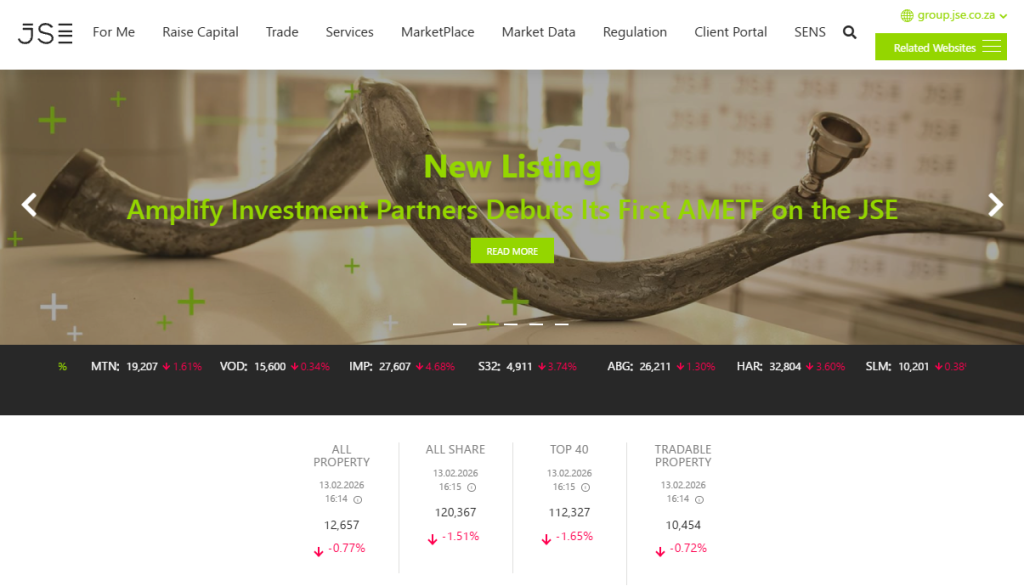
The Johannesburg Stock Exchange (JSE) is Africa’s largest stock exchange, providing a regulated and modern trading environment for investors and companies. With over 430 listed companies and a market capitalization exceeding R24 trillion, the JSE supports capital growth, sustainable investment, and access to diverse financial markets.
| Feature | Details | 2026 Status | Key Focus Area |
| Market Capitalization | Total value of listed companies | R24.22 trillion (~$1.48 trillion) | Largest equity market in Africa |
| Listed Companies | Total number of companies | 431 | Diverse sectors, Main Board and AltX |
| Trading Markets | Asset classes offered | Equities, derivatives, commodities, currencies, bonds | Multi-asset trading environment |
| Record High | FTSE/JSE ALSI Index | 100,000 points (July 2025) | Investor confidence and market growth |
| Modernization | Platforms and initiatives | Millennium Exchange, T+3 settlement, 24 hour trading plans | Efficiency, speed, and accessibility |
 | Minimum Deposit: $200 Regulated by: ASIC, BaFin, CMA, CySEC, DFSA, FCA, SCB Crypto: Yes |
Frequently Asked Questions
What markets and products are available on the JSE?
The JSE offers multiple asset classes, including equities, equity derivatives, commodity derivatives, currency derivatives, and interest rate products. Investors can trade on the Main Board for established companies or AltX for high-growth small-to-medium enterprises, while commodity and derivative markets provide risk management opportunities.
How is the JSE regulated and modernized?
The JSE operates as a self-regulatory organization under the supervision of the 🇿🇦 FSCA. It enforces trading rules, monitors market abuse, and provides transparent company news through SENS. Modernization initiatives include the Millennium Exchange platform, a T+3 settlement cycle, and sustainability disclosure guidance for issuers.
| Minimum Deposit: $200 Regulated by: ASIC, BaFin, CMA, CySEC, DFSA, FCA, SCB Crypto: Yes |
Pros and Cons
| ✓ Pros | ✕ Cons |
| Africa’s largest and most liquid stock exchange. | Market volatility can impact share prices. |
| Regulated under the 🇿🇦 FSCA with clear trading rules. | Investors require understanding of complex products. |
| Diverse investment options across multiple asset classes. | Some markets, such as derivatives, carry higher risk. |
| Modernized trading systems with fast settlement cycles. | 24-hour trading model is still under consideration. |
| Supports sustainable investment and ESG disclosure. | Access requires a licensed broker or financial advisor. |
Our Insights
The JSE combines history, innovation, and regulatory oversight to deliver a world-class trading platform. Investors benefit from access to Africa’s largest capital market, diverse investment products, and ongoing modernization initiatives, making it a strategic gateway for wealth creation and exposure to emerging markets.
5. Anglo American (JSE: AGL)
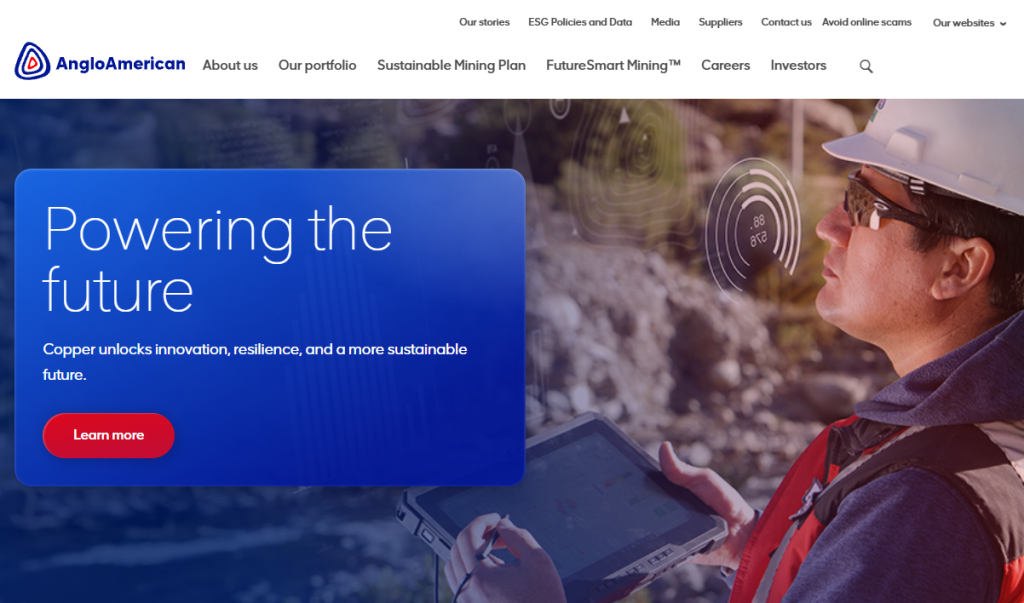
Anglo American is a leading global mining company producing essential metals and minerals that support modern life and the energy transition. Its portfolio includes copper, iron ore, nickel, steelmaking coal, polyhalite, and diamonds, all delivered through world-class operations with a focus on sustainability, innovation, and community impact.
| Feature | Details | 2025 Performance | Key Focus Area |
| Products | Copper iron ore nickel steelmaking coal polyhalite diamonds | N/A | Essential for modern infrastructure and sustainable technologies |
| Operations | Global presence | Multiple countries | Mining, processing, logistics |
| Innovation | FutureSmart Mining™ | Implementation across operations | Technology, digitalisation, sustainability |
| Sustainability | ESG initiatives | Decarbonisation, community programs | Energy transition, responsible mining |
| Financials | Annual results | Full Year 2025 results released Feb 2026 | Shareholder returns and long-term growth |
 | Minimum Deposit: $4 Regulated by: CySEC, ASIC, FSA, SVG Crypto: Yes |
Frequently Asked Questions
What products does Anglo American produce, and why are they important?
Anglo American produces copper, iron ore, nickel, steelmaking coal, polyhalite, and diamonds. These resources are vital for electric vehicles, renewable energy infrastructure, housing, transport networks, and industrial development, supporting the global shift to a cleaner and more sustainable future.
How does Anglo American innovate and promote sustainability?
Through FutureSmart Mining™, Anglo American integrates technology, digitalisation, and sustainability to improve efficiency and reduce environmental impact. The company focuses on decarbonisation, energy-efficient production, and community engagement, ensuring long-term value for shareholders and responsible resource development.
| Minimum Deposit: $4 Regulated by: CySEC, ASIC, FSA, SVG Crypto: Yes |
Pros and Cons
| ✓ Pros | ✕ Cons |
| Global mining leader with diversified product portfolio. | Commodity prices are subject to market volatility. |
| Produces metals critical for energy transition and infrastructure. | Large-scale mining projects require substantial capital. |
| Focus on innovation through FutureSmart Mining™. | Operations are affected by environmental and climate regulations. |
| Strong commitment to sustainability and community development. | Exposure to geopolitical risks in multiple countries. |
| Essential products for billions of consumers globally. | Operational complexity can affect efficiency and cost control. |
Our Insights
Anglo American combines operational excellence with a broad and diversified portfolio of metals and minerals. Investors gain exposure to essential commodities, a sustainable mining approach, and innovations like FutureSmart Mining™, making the company a global leader in responsible resource development and long-term value creation.
6. British American Tobacco (JSE: BTI)
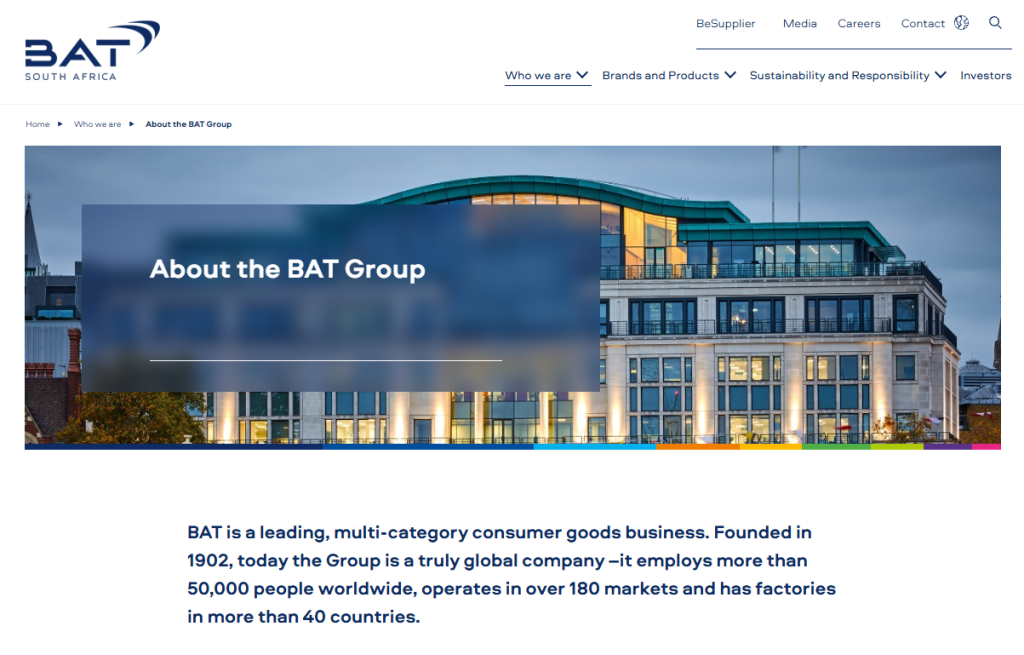
BAT (British American Tobacco) is a leading global consumer goods company, operating in over 180 markets with more than 50,000 employees. The Group focuses on adult consumer products, combining innovation, reduced-risk alternatives, and responsible practices to deliver growth while addressing health impacts.
| Feature | Details | Scope | Key Focus Area |
| Founded | 1902 | London, United Kingdom 🇬🇧 | Long-standing global presence |
| Employees | 50,000+ | 180+ markets | Workforce and operational scale |
| Operations | Factories | 40+ countries | Manufacturing and logistics |
| Regions | US, AME, APMEA | Global coverage | Balanced exposure to growth markets |
| Purpose | A Better Tomorrow™ | Adult consumer products | Reduced-risk innovation and health impact |
 | Minimum Deposit: $5 Regulated by: FSC Crypto: Yes (not available under CySEC (EU) or DFSA (MENA). |
Frequently Asked Questions
What products and regions does BAT operate in?
BAT’s business spans the United States 🇺🇸, Americas & Europe (AME), and Asia Pacific, Middle East & Africa (APMEA). It offers a range of adult consumer products, including combustible cigarettes and scientifically-substantiated reduced-risk alternatives such as Vuse, Velo, Grizzly, Kodiak, and Camel Snus.
How does BAT promote a “Better Tomorrow”?
BAT’s purpose is to reduce the health impact of its business. The company encourages adult consumers to switch completely to reduced-risk products, tracks its transformation progress, and ensures responsible marketing and regulatory compliance across all markets, including FDA oversight in the United States 🇺🇸.
| Minimum Deposit: $5 Regulated by: FSC Crypto: Yes (not available under CySEC (EU) or DFSA (MENA). |
Pros and Cons
| ✓ Pros | ✕ Cons |
| Global consumer goods leader with wide market reach. | Products remain addictive and carry health risks. |
| Balanced presence in both emerging and developed markets. | Regulatory compliance is complex and varies by country. |
| Focus on innovation and reduced-risk alternatives. | Transition to reduced-risk products may take time. |
| Strong workforce and operational infrastructure. | High competition in global tobacco and consumer goods markets. |
| Clear corporate purpose promoting health and sustainability. | Public scrutiny and health regulations can affect reputation. |
Our Insights
BAT Group combines global scale, a diversified product portfolio, and a clear health-focused purpose. Investors and stakeholders benefit from exposure to both emerging and developed markets, innovation in reduced-risk products, and a commitment to sustainable growth and responsible business practices.
7. Vodacom Group (JSE: VOD)
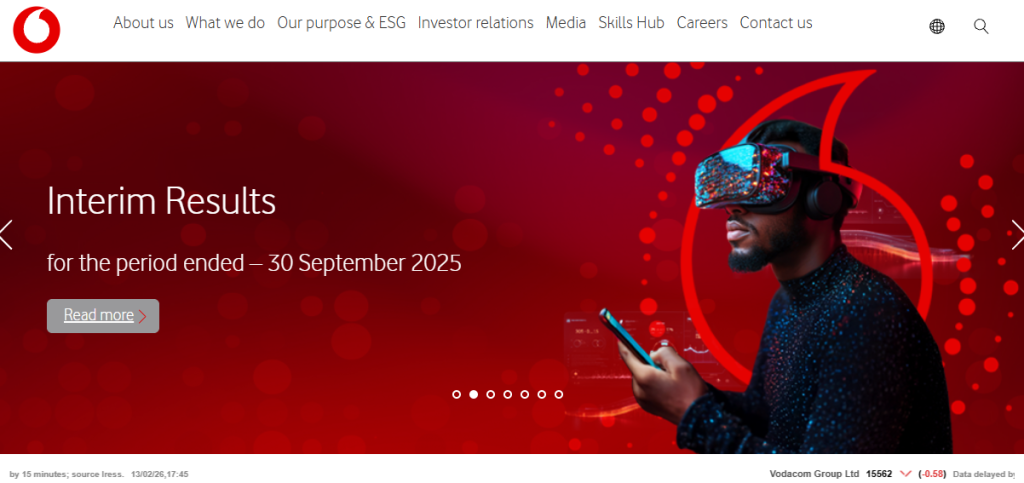
Vodacom is a purpose-driven African connectivity, digital, and financial services company serving over 200 million customers. With operations across South Africa, DRC, Egypt, Ethiopia, Kenya, Lesotho, Mozambique, and Tanzania, Vodacom leverages extensive mobile networks and Vodafone’s 65.1% majority ownership to drive growth and innovation.
| Feature | Details | Scope | Key Focus Area |
| Customers | 200+ million | Africa | Consumer and enterprise segments |
| Operations | Countries | 🇿🇦 South Africa 🇰🇪 Kenya 🇪🇬 Egypt 🇲🇿 Mozambique 🇹🇿 Tanzania 🇱🇸 Lesotho 🇪🇹 Ethiopia 🇨🇩 Democratic Republic of Congo | Network coverage and services |
| Population Reach | Mobile networks | 500+ million people | Connectivity and digital access |
| Ownership | Vodafone | 65.1% holding | Strategic and financial support |
| Services | Mobile, digital, financial | Africa-wide | Connectivity, digital solutions, fintech |
 | Minimum Deposit: $0 Regulated by: FSCA, FSA, FCA, FSC, CMA Crypto: Yes |
Frequently Asked Questions
What services does Vodacom provide and where?
Vodacom offers mobile connectivity, digital solutions, and financial services across Africa. Its networks reach over 500 million people in countries including 🇿🇦 South Africa, 🇰🇪 Kenya, 🇪🇬 Egypt, 🇲🇿 Mozambique, 🇹🇿 Tanzania, 🇱🇸 Lesotho, 🇪🇹 Ethiopia, and 🇨🇩 DRC, supporting both consumer and enterprise clients.
Who owns Vodacom, and how does this impact the business?
Vodacom is majority-owned (65.1%) by Vodafone 🇬🇧, one of the world’s largest communications companies. This ownership provides strategic support, global expertise, and financial stability while enabling Vodacom to expand its services, invest in network infrastructure, and offer innovative digital solutions across Africa.
| Minimum Deposit: $0 Regulated by: FSCA, FSA, FCA, FSC, CMA Crypto: Yes |
Pros and Cons
| ✓ Pros | ✕ Cons |
| Leading African connectivity and digital services provider. | Operations across multiple countries face regulatory complexities. |
| Extensive network coverage reaching over 500 million people. | Market competition from other telecom operators. |
| Strong corporate backing from Vodafone 🇬🇧. | Economic and currency fluctuations may affect performance. |
| Offers both consumer and enterprise solutions. | Infrastructure expansion requires significant capital investment. |
| Strategically positioned for growth in African digital and financial services. | Political and operational risks in certain markets. |
Our Insights
Vodacom combines extensive African network coverage, digital innovation, and strong corporate backing from Vodafone. The company provides reliable connectivity and financial services to millions, driving technological inclusion and economic growth across the continent while maintaining a strategic and scalable business model.
8. Spear REIT (JSE: SPE)
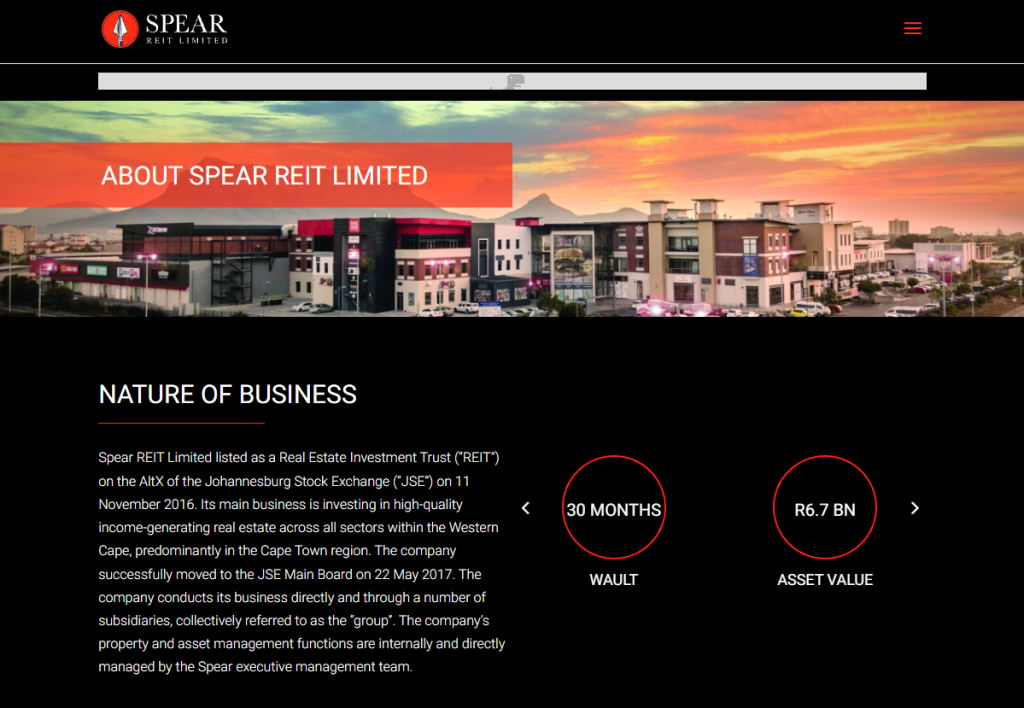
Spear REIT Limited operates as a regionally focused property investor with full internal management control. It targets stable rental income and long-term capital growth through hands-on asset and property management, maintaining high occupancy levels across a diversified Western Cape real estate portfolio.
| Feature | Details | Location | Key Focus Area |
| Listing | REIT on JSE Main Board | 🇿🇦 South Africa | Public property investment |
| Asset Value | R6.7 billion | 🇿🇦 Western Cape | Portfolio scale |
| Occupancy | 95.61 percent | 🇿🇦 Western Cape | Income stability |
| Properties | 42 assets | 🇿🇦 Cape Town region | Portfolio diversification |
| Gross Lettable Area | 627,134 m² | 🇿🇦 Western Cape | Rental capacity |
| WAULT | 30 months | 🇿🇦 South Africa | Lease duration strength |
 | Minimum Deposit: 20 USD (Cent) Regulated by: FSA, FSC, FSCA, CMA, ASIC Crypto: Yes |
Frequently Asked Questions
What type of properties does Spear REIT Limited invest in?
Spear REIT Limited invests in income-generating real estate across all major property sectors, including commercial, industrial, and retail assets. Its portfolio is concentrated in the Western Cape, particularly Cape Town, where demand fundamentals support stable occupancy and rental growth.
How does Spear manage its properties and assets?
Spear manages all property and asset functions internally through its executive team. This includes lease negotiations, tenant renewals, expense control, maintenance, and income forecasting, allowing direct oversight and faster decision-making to protect asset value and improve returns.
| Minimum Deposit: 20 USD (Cent) Regulated by: FSA, FSC, FSCA, CMA, ASIC Crypto: Yes |
Pros and Cons
| ✓ Pros | ✕ Cons |
| High occupancy across portfolio | Geographic concentration risk |
| Fully internal asset management | Limited exposure outside Western Cape |
| Strong focus on income generation | Sensitive to local economic cycles |
| Experienced property management team | Property sector interest rate exposure |
| Listed REIT transparency | Growth tied to regional demand |
Our Insights
Spear REIT Limited is a focused and internally managed South African REIT delivering consistent income from a high-quality Western Cape property portfolio. Its strong occupancy, disciplined management approach, and regional expertise position it as a stable option for income-focused property investors.
9. Capitec Bank (JSE: CPI)
Capitec Bank operates as a modern retail bank that prioritises simplicity, transparency, and affordability. Through digital innovation and an extensive branch network, it serves millions of South Africans while supporting economic progress, financial inclusion, and sustainable community development across the country.
| Feature | Details | Country | Key Focus Area |
| Established | 1 March 2001 | 🇿🇦 South Africa | Retail banking growth |
| JSE Listing | 18 February 2002 | 🇿🇦 South Africa | Public market presence |
| Active Clients | Over 24 million | 🇿🇦 South Africa | Financial inclusion |
| Branch Network | 880 branches | 🇿🇦 South Africa | Nationwide access |
| Employees | Over 16,900 | 🇿🇦 South Africa | Service delivery |
| Shareholders’ Funds | R50 billion | 🇿🇦 South Africa | Capital strength |
 | Minimum Deposit: $10 Regulated by: FSCA, FSC, FSA Crypto: Yes |
Frequently Asked Questions
What is Capitec Bank’s core purpose?
Capitec Bank aims to make a meaningful difference in people’s lives by building simple, effective banking solutions. Its purpose focuses on empowering clients to grow financially while contributing to 🇿🇦 South Africa’s economic progress through accessible and responsible banking services.
How is Capitec Bank regulated and structured?
Capitec Bank is registered with the 🇿🇦 South African Reserve Bank and listed on the Johannesburg Stock Exchange. It operates under strict regulatory oversight, supported by established auditors and global payment partners, ensuring financial stability, transparency, and customer protection.

| Minimum Deposit: $10 Regulated by: FSCA, FSC, FSA Crypto: Yes |
Pros and Cons
| ✓ Pros | ✕ Cons |
| Large and growing client base | Heavy exposure to domestic economy |
| Simple and transparent banking model | Competitive retail banking market |
| Strong capital and shareholder funds | Regulatory changes may impact costs |
| Extensive national branch footprint | Interest rate sensitivity |
| Focus on social impact and inclusion | Limited international operations |
Our Insights
Capitec Bank stands out as a fast-growing, well-regulated South African bank that combines simplicity with scale. Its strong client base, solid capital position, and focus on innovation and social impact make it a reliable choice for everyday banking and long-term confidence.
10. Shoprite Holdings (JSE: SHP)
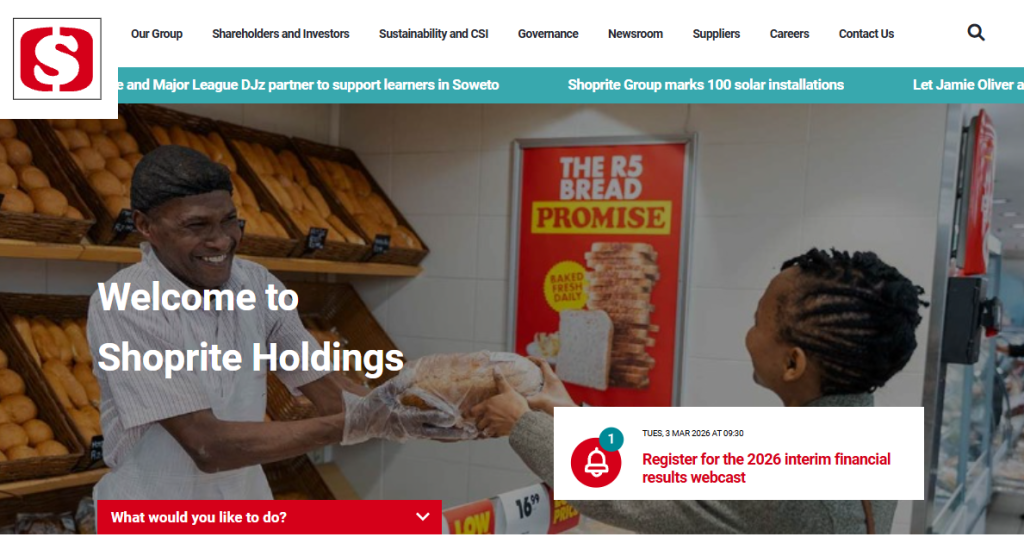
Shoprite Holdings leads African retail through unmatched scale, strong logistics, and a customer-first pricing strategy. The group combines extensive store coverage, digital innovation, and private-label growth to deliver affordable essentials while creating jobs and supporting local suppliers across multiple African markets.
| Feature | Details | Country | Key Focus Area |
| Founded | 1979 | 🇿🇦 South Africa | Food retail leadership |
| Total Stores | 3,478 including franchise | 🇿🇦 South Africa and African operations | Market reach |
| Employees | Almost 169,000 | 🇿🇦 South Africa and Africa | Job creation |
| Customers | 33.7 million loyalty users | 🇿🇦 South Africa | Customer retention |
| Sale of Merchandise | R252.7 billion FY25 | 🇿🇦 South Africa | Revenue growth |
| Trading Profit | R15.0 billion FY25 | 🇿🇦 South Africa | Profitability |
 | Minimum Deposit: $5 Regulated by: FSC, CySEC, ASIC Crypto: Yes |
Frequently Asked Questions
Where does Shoprite Holdings operate?
Shoprite Holdings operates primarily in 🇿🇦 South Africa and across eight African countries. Its footprint includes thousands of owned and franchised stores supported by distribution centres, enabling reliable access to food and household essentials for communities throughout the region.
What drives Shoprite’s continued growth?
Shoprite’s growth comes from scale efficiency, disciplined cost control, and strong private-label development. The group expands through new store openings, digital retail services, and loyalty programmes, while maintaining a low-price promise that attracts millions of repeat customers.
| Minimum Deposit: $5 Regulated by: FSC, CySEC, ASIC Crypto: Yes |
Pros and Cons
| ✓ Pros | ✕ Cons |
| Largest retailer in South Africa and Africa | High exposure to consumer spending cycles |
| Extensive store and distribution network | Thin margins typical of food retail |
| Strong private-label and brand portfolio | Rising logistics and energy costs |
| Consistent earnings and dividends | Currency risk in non-rand markets |
| Strong community and supplier focus | Competitive pricing pressure |
Our Insights
Shoprite Holdings remains a dominant African retail leader with resilient earnings, strong cash generation, and unmatched operational scale. Its commitment to affordability, job creation, and supplier development positions the group as a dependable long-term investment linked to African consumer growth.
10 JSE Shares that Pay Dividends Monthly – A Comparison
| Company | JSE Code | Sector | Core Focus | Primary Geography |
| Tharisa | THA | Mining | PGMs and chrome production with ESG focus | Global |
| Greencoat Renewables | GREEN | Renewable Energy | Cash-generative wind and solar assets | Europe |
| South32 | S32 | Mining | Diversified metals supporting energy transition | Global |
| JSE Limited | JSE | Financial Markets | Exchange services and capital markets | 🇿🇦 South Africa |
| Anglo American | AGL | Mining | Essential metals and FutureSmart Mining™ | Global |
| British American Tobacco | BTI | Consumer Goods | Adult consumer products and reduced risk alternatives | Global |
| Vodacom Group | VOD | Telecommunications | Mobile connectivity, digital and fintech services | Africa |
| Spear REIT | SPE | Real Estate | Income-focused commercial property portfolio | 🇿🇦 South Africa |
| Capitec Bank | CPI | Banking | Simple, affordable retail banking | 🇿🇦 South Africa |
| Shoprite Holdings | SHP | Retail | Large-scale food retail and logistics | Africa |
How to Buy JSE Shares Through a Regulated Forex Broker
Accessing Johannesburg Stock Exchange-listed shares via a regulated Forex broker is now more straightforward, especially for traders already active in Forex or CFD markets. Many international and South African brokers provide exposure to JSE companies through share CFDs.
Typically, you start by opening and verifying an account with a broker that offers JSE instruments. Once funded, the trading platform allows you to locate selected JSE-listed shares and place trades. Instead of buying the shares outright, you trade Contracts for Difference, meaning you gain exposure to price movements without owning the underlying asset.
This approach usually requires less starting capital and enables both buy and sell positions. Still, traders should carefully consider costs, leverage, and risk, as CFD trading operates differently from traditional share ownership.
Pros and Cons of Investing in JSE Shares
| ✓ Pros | ✕ Cons |
| Access to established, market-leading companies | Share prices can fluctuate significantly |
| Exposure to a wide range of economic sectors | Currency movements may affect returns |
| Potential to earn regular dividend income | Certain shares offer limited liquidity |
| Secure trading environment under clear regulation | Requires ongoing research and analysis |
In Conclusion
Dividend investing on the JSE is not only about yield but also about sustainability, earnings quality, and disciplined capital management. As dividend dates, payouts, and market conditions can change, investors should use an up-to-date guide as a forward-looking reference rather than a guarantee. With proper diversification, ongoing review, and a clear understanding of risks, JSE dividend shares can play a valuable role in generating income and building wealth in 2026 and beyond.
You might also like the Best Forex Brokers for JSE Shares Trading:
- AvaTrade Review
- MultiBank Group Review
- Octa Review
- Pepperstone Review
- FISG Review
- XM Review
- HFM Review
- PU Prime Review
- IUX Review
- FBS Review
Frequently Asked Questions
Do any JSE shares truly pay dividends every month?
Very few JSE shares pay monthly dividends. Most follow quarterly, interim, or annual payment schedules that together create regular income opportunities across different months.
Are dividend payments guaranteed?
No. Dividends depend on company earnings, cash flow, and board approval, and can be reduced, delayed, or cancelled.
Why do dividend dates change?
Dividend dates may shift due to changes in company results, reporting timelines, or strategic decisions by management.
Is dividend investing suitable for beginners?
Yes, but beginners should understand dividend cycles, risks, and the importance of diversification rather than relying on a single stock.
Can I earn dividends when trading share CFDs?
Some CFD brokers adjust accounts for dividends, but this differs from owning shares directly and varies by broker.
Are JSE dividends paid in rand?
Most JSE dividends are paid in South African rand, although some globally listed companies may declare dividends in foreign currencies.
Do high dividends mean a stock is low risk?
No. High dividends can signal strength, but they may also reflect higher risk or limited growth prospects.
What sectors on the JSE are known for dividends?
Banks, mining companies, REITs, telecoms, and large retailers are traditionally strong dividend-paying sectors.
How often should I review dividend shares?
Investors should review dividend shares at least annually or after major earnings announcements.
Is diversification important for dividend investing?
Yes. Spreading investments across sectors and companies helps reduce income risk and smooth dividends
Sidebar rates


