Ethereum Defends $2,900 Support: Institutional Giants Accumulate as Rare “Net Taker” Buy Signal Emerges
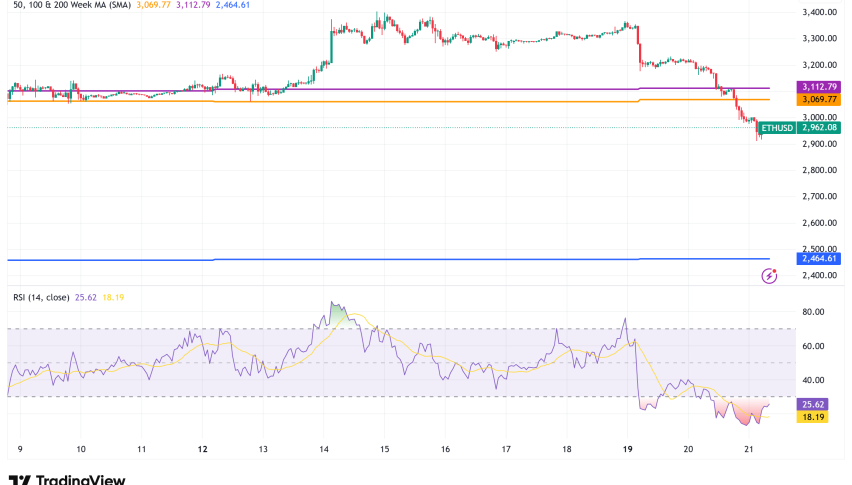
Ethereum (ETH) is trading at about $2,900, down more than 7% in the last 24 hours. This is because of geopolitical tensions that have made
Quick overview
- Ethereum is currently trading at approximately $2,900, down over 7% in the last 24 hours due to geopolitical tensions affecting investor risk appetite.
- For the first time since January 2023, Ethereum's net taker volume has turned positive, indicating a potential trend reversal despite short-term selling pressure.
- Institutional adoption of Ethereum is accelerating, with 35 major firms launching products on the blockchain, signaling strong long-term interest.
- Technically, Ethereum must maintain levels above $2,900 to avoid testing lower support zones, while a recovery above $3,000 could indicate market strength.
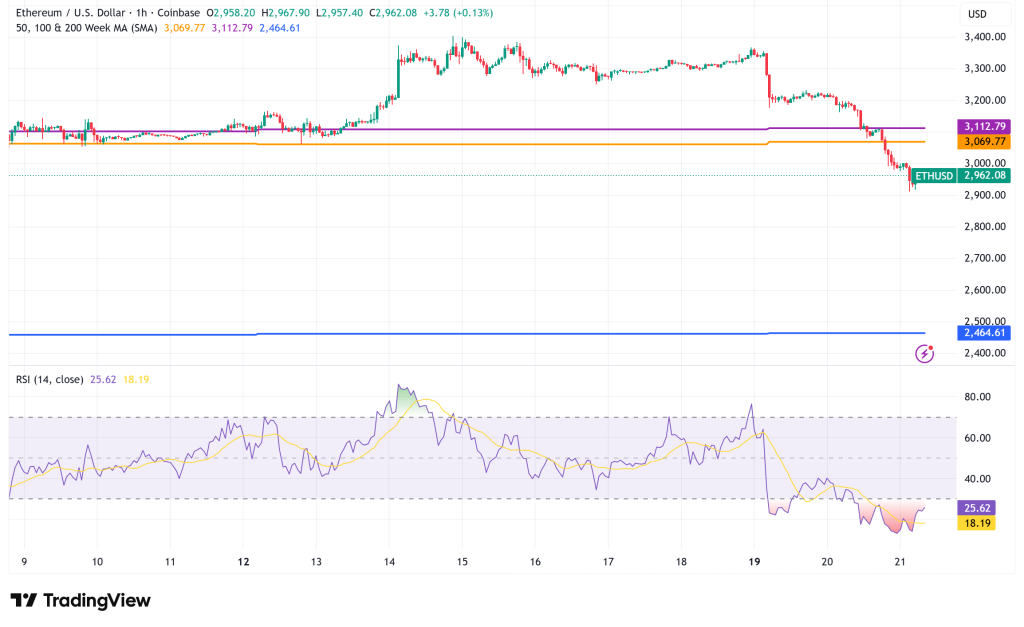
At the time of writing, Ethereum ETH/USD is trading at about $2,900, down more than 7% in the last 24 hours. This is because of geopolitical tensions that have made investors less willing to take risks in the larger market. ETH is now 39% lower than its all-time high of $4,946 in August. However, behind the surface, a compelling story of institutional adoption and changing derivatives dynamics is unfolding that might change the story for the world’s second-largest cryptocurrency.
ETH Derivatives Data Reveals Historic Trend Reversal
Ethereum’s net taker volume has turned positive for the first time since January 2023, after almost three years of sell-side domination. Since January 6, there has been about $390 million in buy-side imbalance. This measure shows whether traders are actively purchasing at market prices or selling into bids. It is a critical sign of conviction among futures traders.
This change is really important. In the past, big positive changes in net taker volume have happened at bottoming ranges or early-stage uptrends, not at local tops. Since 2020, this statistic has usually stayed positive, showing that leveraged participants are getting ready for the trend to continue, often before the entire market can see that the trend is getting bigger.
But the picture is still complicated. The net taker volume shows that people are getting back into the market, but the cumulative volume delta (CVD) stayed negative at -3,676 ETH on Monday, which means there is short-term selling pressure. Even though these two things are different, the 30-day correlation between price and CVD is still close to 0.62. This means that underlying liquidity still supports price behavior to some extent. This suggests that we are in a correction period where short-term traders take their profits and larger traders slowly move their positions, keeping ETH constant above the important $3,000 level.
Institutional Tsunami: 35 Major Firms Building on Ethereum
The price action shows that there is uncertainty in the short term, but the story of institutional adoption has never been stronger. In the last few months, 35 of the world’s biggest IT and financial companies, such as BlackRock, JPMorgan, Fidelity, and Societe Generale, have released new products and services that are built directly on the Ethereum blockchain.
This wave includes tokenized equities, money market funds, stablecoins, and bank deposits. It shows that real-world asset (RWA) tokenization is moving very quickly. Kraken launched xStocks on the network for fully backed U.S. stocks, while Ondo Finance developed a platform with more than 100 tokenized U.S. stocks and ETFs. Fidelity launched its tokenized money market fund FDIT on Ethereum, and JPMorgan migrated its JPM Coin deposit token to Base, an Ethereum Layer 2. Then, the bank launched its first tokenized money market fund with $100 million in seed money.
Payment companies also joined the move. Stripe added USDC stablecoin subscriptions on Ethereum, SoFi became the first national retail bank in the U.S. to offer a stablecoin on a public blockchain, and Google announced an agent payments protocol that uses stablecoins on Ethereum.
This drive from institutions has come at the same time as Ethereum staking has gone beyond 30% of the total supply, with over 36.2 million ETH now tied up in staking contracts. Last week, BitMine Immersion Technologies added 35,268 ETH worth more than $108 million to its holdings. This brought its total to over 4.2 million ETH, which is almost 3.5% of Ethereum’s entire circulating supply, which is worth more than $12.8 billion. Tom Lee, the company’s chairman, has advocated for a “100x Ethereum supercycle.” He recently said that the long-term goal is $250,000 per ETH.
ETH/USD Technical Analysis: Critical Support Zone Under Pressure
From a technical point of view, ETH has gone back to its five-month point of control, which is between $3,050 and $3,140. The stock fell below the $3,000 psychological support level and its 50-day exponential moving average at $3,202, which sped up the recent drop. The breach verified a bearish structure on daily charts, and the Relative Strength Index at 37.83 showed that the market was oversold but not yet showing any signs of a positive divergence.
As long as daily closes stay above $3,000, the larger uptrend is still technically valid. However, if the price stays below this level for a long time, it would mean that the market structure has changed to a bearish one. Data suggests that there are about $540 million in net long positions centered around $3,100 and another $500 million in liquidity below $3,000. This means that ETH may keep moving around in this region as liquidity rebalances.
The next important support level is the 200-week exponential moving average, which is around $2,716. If this level breaks, it could go down to $2,500. In the last 24 hours, more than $500 million in crypto derivatives were sold off, including $200 million from ETH long bets. This created a feedback loop that made selling pressure worse as margin calls drove concentrated liquidations near $2,950.
Ethereum Price Outlook: Macro Headwinds vs. Structural Tailwinds
Ethereum’s price right now is facing a lot of macro headwinds. President Trump’s warnings of tariffs on European Union countries and the U.K., as well as the possibility of 200% duties on French wines, have raised fears of a trade war and made investors less willing to take risks across the board. Japan’s bond yields have reached record highs, and investors are moving their money into safe-haven assets like gold. This has shown that Ethereum has a 0.82 correlation with traditional risk assets, which has caused people to leave crypto.
But the fact that net taker volume is positive for the first time in three years, institutional adoption is speeding up from big global banks, and on-chain activity is increasing all point to a major change in Ethereum’s place in the larger financial ecosystem. The difference between short-term technical weakness and long-term structural strength makes things complicated, and it looks like smart investors are slowly building up their positions despite big price swings.
In the short term, it will be important for ETH to stay above $2,900 as trade talks between the U.S. and Europe continue. If the price goes back up to the $3,000 level and the 50-day EMA, it would show that the market is getting stronger again. This could lead to a test of the $3,140 resistance. On the other hand, if the current levels don’t hold, the $2,716-$2,500 support zone could be tested again.
- Check out our free forex signals
- Follow the top economic events on FX Leaders economic calendar
- Trade better, discover more Forex Trading Strategies
- Open a FREE Trading Account
- Read our latest reviews on: Avatrade, Exness, HFM and XM

Related Articles



Sidebar rates

Related Posts
 Save
Save