Bitcoin Clings to $70K as Sell-Side Pressure Mounts: Hayes Warns of Sub-$60K Crash If Fed Holds Tight
With a 1.2% increase over the last day, Bitcoin (BTC) is currently negotiating one of its most perilous technical setups of the year, hover
Quick overview
- Bitcoin has seen a 1.2% increase but is facing significant resistance around the $70,000 level due to macroeconomic factors and order-book data.
- Arthur Hayes, co-founder of BitMEX, advises against investing in Bitcoin until the Federal Reserve signals a change in monetary policy.
- Order-book data shows a $1.57 billion sell wall above the current price, indicating a potential bearish trend similar to previous market reversals.
- Analysts predict three potential price scenarios for Bitcoin, ranging from a bullish case of $72,000 to a bearish case of $55,000, depending on market catalysts.
With a 1.2% increase over the last day, Bitcoin BTC/USD is currently negotiating one of its most perilous technical setups of the year, hovering just over the psychologically crucial $70,000 level. Bulls have been able to maintain the level for the time being, but a convergence of macroeconomic mood, order-book data, and on-chain measures indicates that the path of least resistance may soon move down until a significant catalyst appears to break through the dense supply wall that is now in place above.
Hayes Steps Back: ‘I Would Wait:’ No BTC Buys Until the Fed Prints
This week’s most notable signal may have come from one of Bitcoin’s most outspoken permabulls rather than a chart. Arthur Hayes, a co-founder of BitMEX, stated on the Coin Stories podcast that he would not invest a single dollar in Bitcoin at current levels. Hayes had maintained his $250,000 year-end price prediction as recently as October 2025.Would I invest $1 in Bitcoin now if I had the money? No. “I would wait,” Hayes stated, adding that his re-entry trigger would be unmistakable proof that the US Federal Reserve is starting to loosen monetary policy and increase its balance sheet. Hayes cautioned that a series of liquidations might bring Bitcoin below $60,000, a level it briefly hit on February 6 before partially recovering, given the ongoing US-Iranian conflict.
Hayes took pains to differentiate between the financial effects of geopolitical strife. “War is not good for Bitcoin — money printing is good for Bitcoin,” he stated. Hayes maintains his longer-term belief that Bitcoin will remain below $100,000 for a few years, but he seems happy to remain on the sidelines until the Fed makes a change.
$1.57B Sell Wall Looms: Order-Book Imbalance Mirrors January’s Bull Trap
An equally cautious picture is painted by the order-book data. Bitcoin ask orders have reached a two-month high, according to cryptocurrency trader Ardi, with $1.57 billion in sell-side liquidity stacked above the current spot price and only $1.125 billion in bids below. Sell orders exceed demand by almost 40% inside a 5% band around spot, resulting in a high supply ceiling that will take strong buying pressure to break through.
The last similar order-book scenario, according to Ardi, was in January 2026, shortly after Bitcoin momentarily surpassed $98,000 before abruptly reversing course. Following BTC’s latest surge above $72,000, which swiftly declined, a similar scenario emerged. It is consistent with traders considering rallies as departure opportunities rather than accumulation signals, as evidenced by the increased ask liquidity.
A partial offset is provided by the 30-day moving average of Bitcoin’s net taker volume, which stayed positive at $83 million in March, indicating that market-order purchasers are still active. This amount of demand, meanwhile, could not be enough to absorb the supply cluster that is resting above current pricing.
Short-Term Holders Trapped at $88,900: The $86K–$99K Cost-Basis Mountain
The bearish supply dynamics are further contextualized by on-chain research. The average acquisition cost of coins held for less than six months is known as the short-term holder (STH) realized price, and it is now close to $88,900. The $86,000–$99,000 band, which represents coins amassed between November 2025 and February 2026, is the greatest supply cluster on the network, according to Bitcoin expert Axel Adler Jr.
This indicates that a sizable group of recent purchasers are waiting on substantial unrealized losses at the current pricing. In the past, when the market gets closer to their cost basis, these holders turn into sellers, which creates structural resistance. The bright side, according to analyst Darkfost, is that realized losses are decreasing. Last week’s net profit-and-loss was minus $264 million, a significant improvement from the negative $2 billion weekly number noted during February’s decline below $60,000.
BTC/USD Technical Analysis: Bearish Trend Line at $69,250 Is the Immediate Gate to Watch
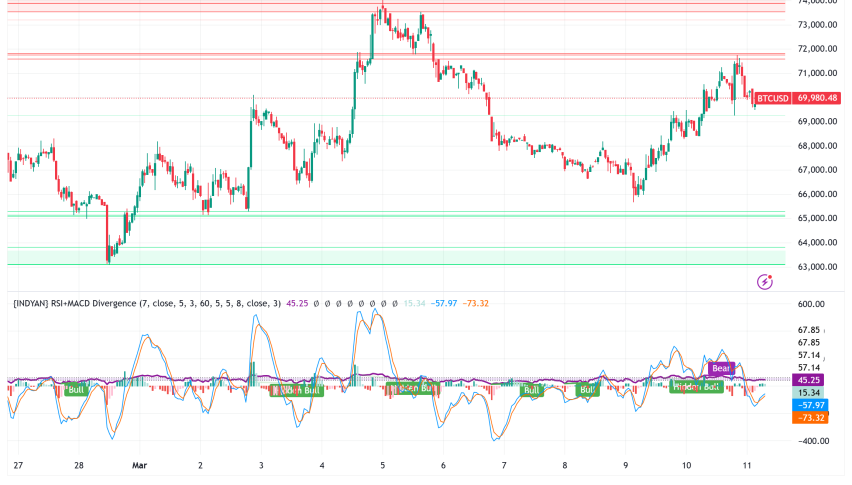
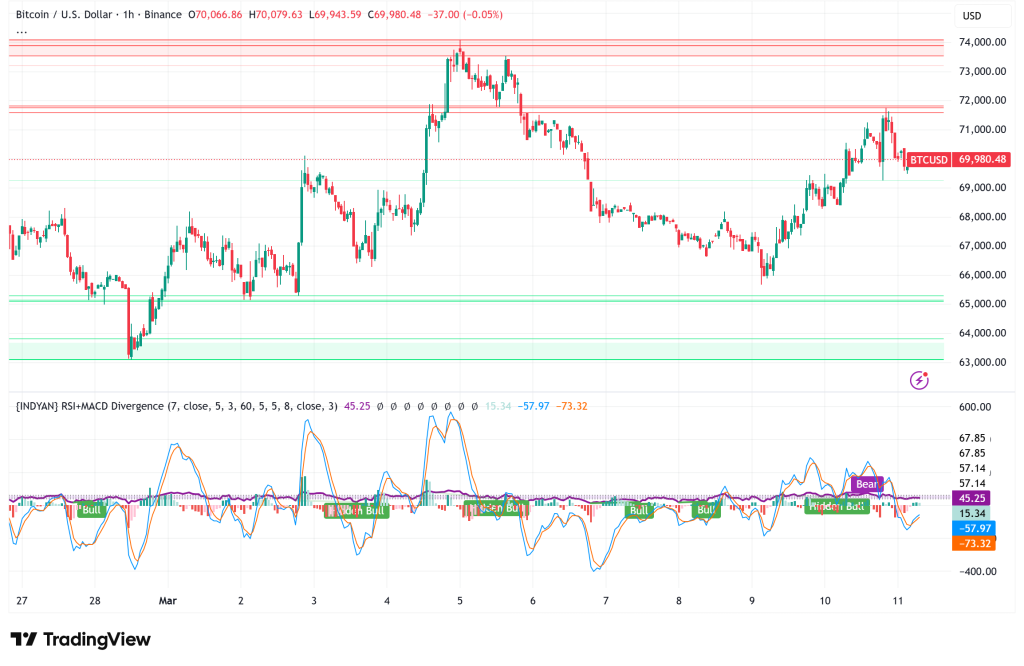
Early indications of a recovery from the $65,646 low hit earlier this week are seen on the hourly chart for BTC/USD. The price has recovered both the 23.6% Fibonacci retracement of the move from $74,062 to $65,646 and the 100-hour simple moving average. Both the RSI has returned above 50 and the hourly MACD is accelerating in bullish territory, both of which are positive near-term indicators.
But around $69,250, a crucial bearish trend line forms a near-term ceiling. A clear close over $69,600, which would coincide with the 50% Fibonacci retracement, would pave the way for $70,500, followed by $72,000 and possibly $72,650. On the other hand, if $68,500 is not maintained, Bitcoin may return to $67,500 and eventually $65,500, where the next major support is located.
Bitcoin Price Prediction: Three Scenarios as Key Support Gets Tested
In light of the confluence of macro uncertainty, on-chain supply pressure, and order-book stress, analysts have identified three likely directions for Bitcoin in the upcoming weeks:
Bull Case Price Range: $72,000 – $86,000
Catalyst: A decisive break above $69,600 combined with sustained positive net taker volume. This shift would likely draw in fresh demand, pushing the price toward the major Short-Term Holder (STH) cost-basis zone.
Base Case Price Range: $65,500 – $72,000
Catalyst: Bitcoin continues to oscillate within its established consolidation range. In this scenario, $70,000 serves as a critical pivot point as buyers and sellers remain roughly balanced amid market uncertainty.
Bear Case Price Range: $55,000 – $60,000
Catalyst: The Federal Reserve maintains high interest rates while geopolitical escalations trigger a broad equity sell-off. As warned by Arthur Hayes, this could spark cascading liquidations, forcing Bitcoin to break below the $60,000 support level.
- Check out our free forex signals
- Follow the top economic events on FX Leaders economic calendar
- Trade better, discover more Forex Trading Strategies
- Open a FREE Trading Account
- Read our latest reviews on: Avatrade, Exness, HFM and XM

Related Articles


Sidebar rates

Related Posts
 Save
Save
