Wall Street Ends Mixed After Iran Announces Protocol Plan for the Strait of Hormuz
From the White House, Trump said the United States would intensify operations against Iran in the coming weeks.

Quick overview
- Stocks finished mixed on Thursday, with the Dow slipping 0.1% and the Nasdaq rising 0.2%, following news of Iran drafting a maritime protocol with Oman.
- U.S. markets will be closed on Friday for Good Friday, leading to cautious trading as investors adjusted positions ahead of the long weekend.
- Oil prices saw a slight decline after the report, with Brent crude futures rising 7.35% to $108.60 per barrel.
- Global markets remain volatile, with Asian and European stocks closing sharply lower amid ongoing concerns over U.S.-Iran tensions.
Stocks pared earlier losses and finished the session mixed on Thursday after Iranian state media reported that Iran is drafting a protocol with Oman to manage maritime traffic through the strategic Strait of Hormuz. U.S. markets will remain closed on Friday for Good Friday.
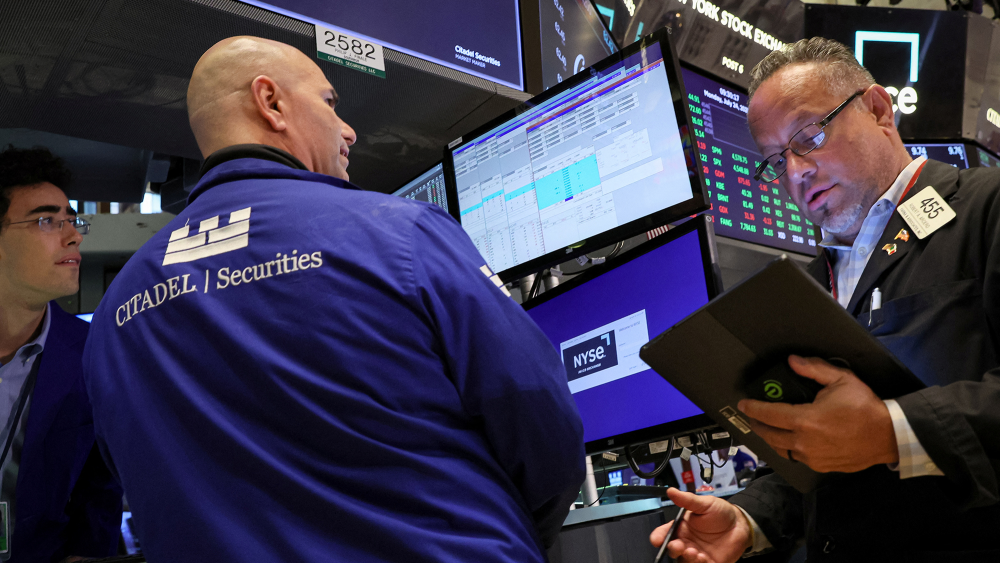
Major Wall Street indexes significantly reduced their losses after the news. Earlier in the session, equities had declined following comments from U.S. President Donald Trump indicating that military operations against Iran could escalate over the next two to three weeks.
By the close, the Dow Jones Industrial Average slipped 0.1% to 46,504.60 points, while the Nasdaq Composite rose 0.2% to 21,879.18. The S&P 500 edged up 0.1% to 6,582.70.
With markets closed Friday for the holiday, investors remained cautious throughout most of the session, adjusting positions ahead of the long weekend. The prospect of a maritime protocol, however, helped ease some uncertainty.
A protocol to ease tensions?
According to Islamic Republic News Agency, Iran is working with Oman to establish a protocol aimed at supervising maritime traffic through the Strait of Hormuz. The report cited Iranian Deputy Foreign Minister Kazem Gharibabadi.
The initiative would seek to facilitate safe passage and improve services for vessels transiting the route rather than impose restrictions, Gharibabadi said.
Oil prices trimmed part of their earlier gains following the report. Brent crude futures for June delivery rose 7.35% to $108.60 per barrel, while U.S. West Texas Intermediate futures climbed 11.35% to $111.48.
The future of the strait and the possibility of reopening it have been central concerns for investors this week, particularly after Trump’s address to the nation on Wednesday evening.
From the White House, Trump said the United States would intensify operations against Iran in the coming weeks and suggested Washington was close to achieving its objectives.
“We’re going to hit them hard in the next two or three weeks. We’re going to push them back to the Stone Age where they belong,” Trump said, adding that negotiations were still ongoing. He reiterated that weakening Iran’s nuclear capabilities remained a key objective and claimed that much of the country’s naval and missile strike capacity had already been destroyed.
Global markets remain volatile
Asian markets ended the session sharply lower, led by the Kospi (-4.5%) and Japan’s Nikkei 225 (-2.4%). European stocks followed the negative trend, with the Euro Stoxx 50 falling 0.6%, Germany’s DAX down 0.6%, France’s CAC 40 losing 0.2%, and Spain’s IBEX 35 slipping 0.14%.
Earlier in the week, optimism had been high following signals from Washington suggesting the United States was seeking a quick end to the war and that Iran’s new government had requested a ceasefire.
On Tuesday, the three major U.S. indexes recorded their best session since May 12 of last year, with the S&P 500 rising nearly 3% and the Nasdaq almost 4%. The rally, driven by investor optimism, helped offset part of March’s steep losses after a report by The Wall Street Journal suggested Trump had told advisers he was willing to withdraw from the conflict even if the Strait of Hormuz remained largely blocked.
Despite the rebound, markets still posted their worst monthly performance in a year amid persistent uncertainty surrounding the conflict.
- Check out our free forex signals
- Follow the top economic events on FX Leaders economic calendar
- Trade better, discover more Forex Trading Strategies
- Open a FREE Trading Account
- Read our latest reviews on: Avatrade, Exness, HFM and XM

Related Articles
Sidebar rates

Related Posts
 Save
Save