USOIL Crashes Below $100 as Trump’s Two-Week Ceasefire with Iran Triggers Massive War Premium Unwind – How Low Can It Go?
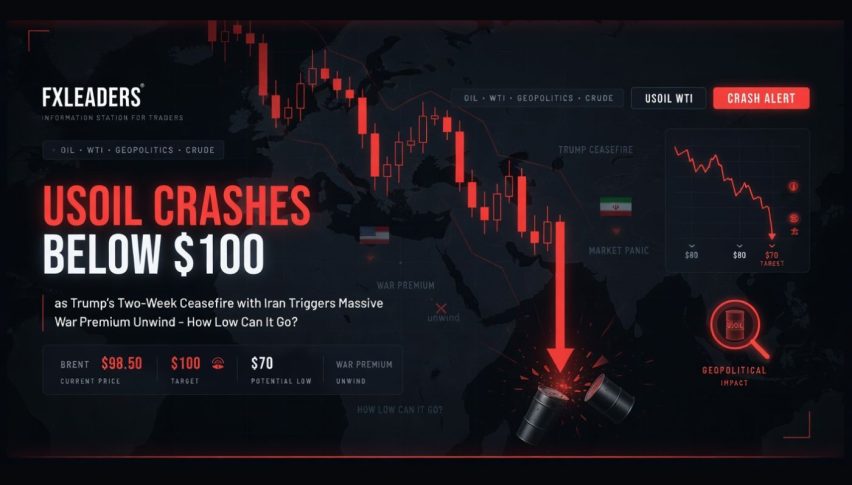
On April 8, 2026, USOIL saw one of its biggest single-day drops in years, falling 14% to 16%. WTI crude slipped below $100 per barrel...
Quick overview
- On April 8, 2026, USOIL experienced a significant drop of 14% to 16%, with WTI crude prices falling below $100 per barrel.
- The decline was triggered by President Trump's announcement of a conditional ceasefire with Iran, alleviating concerns over supply disruptions in the Strait of Hormuz.
- Despite the easing of geopolitical risks, volatility remains high, and oil prices could rebound if negotiations fail or oil flows do not normalize.
- Technical analysis indicates a bearish shift for USOIL, with key price levels to watch for potential support and resistance.
On April 8, 2026, USOIL saw one of its biggest single-day drops in years, falling 14% to 16%. WTI crude slipped below $100 per barrel, trading between $94 and $97, with lows near $93 to $94. Early Asian and follow-through sessions reported prices around $95.79, $96.49, and $95.68.
This sharp drop wiped out much of the recent geopolitical premium. Just a day earlier, WTI had climbed as high as $115 to $117 because of ongoing disruptions in the Strait of Hormuz.
Why did USOIL crash below $100 today?
President Trump announced a conditional two-week ceasefire with Iran, easing immediate concerns about long-term supply shocks in the Strait of Hormuz. This led to a quick drop in the war premium that had built up in recent weeks.
Ceasefire Announcement Removes Immediate Supply Shock Fears
Late on April 7, President Trump announced a conditional ceasefire, pausing US and Israeli military actions against Iran for two weeks. In return, Iran agreed to restore safe and full passage for tankers through the Strait of Hormuz, a key route that had been disrupted since early March and had blocked about 20% of global oil supply.
Iran’s Foreign Minister said Iran is willing to help coordinate safe transit. Pakistan is acting as an intermediary, and more talks may happen in Islamabad. Israel has also agreed to the pause.
The deal was reached just before Trump’s deadline for possible increased strikes on Iranian infrastructure. This move quickly unwound the war premium that had pushed prices from $67 to $73 in late February to over $112 to $115 recently.
Some tankers had started moving again in recent days, but full normalization of oil flows now depends on how the ceasefire is carried out over the next two weeks.
Stocks rallied as geopolitical risks eased, but oil prices dropped sharply as traders took profits from the earlier surge. Volatility is still high because the ceasefire is conditional. If talks break down or oil flows do not resume soon, prices could rebound quickly.
Technical Analysis: USOIL Shifts Bearish After Breaking Key Levels
On the four-hour chart, WTI has clearly broken below the rising trendline that supported the recent uptrend and has also dropped under the 50-period moving average near $104. The price is now below the 0.382 Fibonacci retracement at $98.17 and is moving toward the 0.5 level near $91.57.
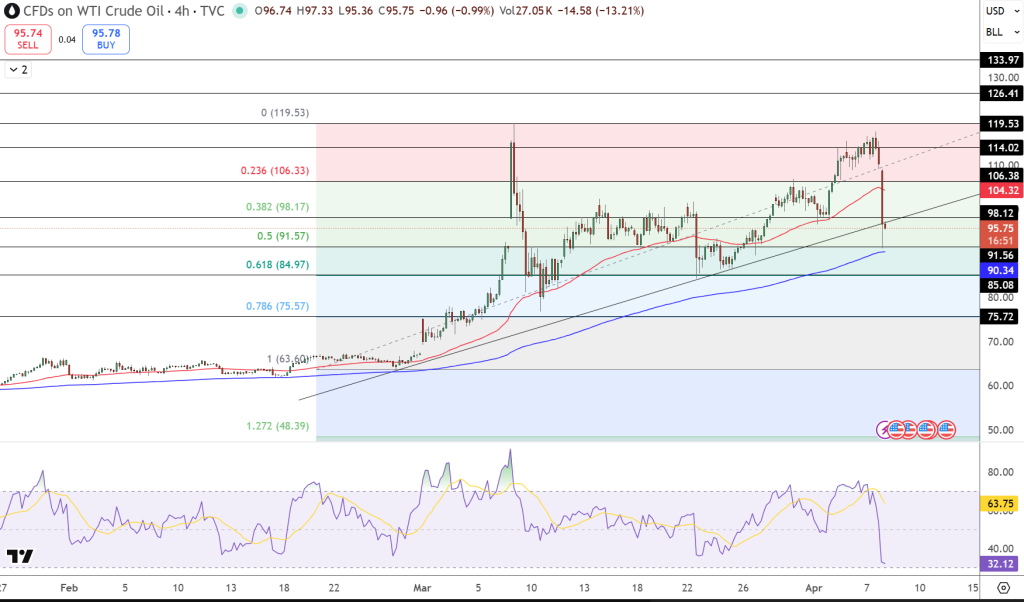
The strong downward candles show heavy selling, and the Relative Strength Index (RSI) has dropped to 32, which means the market is now in oversold territory.
Key USOIL / WTI Price Levels to Watch (April 8, 2026)
| Level Type | Price Level | Significance |
| Immediate Resistance | $98 – $104 | Broken trendline + 50-period MA |
| Key Support | $91.57 | 0.5 Fibonacci retracement |
| Deeper Support | $90.34 – $85.08 | 200-period MA + 0.618 Fibonacci |
| Bullish Reversal | Above $104 | Needed to shift short-term bias |
If prices stay below $91.57, the next targets are $90.34, which is close to the 200-period moving average, and possibly $85.08 at the 0.618 Fibonacci level. If there is a short-term bounce, resistance is now between $98 and $104, where the broken trendline could act as a ceiling.
Three Key Elements to Watch in the Coming Days
- Confirmation of actual tanker resumption through the Strait of Hormuz during the ceasefire window
- Progress in negotiations and any signals from talks potentially in Islamabad
- Broader macro reaction, including shifts in US dollar strength and equity market sentiment
Short-Term Bearish Bias with Lingering Uncertainty
In the short term, the ceasefire has eased the immediate supply fears that drove prices higher, but prices are still much higher than before the conflict. Analysts say that while the main war premium is gone, some risk remains if the two-week pause does not lead to a lasting solution.
For now, factors like US oil inventories and OPEC+ decisions are less important, as geopolitics continue to drive price movements.
- Check out our free forex signals
- Follow the top economic events on FX Leaders economic calendar
- Trade better, discover more Forex Trading Strategies
- Open a FREE Trading Account
- Read our latest reviews on: Avatrade, Exness, HFM and XM

Related Articles


Sidebar rates

Related Posts
 Save
SaveAva