Intel Stock Dips Under $40: Can INTC Uptrend Become Sustainable After Trump’s Chip Order?
Intel has returned to the forefront of investor attention as a result of its sudden transition from a large selloff to a strong rebound...
Quick overview
- Intel's stock has rebounded nearly 35% after a significant pullback, raising questions about the sustainability of its momentum.
- The company's recent partnership with Tata Electronics marks a strategic expansion of its global manufacturing capabilities.
- Macroeconomic shifts, including a dovish Federal Reserve, have positively influenced investor sentiment towards Intel.
- Speculation about a potential manufacturing partnership with Apple has further heightened investor enthusiasm for Intel's long-term prospects.
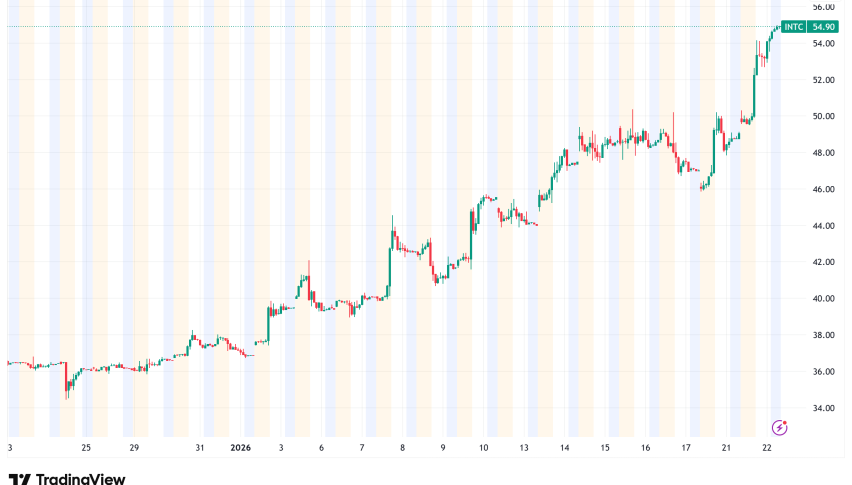
Live INTC Chart
[[INTC-graph]]
Intel has returned to the forefront of investor attention as a result of its sudden transition from a large selloff to a strong rebound, generating new concerns about the sustainability of its most recent momentum.
Intel’s Market Position Strengthens As Volatility Re-Shapes Sentiment
Intel’s performance over the past several weeks has become one of the most watched developments in the semiconductor space. After suffering a steep pullback in November that sent the stock under $33, the chipmaker staged a dramatic recovery, fueled by an improved macro backdrop, revived sector sentiment, and growing confidence in its multi-year restructuring strategy. The advance accelerated rapidly, lifting shares nearly 35% in just two weeks and propelling Intel back above major resistance areas that had held firm for months.
That surge briefly suggested the company was entering a sustained new phase of its comeback narrative. But as the rally reached the $44 region, upward momentum faded, and a swift drop of more than 7% erased part of the recent gains. The decline raised legitimate worries that Intel might once again slip into the pattern of short-lived rallies that defined much of its trading behavior over the past several years.
Yet, the latest rebound above $42 has shifted sentiment again, signaling that buyers remain firmly engaged and are treating weakness as an opportunity rather than a warning signal. Market participants appear convinced that Intel’s fundamental and strategic landscape has changed meaningfully compared with 2023 and early 2024, and that short-term volatility does not necessarily undermine the broader recovery arc.
Technical Landscape Signals Resilience Despite Major Hurdles
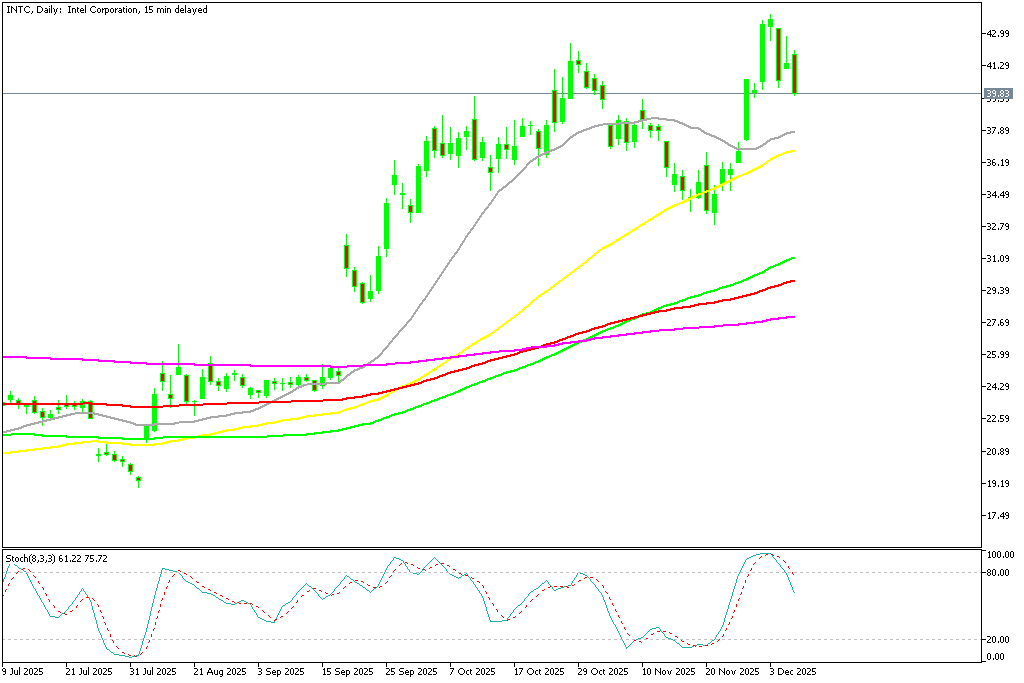
The technical structure supporting Intel’s recovery has been essential to maintaining bullish conviction. After reclaiming the mid-$30 range, the stock began establishing higher lows, attracting momentum traders who had stepped aside during the autumn pullback. The renewed push above $40 in late November triggered strong interest from both discretionary and systematic buyers, as that level represented a break above a series of lower-high resistance points dating back several quarters.
INTC Chart Daily – Slipping Below $40 Again
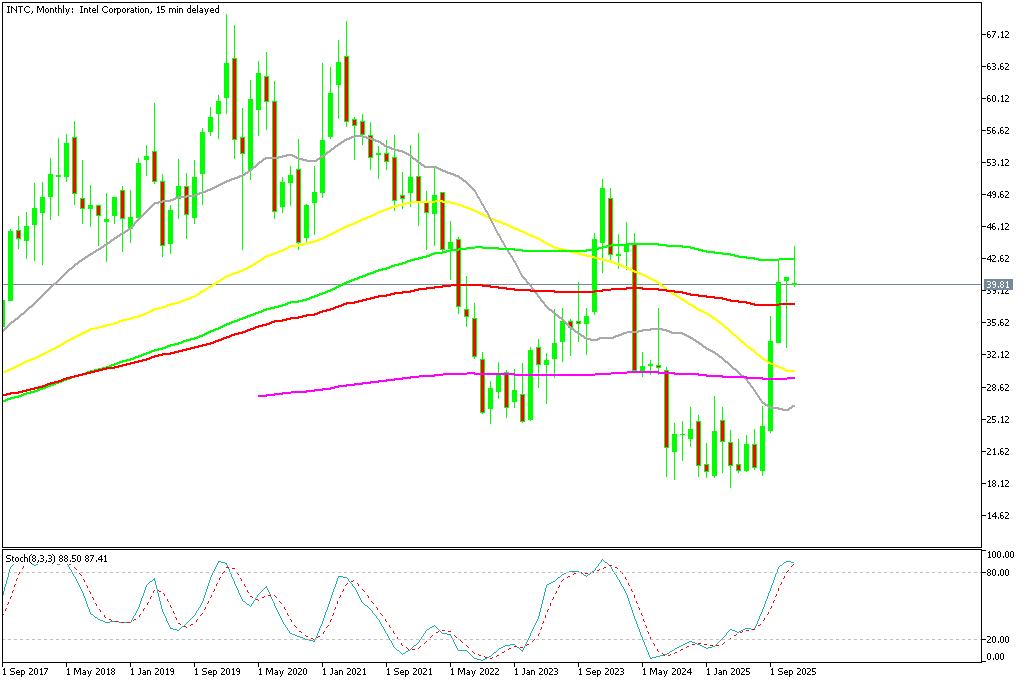
The key battleground now sits at the 100-month simple moving average (green). Attempts to decisively clear this long-term barrier energized bullish sentiment earlier last week, especially among traders anticipating a test of the 2024 highs above $51. However, the subsequent rejection—followed by Thursday’s pullback—suggests that Intel may need another consolidation phase before it can break through such a historically influential threshold.
INTC Chart Monthly – Buyers Couldn’t Hold the Price Above the 100 SMA
Even so, the structure remains constructive. INTC has slipped below $40 today, down more than 3% but as long as shares hold above the low-$436.50 support band at the 20 daily SMA holds, the broader formation continues to point toward eventual continuation higher. The technical picture now shows a market that is still vulnerable to quick collapses but instead is finding steady support from participants willing to accumulate during downswings.
India Partnership With Tata Electronics Expands Intel’s Global Manufacturing Footprint
A major strategic milestone emerged this month with the announcement that Tata Electronics will manufacture and assemble Intel-designed chips in India. This agreement solidifies Tata’s entrance into semiconductor fabrication and positions Intel as its first major public partner.
Production will take place at Tata’s Dholera fabrication plant, while advanced assembly and testing will be completed at its OSAT facility in Assam. The partnership highlights Intel’s ongoing efforts to diversify its global manufacturing ecosystem, reduce geopolitical concentration risks, and align itself with emerging chipmaking hubs outside East Asia.
Macro Environment Shifts From Constraint To Catalyst
Market dynamics at the macro level have played a critical role in shaping Intel’s recent fortunes. As the Federal Reserve’s tone turned increasingly dovish heading into year-end, investor expectations for earlier-than-anticipated rate cuts surged. This provided a notable tailwind for growth-sensitive industries that had been pressured during the tightening cycle.
Semiconductors, which often react sharply to shifts in global liquidity, responded immediately. Intel—still viewed as a central player in both national security and U.S. manufacturing strategy—benefited disproportionately. The company is now widely perceived as one of the key winners of the multi-year trend toward domestic chip production and supply chain diversification.
Intel’s third-quarter performance reinforced the improving outlook. Revenue rose 3% to $13.65 billion, handily beating estimates, while non-GAAP earnings hit $0.23 per share. Gross margins climbed to 40% thanks to operational efficiencies and improvements within Intel’s foundry model. The company’s Q4 guidance, projecting up to $13.8 billion in revenue, signals stability at a time when several competitors have issued more cautious forecasts.
Another major catalyst has been Nvidia’s $5 billion equity investment, acquired at $23.28 per share. Once the issuance finalizes, Nvidia will own roughly 4% of Intel—an extraordinary development that reshapes competitive dynamics. Beyond the capital, the partnership involves Intel designing custom data-center CPUs for Nvidia and integrating x86 SoCs with next-generation GPU chiplets, strengthening Intel’s position in AI-optimized hardware ecosystems.
Apple Foundry Speculation Adds A High-Impact Strategic Wildcard
One of the most influential drivers of investor enthusiasm has been the renewed speculation linking Apple to a future manufacturing partnership with Intel. Reports suggest that Apple may consider Intel’s 18AP node for an upcoming generation of its M-series processors—a potential game-changer for Intel’s foundry credibility. While discussions remain unconfirmed, the possibility alone has significantly altered how investors view the company’s long-term potential.
New Process Design Kits planned for early 2026 are widely expected to determine whether Apple’s engineering roadmap can align with Intel’s process capabilities. Should the partnership advance, production could begin in 2027, placing Intel among the world’s most elite fabrication providers.
Panther Lake Marks The Next Evolution In Intel’s Architectural Strategy
Internal innovation is also gaining pace. Early benchmark sightings of the Core Ultra 9 386H—part of the upcoming Panther Lake generation—suggest Intel is focusing on efficiency, thermals, and real-world performance rather than raw core expansion. This signals a strategic pivot aimed at reclaiming competitiveness in premium laptop and gaming markets, where performance-per-watt and integrated AI acceleration are becoming decisive factors.
If execution remains consistent, Panther Lake could represent the clearest sign yet that Intel’s multi-year architectural roadmap is regaining coherence, discipline, and forward momentum.
- Check out our free forex signals
- Follow the top economic events on FX Leaders economic calendar
- Trade better, discover more Forex Trading Strategies
- Open a FREE Trading Account
- Read our latest reviews on: Avatrade, Exness, HFM and XM



 Save
Save