Weak Comeback Attempt for AMD Stock on China Chips, Points Under $200 on Valuation Stress, Rivals Pressure
AMD's once-bright 2025 ascent has faded as the firm enters a deeper fall owing to shifting AI attitude, fierce competition, and...
Quick overview
- AMD's stock has experienced a significant decline, losing nearly 20% of its value in just a week due to shifting AI sentiment and increased competition.
- Despite reporting strong earnings with a 36% year-over-year revenue increase, AMD's performance fell short of heightened investor expectations, leading to a selloff.
- The company's partnership with OpenAI, once seen as a major advantage, has lost momentum amid concerns over revenue guarantees and competition from custom silicon designs.
- AMD's technical indicators show weakness, as it struggles to reclaim its 50-day moving average, signaling potential deeper structural issues.
Live AMD Chart
[[AMD-graph]]
AMD’s once-bright 2025 ascent has faded as the firm enters a deeper fall owing to shifting AI attitude, fierce competition, and technological opposition.
AMD’s Rally Fades As AI Expectations Reset
After a spectacular rise earlier in 2025, Advanced Micro Devices has entered a cooling phase that has surprised even long-time bulls. The enthusiasm that once pulled the stock into one of its strongest runs in years has given way to a harsher reality: investors are now reassessing the true durability of the AI boom. As expectations recalibrate across the semiconductor sector, AMD has become one of the more visibly affected names.
By late November, the decline accelerated sharply. A fresh 4% drop on Tuesday extended a downturn that had already erased nearly 20% of AMD’s value in just a week. While some technology stocks found firmer footing, AMD struggled to participate in the rebound, an indication that sentiment around the company has cooled far more aggressively than around its peers.
Momentum Unravels After A Record-Breaking Run
The turn in mood follows an extraordinary rally that pushed AMD deep into overextended territory. Fueled by AI euphoria, the stock’s valuation soared to levels that left no room for disappointment. As broader concerns emerged that the leading AI winners had surged too quickly, analysts began issuing cautious revisions across the sector.
AMD, with its premium valuation and lofty expectations, became a prime target for profit-taking. When the stock failed to maintain its technical breakout, traders wasted little time locking in gains, accelerating the reversal. What had been a vertical climb quickly morphed into a crowded exit.
Strong Results, But A Market That Wanted More
AMD’s latest earnings report was, on paper, impressive. The company posted:
- Revenue of $9.25 billion, rising 36% year over year
- Non-GAAP EPS of $1.20
- Forward guidance approaching $9.6 billion
Growth was broad-based, with meaningful contributions from data center products and the recovering PC segment. Under ordinary market conditions, such numbers might have fueled another leg higher.
But the broader environment is no longer ordinary. With expectations pushed to extremes, investors were looking for blockbuster upside catalysts—and AMD’s strong but measured delivery was not enough to justify the stretched valuation. The selloff that followed showed how quickly sentiment can turn when the market prices perfection into every result.
Navigating Export Controls And New Strategic Limits
Another dimension impacting AMD’s outlook is the company’s approach to U.S.–China export restrictions. CEO Lisa Su recently confirmed that AMD is authorized to ship certain MI308 AI chips to China under a licensing framework created by the Biden and Trump administrations. These exports, however, would carry a 15% fee payable to the U.S. government.
The structure itself has raised legal questions, with some scholars arguing it may resemble an export tax—something the Constitution prohibits. Nevertheless, AMD appears ready to comply, choosing regulatory certainty and limited market access over confrontation.
While this strategy helps keep a foothold in China, the revenue upside is modest, and uncertainty around future policy shifts continues to cloud the long-term picture for all U.S. chipmakers.
The OpenAI Partnership Loses Momentum
Earlier this year, one of the most celebrated catalysts for AMD was its deal with OpenAI, which included access to AMD’s Instinct accelerators and a 10% equity stake. Initially hailed as a breakthrough that could meaningfully alter the balance of power in AI hardware, the partnership now looks less transformative than hoped.
Analysts have begun citing concerns such as unclear volume guarantees, uncertain revenue timing, and heavy reliance on a narrow customer base. With hyperscalers increasingly designing custom silicon and competitors tightening their grip, the OpenAI relationship—once a key bullish driver—has lost its shine.
Technical Structure Turns Negative
The chart is telling a story of its own. AMD has fallen decisively below its 50-day moving average, a once-reliable support zone that has now turned into a ceiling. For two consecutive weeks, each attempt to reclaim that level has been rejected, and the stock closed red again today despite broader strength across major indices.
AMD Chart Daily – Buyers Unable to Overcome the 50 SMA
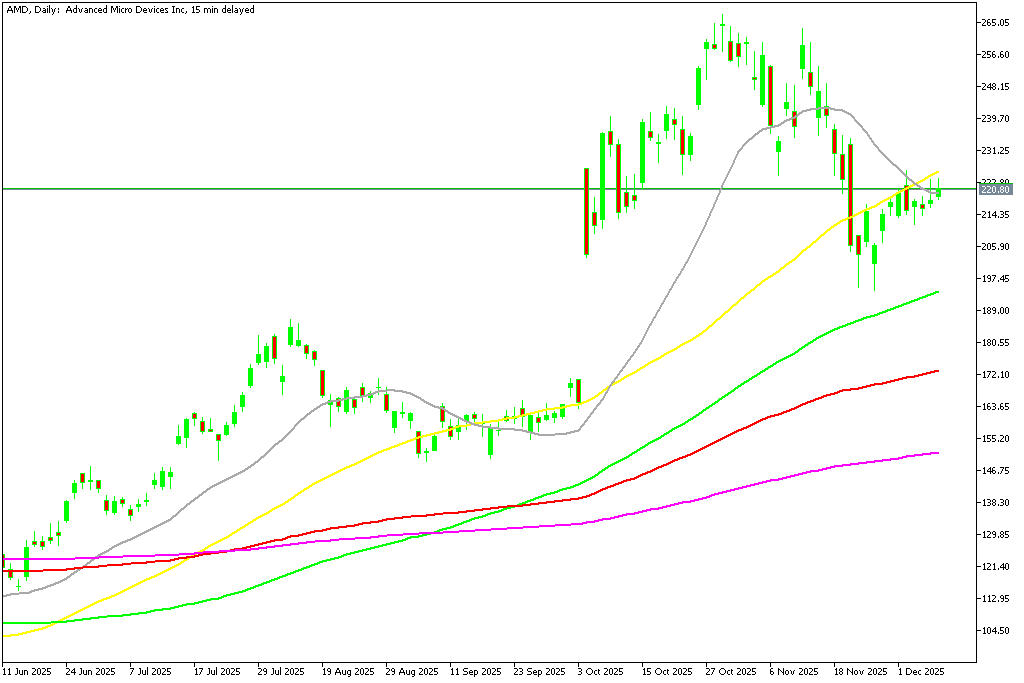
This type of relative weakness is often a cautionary sign. When a stock cannot rally in a supportive market, it typically signals deeper structural issues—and can fall faster once pressure returns.
Competitive Forces Intensify Across AI Hardware
Adding to AMD’s challenges is a rapidly evolving competitive landscape. Nvidia continues to dominate with its unrivaled ecosystem, while Intel has reemerged through renewed partnerships and aggressive investments. Recent collaboration between Nvidia and Intel has raised fresh questions about whether AMD risks being squeezed from both sides.
Meanwhile, Broadcom and other players are building advanced custom AI silicon tailored to enterprise and cloud operators, further fragmenting the market AMD hoped to penetrate more aggressively.
As competition escalates, AMD faces a widening strategic battlefield—one in which innovation alone may not be enough to maintain momentum.
- Check out our free forex signals
- Follow the top economic events on FX Leaders economic calendar
- Trade better, discover more Forex Trading Strategies
- Open a FREE Trading Account
- Read our latest reviews on: Avatrade, Exness, HFM and XM

Related Articles

Sidebar rates

Related Posts
 Save
Save