Oracle Stock ORCL Breaks Down as AI Data Center Spending Outpaces Cash Flow Reality
As Oracle's earnings fallout rekindled concerns about AI infrastructure costs, U.S. markets became wary, putting pressure on the Nasdaq.

Quick overview
- U.S. markets are experiencing caution as Oracle's earnings report raises concerns about AI infrastructure costs, impacting the Nasdaq more than the Dow.
- Investor anxiety is heightened due to Oracle's stalled funding for a major data center project and its rising debt burden amid aggressive AI spending.
- Oracle's financial struggles, including negative free cash flow and a significant drop in stock value, reflect a broader market shift towards demanding sustainable profitability.
- The market is becoming more selective, rewarding companies with strong balance sheets while penalizing those perceived as overextending in AI investments.
Live ORCL Chart
[[ORCL-graph]]
As Oracle’s earnings fallout rekindled concerns about AI infrastructure costs, U.S. markets became wary, putting pressure on the Nasdaq.
Oracle’s Earnings Fallout Spreads Unease Across Tech
Investor anxiety rippled through U.S. markets after Oracle’s latest earnings report reinforced concerns that its aggressive push into artificial intelligence and cloud infrastructure may be stretching the company’s finances faster than profits can keep up. Shares extended their decline on Wednesday as fresh headlines emerged around stalled funding for a major U.S. data center project, amplifying worries that the AI investment boom could be running ahead of sustainable cash generation.
The renewed weakness in Oracle weighed on broader technology sentiment, contributing to pressure on the Nasdaq even as the Dow Jones Industrial Average showed relative resilience. Markets are increasingly sensitive to signs that the cost of building AI infrastructure—data centers, power, and hardware—may be outpacing near-term returns.
Data Center Funding Troubles Raise Red Flags
According to reporting by the Financial Times, Oracle’s main financial backer declined to fund a planned $10 billion, one-gigawatt data center facility in Michigan. The hesitation reportedly stemmed from concerns over Oracle’s rising debt burden and the scale of its AI-related spending commitments. The news followed Oracle’s softer quarterly results and sent its shares lower once again, reinforcing a narrative of mounting financial strain.
The issue extends beyond Oracle alone. Bloomberg data show that major cloud players, including Oracle, Microsoft, and Meta, have collectively accumulated roughly $500 billion in future obligations tied to data center leases. These commitments are now drawing sharper scrutiny from investors wary of a potential AI bubble, as well as from U.S. lawmakers sensitive to voter backlash against rapid and energy-intensive AI expansion.
Markets React: Dow Holds, Nasdaq Feels the Pressure
The broader market response reflected a growing divergence. The Dow, with its heavier weighting toward industrials and defensive names, proved more insulated from the selloff. In contrast, the Nasdaq—dominated by technology and growth stocks—felt the impact more acutely as investors reassessed valuation premiums attached to AI-driven narratives.
Selling pressure was particularly evident in companies perceived as heavy spenders on AI infrastructure, where future profitability remains uncertain. The tone suggested a market shifting from enthusiasm to selectivity, rewarding balance-sheet strength and penalising aggressive capital deployment without clear cash-flow visibility.
Oracle’s AI Transition Comes Under Question
At the heart of the selloff lies Oracle’s increasingly expensive transformation. The company’s latest quarterly report revealed a troubling combination of softer-than-expected revenue and a sharp deterioration in free cash flow. While earnings exceeded expectations and margins remained stable, negative free cash flow ballooned to more than $13 billion, intensifying doubts about how Oracle plans to fund its AI ambitions.
Revenue rose 14% year over year to $16.05 billion, and net income nearly doubled to $6.1 billion. Cloud services and applications revenue jumped 34% to $8 billion, highlighting genuine demand. Yet investors appeared unwilling to overlook the cash-flow strain, particularly given Oracle’s valuation and growing debt load. The stock fell sharply after the report and has struggled to regain footing since.
From AI Darling to Market Skepticism
Earlier in the year, Oracle was briefly embraced as a rising AI infrastructure beneficiary. Optimism around potential mega-deals and expanded cloud partnerships helped propel the stock to record highs above $340. That enthusiasm has since faded dramatically. Since late September, Oracle has shed a substantial portion of its market value, with each rebound proving shallow and short-lived.
The reversal reflects a broader shift in market psychology. Investors are no longer content with long-term AI promises alone. Instead, they are demanding evidence of sustainable profitability, disciplined spending, and credible returns on capital—criteria Oracle is currently struggling to meet in the eyes of the market.
Debt and Expansion Intensify Investor Concerns
Oracle’s balance sheet has become a focal point of concern. The company raised $18 billion earlier in the year to support AI-focused data center expansion and is reportedly exploring additional financing that could run into tens of billions of dollars. These funds are tied to long-term infrastructure commitments that may not generate immediate returns.
While such investments could position Oracle as a serious AI infrastructure player over the long term, they also increase financial risk. Higher debt levels translate into rising interest costs and reduced flexibility, particularly if economic conditions tighten or if AI adoption progresses more slowly than anticipated.
Technical Weakness Reinforces the Bearish Tone
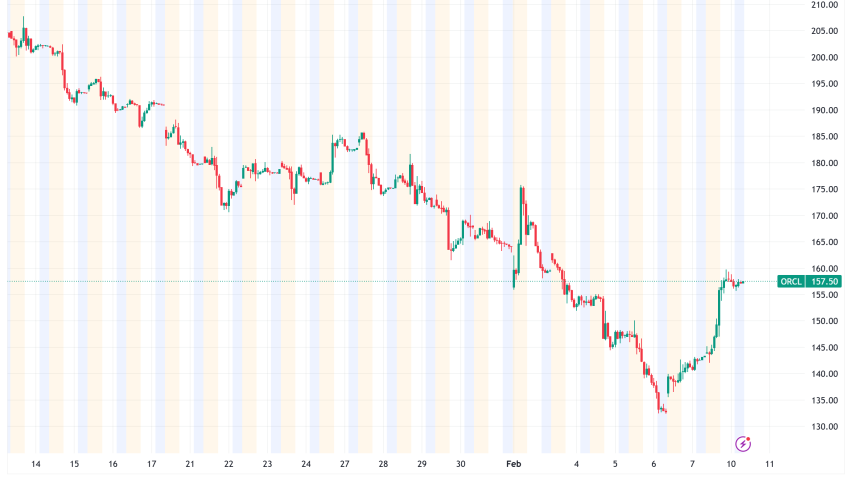
From a technical perspective, Oracle’s stock structure has deteriorated. Shares have fallen below key moving averages, and recent attempts at recovery have been rejected at resistance levels. The failure to reclaim important technical thresholds has reinforced bearish sentiment, with traders increasingly focused on lower support zones at $150 and the April low of $118.
ORCL Chart Monthly – The Breakdown Is Obvious After the Break of the 20 SMA

This technical fragility after the break of the 20 monthly SMA (gray) has compounded fundamental concerns, creating a feedback loop in which negative headlines accelerate selling pressure and undermine confidence in near-term stabilization.
AI Headlines Lose Their Power
One of the most notable shifts is how the market is responding to AI-related announcements. Deals, partnerships, and infrastructure expansions that once sparked rallies are now being met with indifference—or outright selling—unless accompanied by clear improvements in margins and cash flow. Investors are prioritising execution over ambition.
For Oracle, this means that continued AI investment alone is unlikely to revive sentiment. The company must demonstrate that its strategy can translate into sustainable financial performance without overburdening its balance sheet.
A Market Demanding Proof, Not Promises
The broader takeaway for U.S. markets is a growing insistence on discipline. The AI boom is far from over, but its next phase appears likely to be more selective and less forgiving. Companies that can pair innovation with financial resilience may continue to command premiums, while those perceived as overextended face increasing scrutiny.
Oracle’s struggles have become a cautionary tale, influencing sentiment across the Nasdaq and reinforcing a more measured tone on Wall Street—even as isolated bright spots like Micron remind investors that opportunity still exists within a rapidly evolving tech landscape.
- Check out our free forex signals
- Follow the top economic events on FX Leaders economic calendar
- Trade better, discover more Forex Trading Strategies
- Open a FREE Trading Account
- Read our latest reviews on: Avatrade, Exness, HFM and XM


 Save
Save