Ethereum Faces Short-Term Headwinds at $3,100 Despite Morgan Stanley ETF Filing and Network Upgrades
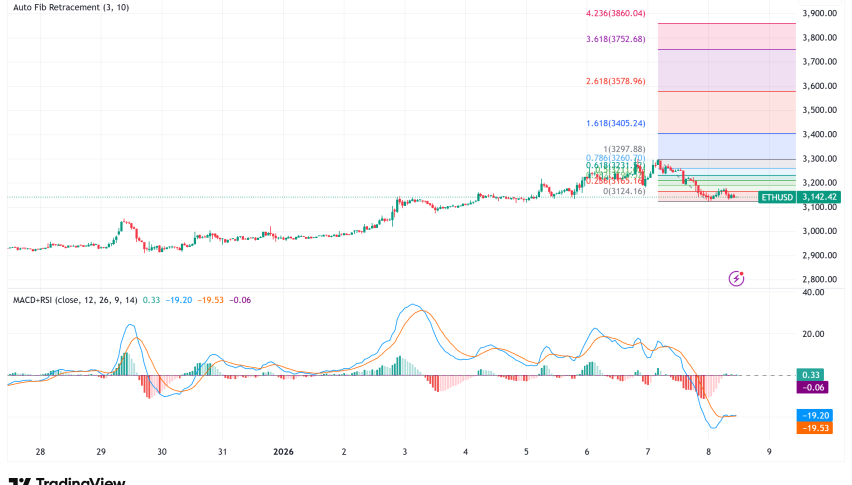
Ethereum is trading at $3,100, down 3.3% in the last 24 hours. This is because the second-largest cryptocurrency is getting contradictory
Quick overview
- Ethereum is currently trading at $3,100, down 3.3% in the last 24 hours due to mixed institutional signals and bearish technical indicators.
- Morgan Stanley has filed for an Ethereum Staking ETF, indicating growing institutional interest in Ethereum despite recent market volatility.
- Recent network upgrades aim to enhance Ethereum's scalability, while whale activity shows a mix of buying and selling among large investors.
- The short-term outlook for ETH remains cautious, with critical support at $3,032, but medium-term prospects could improve with potential ETF approvals and continued whale accumulation.
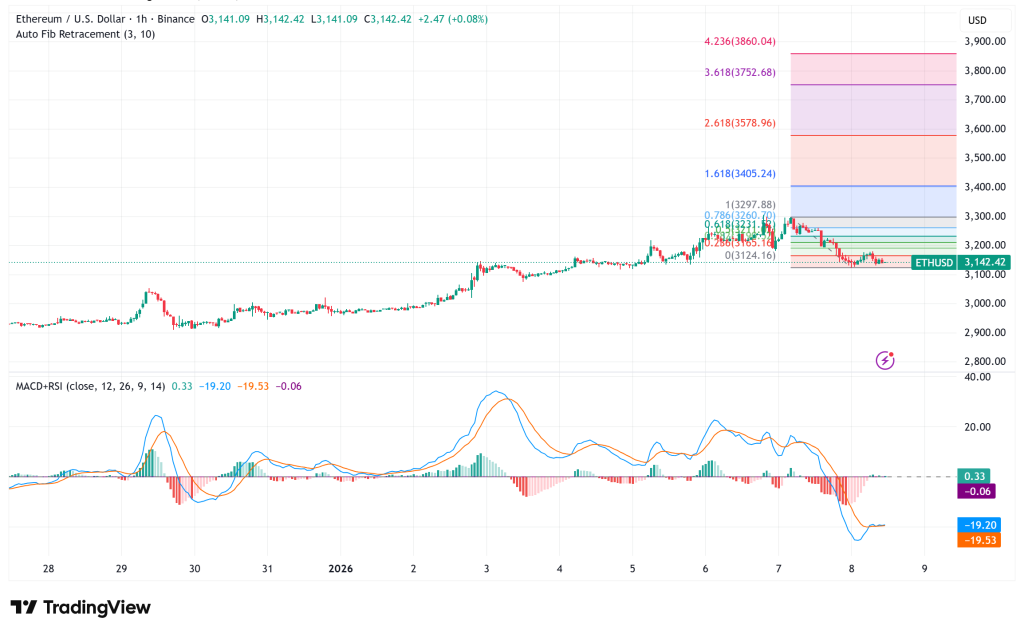
Ethereum ETH/USD is trading at $3,100, down 3.3% in the last 24 hours. This is because the second-largest cryptocurrency is getting contradictory signals from institutions and bearish technical signals. Even though the price is going down, fresh developments from big banks and enhancements to the network make the future look more complicated for ETH investors.
Morgan Stanley Expands Crypto Ambitions with Ethereum Staking ETF
On Tuesday, Morgan Stanley asked the SEC for permission to start the Morgan Stanley Ethereum Trust, a spot Ether ETF that will include staking services to help investors make more money. This is the third cryptocurrency ETF application the investment bank has filed this week, following similar applications for Bitcoin and Solana products.
The planned fund wants to acquire and hold spot Ether while keeping an eye on its price. One interesting thing about the fund is that it seeks to use third-party staking services to make passive income from some of its holdings. The ETF will be sponsored by Morgan Stanley Investment Management, although the original S-1 filing does not say who would be the custodians or the exchange.
This action shows that institutions are becoming more interested in Ethereum. For example, since October 2024, the bank has allowed financial advisers to offer crypto assets to clients with IRAs and 401(k) accounts. If it gets the go-ahead, the fund might help Ether’s demand at a time when existing spot ETFs have shown they can handle market swings.
ETH ETF Flows Tell Mixed Story as Institutional Appetite Wavers
On January 7, current spot Ethereum ETFs had $98.6 million in net outflows, snapping a three-day sequence of inflows. With $52 million in withdrawals, Grayscale’s ETHE led the way, which could mean that people are taking profits after ETH’s recent 10% weekly increase. James Seyffart, an analyst at Bloomberg, says that spot Ether ETFs have lost just $2.8 billion from their $15 billion top. This is only 18% of flows, even though Ether’s price has been hard to deal with since the market fall in October that cost $19 billion.
Whale activity, on the other hand, tells a different story. Over the previous week, large investors bought $4.83 million worth of spot Ether in 32 wallets, while smart money traders sold $8.9 million in 63 wallets. More importantly, new wallets made in the last 14 days contributed $2.34 billion in spot Ether tokens, showing that there is a lot of demand from new users.
BlackRock’s actions make the picture of institutions more complicated. The asset manager bought $149 million worth of ETH over three days, but at the same time, it sent 7,255 ETH ($22.8 million) to Coinbase. This raises questions about what they plan to do next.
Network Upgrades Position Ethereum for Scaling Future
Ethereum made its second blob parameter-only fork on Tuesday. This raised the blob target from 10 to 14 and the maximum blob limit from 15 to 21. This technical change increases the amount of data that can be stored in each block on the network. This is good for layer-2 rollups like Base, Arbitrum, and Optimism, as well as zero-knowledge solutions like zkSync Era and StarkNet.
The upgrade shows how Ethereum’s scaling strategy is changing: instead than big forks that cause problems, it wants to make small, predictable changes over time. On-chain data shows that blob usage is still considerably below capacity, even though rollup activity is going up. This suggests that Ethereum is scaling ahead of time to avoid congestion issues. This method fits with Vitalik Buterin’s goal of getting more bandwidth without losing decentralization.
ETH/USD Technical Analysis Points to Critical Support Test
Ethereum’s failure to break above the $3,200 resistance level (38.2% Fibonacci retracement) led to Tuesday’s selloff, which brought prices down below the 7-day simple moving average of $3,154. The MACD histogram is still positive at +36.12, which shows that the market is still moving up, but the RSI is at 59.5, which signals that the strength is fading.
The 61.8% Fibonacci level is where critical support is at $3,032. If the price drops below this level, it might speed up selling toward $2,920, which is the 78.6% Fibonacci level. On the other hand, if buyers get back in control, the 200-day exponential moving average at $3,368 is a major upside target.
The Fear & Greed Index fell to 43, which is neutral. This shows that people are less willing to take risks in the crypto markets after recent turbulence.
Ethereum Price Prediction: Cautious Optimism for Q1 2026
The short-term prognosis is still gloomy because ETH needs to protect the $3,032 support level. If it doesn’t hold, it might lead to liquidations and prices could drop to $2,920. But there are a number of reasons to have a positive attitude in the medium term:
- Sustained whale accumulation despite price weakness
- Morgan Stanley’s ETF filing could catalyze additional institutional demand upon approval
- Network upgrades demonstrate technical progression and scaling readiness
- New wallet creation indicating fresh capital inflows
In the base case, ETH will stay between $3,000 and $3,200 for the next two weeks before trying to break out again toward $3,446, which is the most recent swing high. If the $3,032 support level holds strong and more ETFs come in, ETH might rise to $3,500-$3,600 by the end of January. Bear case: If ETF outflows keep on, a drop below $3,000 might mean a retest of $2,800-$2,900.
- Check out our free forex signals
- Follow the top economic events on FX Leaders economic calendar
- Trade better, discover more Forex Trading Strategies
- Open a FREE Trading Account
- Read our latest reviews on: Avatrade, Exness, HFM and XM

Related Articles


Sidebar rates

Related Posts
 Save
Save
