Tesla Stock TSLA Rebound Points Above $500 as Autonomy Narrative Takes Center Stage
Tesla shares are rising after a temporary decline from record highs as investors' attention is drawn to the company's long-term AI-driven...
Quick overview
- Tesla shares are rebounding after a brief consolidation period, supported by renewed investor confidence in the company's long-term AI-driven growth.
- The Consumer Electronics Show has refocused attention on autonomous driving, reinforcing Tesla's competitive edge in real-world autonomous driving data.
- Investor expectations are shifting from vehicle deliveries to Tesla's advancements in AI and software, with a focus on the company's robotaxi ambitions.
- Recent legal clarity regarding Elon Musk's compensation has improved governance outlook, further supporting investor sentiment.
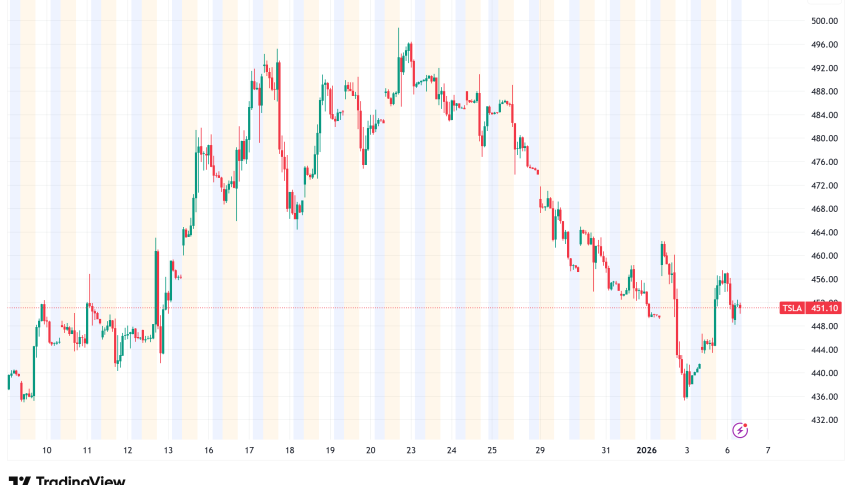
Live TSLA Chart
[[TSLA-graph]]
Tesla shares are rising after a temporary decline from record highs as investors’ attention is drawn to the company’s long-term AI-driven growth story by CES breakthroughs and a renewed emphasis on autonomy.
Tesla Shares Stabilize After Record Highs
Tesla entered the final weeks of 2025 riding strong momentum, reaching a new all-time high just below the $500 mark before experiencing a natural period of consolidation. Following a 25% pullback from the December peak of $498.80, shares found solid technical support near $424 and have since rebounded, closing the week at $445.11.
The recent price action reflects healthy profit-taking after a strong run rather than a deterioration in Tesla’s underlying investment case. As selling pressure eased, buyers returned, encouraged by renewed confidence in Tesla’s strategic direction and long-term technological advantages.
CES Refocuses Attention on Autonomy
The Consumer Electronics Show played a key role in redirecting market attention toward autonomous driving, a theme central to Tesla’s long-term valuation. While Tesla itself was not the loudest voice at the event, CES announcements from competitors and partners highlighted how central self-driving technology has become across the automotive industry.
Nvidia’s expanded push into automotive AI drew particular interest. The company unveiled a next-generation platform that will support a robotaxi alliance involving Lucid, Nuro, and Uber, underscoring the intensity of competition in the race toward autonomy. Mercedes-Benz also announced plans to launch a new city-capable driver-assistance system in the U.S. later this year.
Rather than diminishing Tesla’s position, these developments reinforced how far ahead the company remains in real-world autonomous driving data and system integration.
Autonomy Narrative Reasserts Itself
Tesla’s renewed emphasis on full autonomy has helped re-anchor investor expectations. After years of being valued largely through the lens of vehicle deliveries, the company is increasingly being seen as an AI and software platform with transportation as its first large-scale application.
This shift in perception supported Tesla’s climb to record highs in December and continues to underpin the stock’s resilience. Even during the recent pullback, long-term investors remained focused on Tesla’s progress in artificial intelligence, neural networks, and real-world deployment rather than near-term sales fluctuations.
Delivery Expectations Reset the Bar Lower
In the near term, attention remains on Tesla’s fourth-quarter delivery report, due in early January. Consensus forecasts suggest deliveries around 422,000 vehicles, down from nearly 496,000 a year earlier. The year-over-year comparison is distorted by an unusually strong third quarter in 2025, when buyers rushed to purchase EVs ahead of the expiration of U.S. federal tax incentives.
With those incentives now removed, demand naturally softened toward year-end. However, expectations have already been adjusted lower, reducing downside risk. Many analysts believe deliveries in the 415,000 range would be sufficient to keep investor sentiment stable, while any upside surprise could reignite momentum.
Importantly, vehicle deliveries are no longer viewed as the sole determinant of Tesla’s valuation.
Robotaxi Progress Moves Into Focus
The most closely watched developments are now tied to Tesla’s robotaxi ambitions. In Austin, Texas, Cybercab prototypes have been observed operating on public roads, marking an important step toward commercialization. These vehicles are testing Tesla’s vision-only Full Self-Driving system under real-world conditions, with temporary controls in place to satisfy regulatory requirements.
Market participants see progress in Austin as a meaningful validation phase. The next major milestone—removal of human safety monitors—would signal readiness for broader deployment. Elon Musk has suggested Tesla could expand robotaxi operations to eight to ten cities over the coming year, well ahead of full-scale production expected in 2026.
Real-World Performance Strengthens the Case
Recent real-world events have provided additional confidence in Tesla’s autonomy strategy. During a widespread power outage in San Francisco that disrupted traffic signals, some competing autonomous services reportedly struggled or temporarily halted operations.
Tesla vehicles, by contrast, continued functioning without major issues. Musk pointed to the episode as evidence of the robustness of Tesla’s camera-based system, which relies less on external infrastructure and pre-mapped environments. For investors, the incident reinforced the scalability and adaptability of Tesla’s approach to autonomy.
Technical Picture Remains Supportive
From a technical standpoint, Tesla’s chart structure continues to look constructive. After breaking above its prior 2024 high near $488, TSLA briefly approached the $500 level before consolidating. The 20-week simple moving average has acted as consistent support during pullbacks, helping stabilize price action.
TSLA Chart Weekly – The 20 Moving Average Provides Support Again

With selling pressure easing and momentum rebuilding, a renewed push toward the $500 level appears increasingly plausible. Several major brokerages have reiterated positive outlooks, with Wedbush maintaining a $600 price target driven by Tesla’s autonomy and AI roadmap rather than traditional auto metrics.
Legal Clarity Improves Governance Outlook
Investor sentiment also benefited from a key legal resolution late in 2025. The Delaware Supreme Court overturned a prior ruling that had invalidated Elon Musk’s 2018 compensation package, restoring his performance-based incentives.
The decision removed a lingering governance uncertainty and reinforced alignment between management incentives and long-term shareholder value. Markets welcomed the clarity, viewing it as supportive of continued strategic focus and execution.
Beyond Vehicles: AI and Robotics Expansion
Tesla’s ambitions extend well beyond cars. The company plans to scale robotaxi services while advancing Optimus V3, its next-generation humanoid robot, with a targeted rollout in 2026. These initiatives position Tesla at the crossroads of transportation, robotics, and artificial intelligence.
If successful, autonomy and robotics could unlock entirely new revenue streams and materially reshape Tesla’s earnings profile. While execution risks remain, the scope of opportunity continues to anchor Tesla’s premium valuation.
Bottom Line
Tesla’s recent pullback appears to have been a pause, not a reversal. As attention shifts away from short-term delivery fluctuations and back toward autonomy, AI, and robotics, the company’s long-term narrative is regaining momentum. With technical support holding and strategic milestones approaching, Tesla enters the new year with renewed confidence in its next phase of growth.
- Check out our free forex signals
- Follow the top economic events on FX Leaders economic calendar
- Trade better, discover more Forex Trading Strategies
- Open a FREE Trading Account
- Read our latest reviews on: Avatrade, Exness, HFM and XM


 Save
Save