GBP/USD Slips After CPI as Dovish BoE Meets Technical Resistance
The GBP/USD pair failed to hold early gains after US inflation data came in broadly in line with expectations, shifting attention...

Quick overview
- The GBP/USD pair struggled to maintain early gains after US inflation data aligned with expectations, highlighting central bank risks.
- US December CPI showed steady headline inflation at 2.7% year-on-year, while core CPI slowed, reinforcing expectations for future Federal Reserve policy easing.
- Concerns over Federal Reserve independence have pressured the dollar, but the lack of significant CPI surprises prevented aggressive selling.
- The Bank of England's dovish outlook continues to limit sterling's upside, with further rate cuts anticipated in 2026.
The GBP/USD pair failed to hold early gains after US inflation data came in broadly in line with expectations, shifting attention back to relative central bank risks and technical resistance. The pair briefly pushed toward the 1.3485 area before losing momentum, as softer UK fundamentals and lingering Federal Reserve uncertainty kept traders cautious.
US December CPI showed headline inflation steady at 2.7% year-on-year, matching forecasts, while core CPI slowed to 0.2% month-on-month, below the expected 0.3%. The data reinforced expectations that the Federal Reserve will eventually ease policy in 2026, but it did not deliver a decisive dovish shock. As a result, the US dollar stabilized after recent weakness rather than extending losses.
Fed Independence Fears Cap Dollar Relief
Earlier pressure on the dollar stemmed from renewed concerns over Federal Reserve independence after reports that the US Department of Justice threatened potential charges against Fed Chair Jerome Powell related to testimony on cost overruns tied to a $2.5 bn headquarters renovation. Powell described the probe as politically motivated pressure to force rate cuts, unsettling markets and weighing on the greenback.
However, with CPI failing to surprise meaningfully lower, traders avoided aggressively selling the dollar. Treasury yields remained mixed, and FX markets shifted back toward relative rate expectations rather than political headlines.
Dovish BoE Limits Sterling Upside
On the UK side, sterling remains constrained by the Bank of England’s dovish outlook. The BoE cut rates to 3.75% in December, citing easing inflation and softening labor conditions. Policymakers have signaled that further cuts are likely in 2026, with markets pricing the next move as early as March or April.
This policy divergence continues to limit GBP/USD rallies, especially against a US backdrop where rate cuts are expected but not yet imminent.
GBP/USD Technical Outlook: Sellers Regain Control
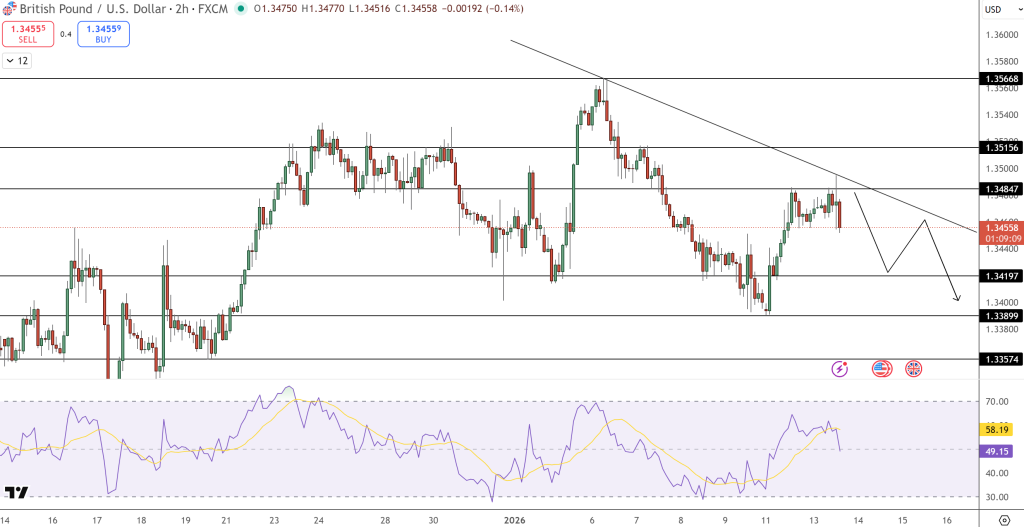
Technically, GBP/USD remains capped below a descending trendline from the 1.3565 peak. The pair is struggling to reclaim the 1.3485–1.3515 resistance zone, which has flipped from support into supply. Repeated failures in this area, marked by long upper wicks and small candle bodies, point to fading bullish momentum.
The RSI has rolled over toward the 50 level, signaling loss of upside momentum without bullish divergence. As long as price stays below trend resistance, risks remain skewed lower.
- Resistance: 1.3485–1.3515
- Support: 1.3420, then 1.3390
- Below 1.3390: opens 1.3357 and 1.3300
Trade idea:
Sell rallies near 1.3480–1.3500, targeting 1.3420, with extension toward 1.3360. A stop above 1.3520 protects against a trendline break.
- Check out our free forex signals
- Follow the top economic events on FX Leaders economic calendar
- Trade better, discover more Forex Trading Strategies
- Open a FREE Trading Account
- Read our latest reviews on: Avatrade, Exness, HFM and XM





 Save
Save