Bitcoin Struggles at $92K After Tariff-Driven Selloff Triggers $680M Derivatives Liquidation
Bitcoin dropped sharply by 2.53% to $92,574 in the last 24 hours. This is a turbulent time for the currency due to global shocks, huge
Quick overview
- Bitcoin dropped 2.53% to $92,574 amid global shocks and weak demand, losing about $4,000 after Trump's tariff announcement.
- The derivatives market faced significant liquidations, with over $680 million in long bets sold off in 24 hours, exacerbating the price decline.
- Bitcoin's technical indicators show a negative trend, with critical support levels being tested as traders await the Federal Reserve's interest rate decision.
- Despite the current volatility, some fundamental signals suggest potential stabilization, including increased institutional interest and reduced selling from long-term holders.
Bitcoin BTC/USD dropped sharply by 2.53% to $92,574 in the last 24 hours. This is a turbulent time for the currency due to global shocks, huge derivatives liquidations, and weak demand in the spot market. The top cryptocurrency lost about $4,000 in just two hours after President Trump said he would put high taxes on goods from the European Union. This shows that cryptocurrencies are still quite sensitive to changes in the economy.
Geopolitical Shock Triggers Risk-Off Sentiment
The declaration of 10–25% tariffs on EU goods by Trump, which would start on February 1, 2026, was the main reason for Bitcoin’s precipitous drop. The sudden change in policy sent shockwaves through the markets for risky assets, and traders quickly moved into traditional safe havens. As investors ran away from risky assets, gold prices shot up to a record high of $4,670. Bitcoin’s connection to gold also reached its highest level since October 2025, at +0.7.
This news shows a major problem that Bitcoin needs to solve in order to grow as an asset class. People hoped that the cryptocurrency would act as “digital gold” during times of uncertainty, but the tariff announcement showed that institutional investors still see BTC as a risky asset. If there is still economic uncertainty, the tariffs could make things worse for cryptocurrencies for a longer time.
Adding to the uncertainty, possible Supreme Court challenges to Trump’s tariff authority might lead to refunds of more than $100 billion, which would make the market even more unstable in the coming weeks.
BTC Derivatives Market Carnage Exposes Leverage Vulnerability
A huge derivatives unwind made the selloff much worse, with more than $680 million in long bets being sold off in just 24 hours. According to CoinDesk, the worst of the carnage happened in just one hour, when $514 million in leveraged bets were lost. Analysts at Glassnode said that the lack of liquidity in the futures market made the price drop worse, turning what could have been a little correction into a huge liquidation event.
This derivatives mess showed a major flaw in Bitcoin’s rapid rise to $96,000 earlier this week. The rise was mostly caused by leveraged speculation instead than natural demand. CryptoQuant statistics backed up this story by showing that U.S. spot ETF inflows stayed the same at about $126 billion, which wasn’t enough to make up for the selling pressure caused by the tariff news.
The average financing rate for Bitcoin futures has dropped to -0.0023%, which means that traders are now betting on more losses. If this negative feeling keeps up, it could mean that more corrections are on the way as positions that are too leveraged keep unwinding.
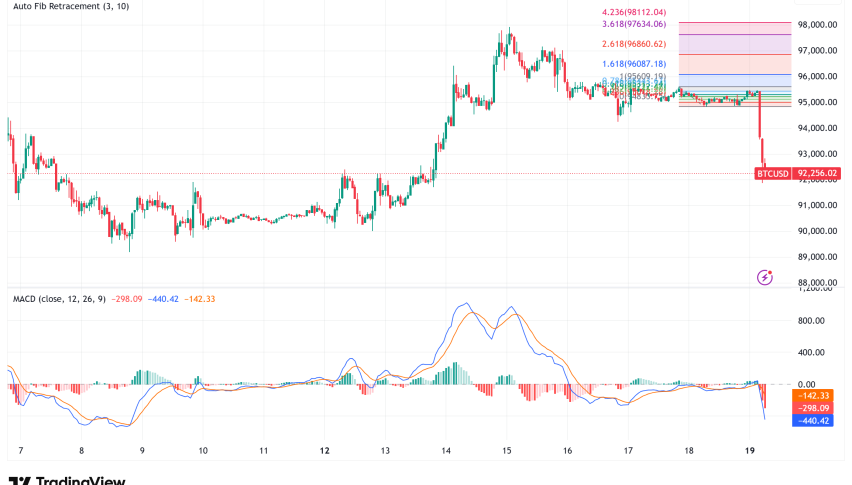
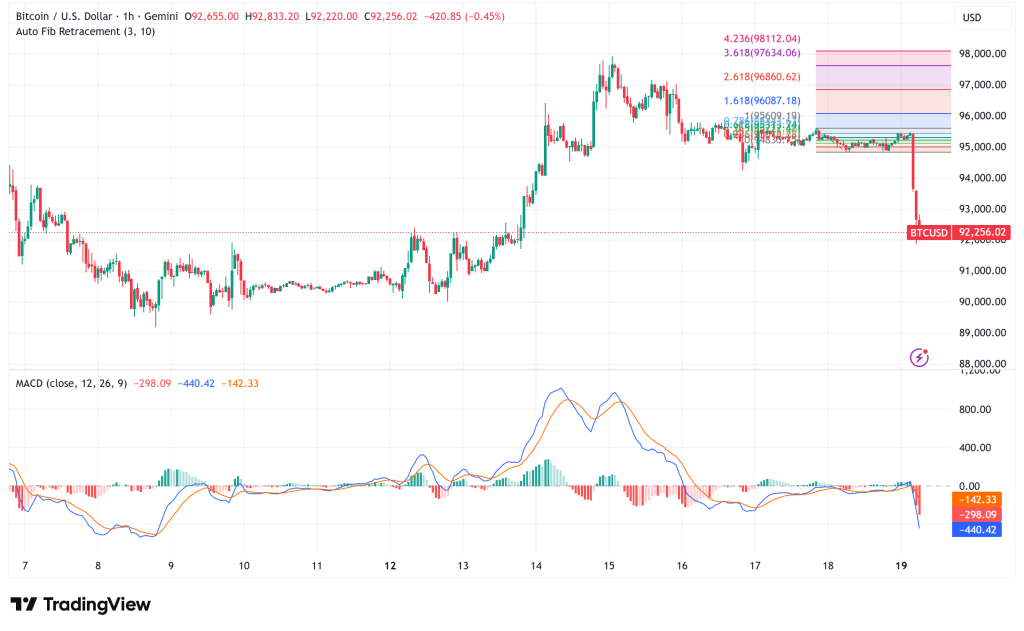
BTC/USD Technical Analysis: Key Levels to Watch
Bitcoin’s price movement has gotten a lot worse from a technical point of view. The cryptocurrency broke through its 30-day simple moving average at $90,645 and is currently trading well below its 200-day SMA of $105,820. This means that it is now in a negative trend on longer timeframes.
The fact that the important $93,000 support level (the 38.2% Fibonacci retracement) couldn’t be held has made traders look to the next important support zone at $88,800 (the 78.6% Fibonacci level). The MACD histogram has gone slightly positive to +337, but the Relative Strength Index is at a neutral 52, which means that the market is neither oversold nor overbought and could go down more.
To change the present negative mood, bulls need to make a sustained closing above $95,158, which is the 23.6% Fibonacci retracement line. If BTC doesn’t get back to this level, it might challenge its 365-day moving average at $101,000, but it would have to drop below the critical $91,000 barrier first.
Bitcoin’s Mixed Fundamental Signals
The immediate technical and futures picture seems negative, but several fundamental data imply that the selloff may be about to stabilize. The Crypto Fear & Greed Index is around 45 right now, which means that people are feeling neutral, which lowers the chance of full capitulation selling. Bitcoin’s market share has grown to 59.09%, which means that money isn’t yet moving into other cryptocurrencies. This is a common pattern during the early stages of bad market recoveries.
But these stabilizing factors are having trouble because of ongoing uncertainty in the economy as a whole. Traders are still unsure about the Federal Reserve’s monetary policy direction as inflation worries rise and geopolitical tensions rise. The Fed’s decision on interest rates on January 28 might be quite important.
Bitcoin Price Outlook: Testing Support Ahead of Fed Decision
Bitcoin’s ability to stay above its recent seven-day low of $92,284 will be very important in the short future. If prices stay below $91,000 for a long time, it might cause another wave of selling, which could push prices down to the $88,000–$90,000 support zone. On the other hand, if the price goes back up above $95,000, it would mean that purchasers are protecting the existing levels and could lead to a retest of the $100,000 threshold, which is very important to the mind.
There are a number of things that analysts say could help a rebound: According to CryptoQuant data, long-term holders are selling much less now. The 90-day average of spent outputs has dropped from 2,300 BTC to about 1,000 BTC. Spot Bitcoin ETFs also saw their biggest weekly inflows since early October, with $1.42 billion coming in. This shows that institutional interest is still high even though the market is volatile in the near term.
- Check out our free forex signals
- Follow the top economic events on FX Leaders economic calendar
- Trade better, discover more Forex Trading Strategies
- Open a FREE Trading Account
- Read our latest reviews on: Avatrade, Exness, HFM and XM

Related Articles


Sidebar rates

Related Posts
 Save
Save
