EUR/USD Price Forecast: Eyes 1.1760 as Tariff Fears Shake Dollar; US GPD Ahead
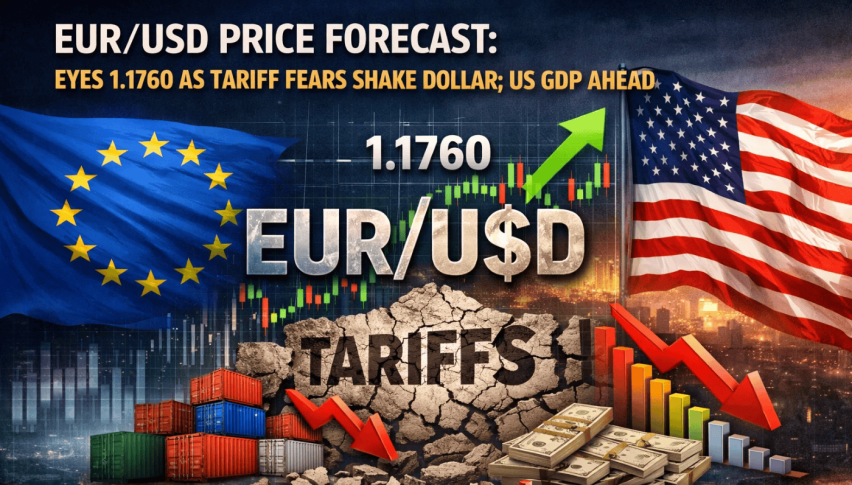
EUR/USD is currently trading near $1.1690, holding its recent gains after a sharp rebound from the $1.1575 low...
Quick overview
- EUR/USD is trading near $1.1690 after rebounding from a low of $1.1575, influenced by geopolitical tensions and investor positioning.
- The European Central Bank's positive messaging on inflation and monetary policy is boosting euro confidence amid trade uncertainties.
- US dollar strength is being pressured by tariff threats and policy uncertainty, leading to cautious trading behavior.
- Traders are closely watching the upcoming US GDP data, which could impact dollar strength and the EUR/USD outlook.
EUR/USD is currently trading near $1.1690, holding its recent gains after a sharp rebound from the $1.1575 low. That rebound reflects a mix of pretty complex geopolitics and positioning, with investors quietly cutting back their exposure to the US dollar at Davos, where President Donald Trump is set to speak. Renewed threats from Trump about tariffs on Europe, on top of unsettling talk about leaking private diplomatic messages, have spooked people about US-EU relations, prompting some to move cash into euros.
The markets are treating this more as a long-term shift in how people see the risks between the two countries than as a one-day knee-jerk reaction, which has helped keep the euro looking pretty solid as it hits $1.17. If you’re looking for a sign that investors are still feeling pretty uncertain about this whole trade thing, then the fact that the euro is staying afloat near this level is a pretty good one.
ECB Messaging Starts to Help Anchor Euro Confidence
Of course, it’s not just the geopolitical drama that’s helping the euro out right now. The European Central Bank has been sending out some pretty positive signals, too. ECB President Christine Lagarde has been publicly saying inflation is under control and that monetary policy is in a good place, which is basically code for saying they’re not in a rush to cut interest rates anytime soon.
That prompted other ECB officials to chime in with similar views, and they’re all saying the same thing: they’re feeling pretty confident about the economy’s resilience and warning that tariffs won’t have a huge impact on inflation. Germany’s ZEW investor sentiment index surged to 59.6 in January, its highest in over four years. Stabilizing and rising confidence, despite trade tensions, seems increasingly grounded.inking.
US Dollar Pressured by Tariffs and Policy Uncertainty
On the US side, we’re seeing a pretty broad “Sell America” trade getting underway. US labour data is still holding up pretty well, but that’s being more than offset by the uncertainty around trade policy and global alliances. The safe-haven appeal of the dollar is looking a bit wobbly, and Treasury yields just don’t have the same pull they used to, which is making traders a bit more cautious about jumping on the bandwagon if the dollar looks poised to make a strong move.
This overall backdrop is keeping EUR/USD pretty well-supported on dips, and the picture is of a trade that is reassessing how these trade disputes could affect US growth expectations.
US GDP Ahead Adds Another Layer of Caution
Looking ahead, traders are also positioning cautiously ahead of the US final GDP reading, which is expected to confirm growth near 4.3% quarter-on-quarter. While a solid headline number would normally support the dollar, markets are more focused on what the data implies for inflation persistence and Federal Reserve policy rather than growth alone.
With recent tariff threats and geopolitical uncertainty already weighing on sentiment, a stronger GDP print may not translate into sustained dollar strength unless it shifts expectations around interest rates. Conversely, any downside surprise could reinforce the current dollar softness and give EUR/USD room to extend higher.
As a result, EUR/USD price action near $1.17 reflects a market balancing political risk against incoming macro data, with US GDP acting as a near-term catalyst rather than a decisive trend driver.
EUR/USD Technical Outlook: Stalling But Still Looking Up
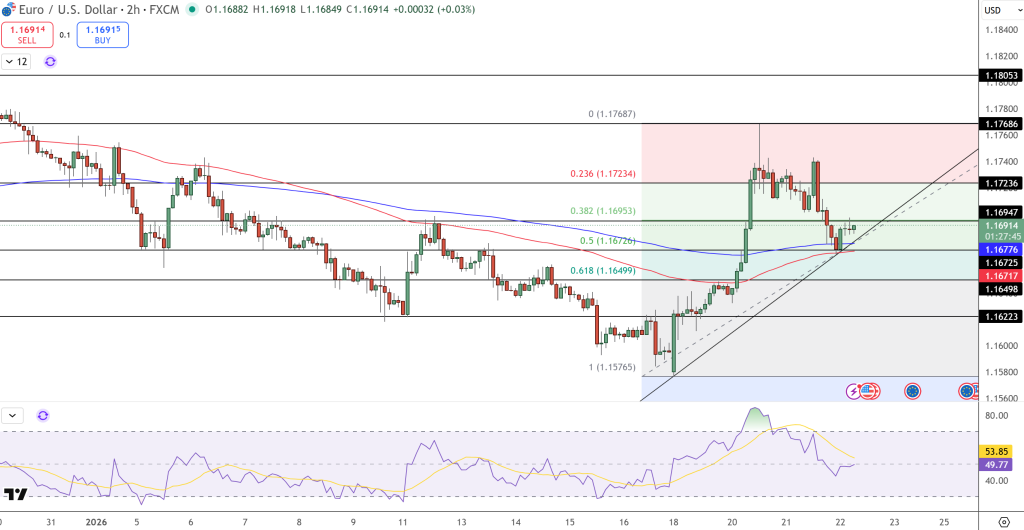
From a technical perspective, EUR/USD remains pretty constructive. On the 2-hour chart, the price is holding firm above a rising trendline that started forming back in mid-January. The 50 EMA near $1.1675 is acting as support, while the 200 EMA around $1.1650 is deeper down, providing further support. When you pull up the Fibonacci retracement from the January low, you get a clear idea of the kind of demand zones we’re looking at – $1.1695 (0.382) and $1.1672 (0.5).
The recent candlesticks show some smaller bodies with upper wicks near $1.1720–$1.1740, which is a pretty strong sign of consolidation rather than a full-on rejection. The RSI has cooled a bit towards 50–54, suggesting we’re in a bit of a shakeout rather than the end of the trend. The path is still open to $1.1735–$1.1765. If it breaks below the trendline support, we’ll have to focus on $1.1620.
Trade suggestion: Consider buying on dips near $1.1670, with a target of $1.1760 and a stop-loss below $1.1620.
- Check out our free forex signals
- Follow the top economic events on FX Leaders economic calendar
- Trade better, discover more Forex Trading Strategies
- Open a FREE Trading Account
- Read our latest reviews on: Avatrade, Exness, HFM and XM

Related Articles

Sidebar rates

Related Posts
 Save
Save
