XRP Price Forecast: Buyers Activate on Ripple CEO Job at CFTC, Next Above $2!
XRP surged after Ripple’s CEO joined the CFTC’s Innovation Advisory Committee, fueling hopes that closer regulatory collaboration could...
Quick overview
- XRP surged over 10% following Ripple CEO Brad Garlinghouse's appointment to the CFTC's Innovation Advisory Committee, signaling potential regulatory collaboration.
- Despite the initial price spike, XRP faced resistance near $1.70–$1.80 and has since dropped below $1.50, indicating profit-taking among traders.
- The CFTC's focus on tokenization and blockchain market structure aligns with XRP's ecosystem, suggesting a shift from regulatory tension to constructive dialogue.
- Institutional adoption of XRP and the expansion of regulated investment vehicles are contributing to a more stable long-term outlook for the token.
Live XRP/USD Chart

XRP surged after Ripple’s CEO joined the CFTC’s Innovation Advisory Committee, fueling hopes that closer regulatory collaboration could mark a constructive new chapter for the token.
XRP Spikes on CFTC Committee Appointment
XRP climbed more than 10% on Sunday to around $1.67 after Brad Garlinghouse was appointed to the Innovation Advisory Committee of the Commodity Futures Trading Commission (CFTC).
The price jump was accompanied by a noticeable spike in trading volume, signaling strong participation from traders. However, the rally stalled near the $1.70–$1.80 resistance zone, and XRP has since slipped back below $1.50—suggesting that profit-taking emerged quickly near recent highs.
The symbolic shift—from years of regulatory tension to active policy dialogue—has nonetheless altered the tone around Ripple and XRP.
From Legal Battles to Policy Dialogue
The CFTC recently expanded its Innovation Advisory Committee to 35 members. Garlinghouse joins a diverse group that includes Brian Armstrong of Coinbase Global Inc., as well as representatives from Chainlink Labs, Solana Labs, Uniswap Labs, CME Group Inc., and Nasdaq Inc..
The committee’s focus areas—tokenization, perpetual contracts, and blockchain market structure—directly intersect with XRP’s ecosystem and broader digital asset infrastructure.
Importantly, the CFTC primarily regulates derivatives markets, not spot crypto securities. Ripple’s prior legal conflict centered on the SEC, not the CFTC. That distinction matters. For many XRP holders, the appointment signals a potential shift from adversarial engagement to collaborative rulemaking.
CFTC Chairman Michael S. Selig has emphasized the goal of “future-proofing” U.S. markets by working alongside industry participants. For XRP investors, that tone has provided a welcome boost to sentiment.
Volatility Follows Early-2026 Optimism
XRP entered 2026 with renewed optimism. Improved regulatory clarity in key jurisdictions, expanding institutional vehicles, and rising adoption of the XRP Ledger (XRPL) for cross-border payments pushed the token toward the $2.40 region earlier in the year.
However, broader crypto market conditions shifted. Liquidity tightened, risk appetite cooled, and capital rotated away from higher-beta assets. XRP broke below $2.00 and eventually fell toward the $1.10 zone during the wider downturn.
The recent bounce above $1.60 reflects a stabilization attempt rather than a confirmed trend reversal. Technical resistance remains firm, and the inability to sustain gains above $1.70 highlights the presence of overhead supply.
Still, the sharp reaction to the CFTC news indicates that regulatory developments remain a key driver of XRP’s narrative.
XRP Stabilizes After the Late-January Correction
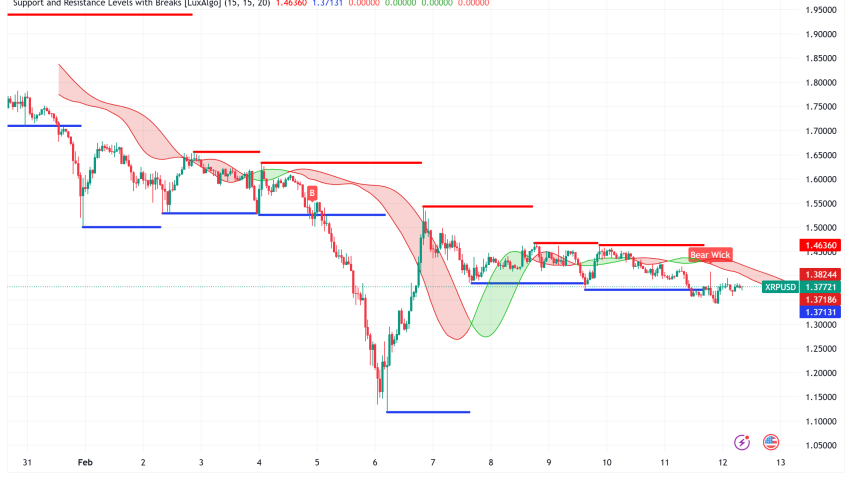
The late-January selloff pushed XRP toward a critical long-term technical zone near $1.10, where the 200-week moving average provided strong support. Buyers stepped in aggressively at that level, triggering a rebound that lifted prices back above $1.40 and signaling early stabilization following the broader crypto downturn.
Ripple Chart Weekly – Threatening to Break the 100 SMA

This successful defense of long-term support suggests that downside momentum has slowed considerably. Volatility has begun to compress, and trading activity indicates that sellers are losing dominance while buyers gradually re-enter the market. Such behavior is often associated with the early stages of base formation rather than the continuation of a sustained downtrend.
The coming weeks will determine whether the recovery can extend further, but the ability of the market to hold major support levels during a period of widespread crypto weakness is an encouraging sign for longer-term participants.
Key Support and Resistance Levels Shape the Near-Term Outlook
Technically, XRP now sits at an important inflection point, with clearly defined support and resistance zones guiding market expectations.
Primary Support:
The $1.10–$1.15 region represents the most important support zone in the current cycle. This area absorbed intense selling pressure during the recent decline and now stands as a well-established demand pocket. Continued defense of this zone preserves the broader bullish structure and reinforces confidence among longer-term investors.
Should this level fail, attention would shift toward deeper macro supports near $1.00 and $0.50, though such a scenario would likely require a significant deterioration in broader crypto market conditions.
Key Resistance:
On the upside, XRP must reclaim the $1.70-$1.80 zone to confirm a more durable trend reversal. A sustained move above this area could open the path toward the $2.00 psychological threshold, followed by potential extensions to $2.50 and eventually $3.00. Until such levels are cleared, the market is likely to remain range-bound, with traders watching for confirmation of the next directional move.
Institutional Products Expand Demand Channels
One structural change in this cycle is the expansion of regulated XRP investment vehicles. Spot XRP exchange-traded products now manage roughly $1.5 billion in assets, representing around 1.2% of total market capitalization.
This suggests that hundreds of millions of XRP tokens have effectively moved into longer-term holdings, reducing actively traded supply. ETF inflows have remained relatively steady in recent weeks, even during broader market volatility.
While XRP’s ETF ecosystem remains smaller than that of Bitcoin or Ethereum, its underrepresentation could become a source of incremental demand if institutional adoption continues to broaden.
Real-World Utility Gains Traction
Beyond trading markets, adoption of the XRP Ledger continues to expand. Financial institutions increasingly explore XRPL-based solutions for cross-border settlement, attracted by speed and lower transaction costs.
Ripple has also pursued banking and payments licences in multiple jurisdictions. In Europe, progress toward obtaining an Electronic Money Institution licence could enable regulated services across the EU. In the United States, engagement with regulatory frameworks has shifted from legal defense to structural integration.
This gradual institutional alignment strengthens XRP’s positioning as a payments infrastructure layer rather than purely a speculative asset.
Additional sectors—including healthcare payments, enterprise treasury platforms, and fintech settlement networks—are evaluating blockchain-based rails. While adoption remains incremental, the diversification of use cases contributes to a more balanced demand profile.
Supply Dynamics and Sentiment Shift
Tightening supply dynamics, institutional participation, and improving regulatory clarity collectively point toward a more constructive long-term backdrop.
The CFTC committee appointment does not guarantee policy outcomes, nor does it eliminate volatility. However, it reinforces the perception that Ripple now has a voice within regulatory discussions rather than standing outside them.
For investors, that narrative shift matters. Crypto markets are highly sensitive to regulatory tone. The prospect of clearer, more coordinated oversight—especially from a derivatives-focused regulator—could reduce uncertainty over time.
A Cautious but Constructive Outlook
XRP’s price action remains volatile, and resistance levels have yet to break decisively. The broader crypto market environment will continue to influence near-term direction.
Yet structurally, the landscape appears different from prior cycles. Regulatory engagement is expanding, institutional channels are deepening, and real-world applications are growing.
While short-term fluctuations are likely to persist, XRP investors are increasingly betting that closer collaboration between Ripple and regulators could reshape the token’s trajectory. If regulatory clarity continues to advance and adoption steadily builds, the recent volatility may ultimately be remembered as consolidation within a longer-term structural evolution.
- Check out our free forex signals
- Follow the top economic events on FX Leaders economic calendar
- Trade better, discover more Forex Trading Strategies
- Open a FREE Trading Account
- Read our latest reviews on: Avatrade, Exness, HFM and XM


 Save
Save