Intel Pushes Forward With Production As INTC Stock Trends Toward $70
Despite short-term share price volatility, Intel is reinforcing its long-term AI and manufacturing strategy with fresh investments and...
Quick overview
- Intel is reinforcing its long-term AI and manufacturing strategy with a $100 million investment in SambaNova Systems, signaling a commitment to AI amid competitive pressures.
- Despite recent share price volatility, Intel's market share in the CPU segment has stabilized, indicating a potential recovery in its core franchise.
- The company is experiencing strong demand in its data-center business, particularly in China, although supply constraints pose operational challenges.
- Intel's latest quarterly results exceeded expectations, but conservative guidance suggests that disciplined execution will be crucial for sustainable growth.
Live INTC Chart
[[INTC-graph]]
Despite short-term share price volatility, Intel is reinforcing its long-term AI and manufacturing strategy with fresh investments and improving operational signals.
Share Volatility Masks Strategic Progress
Intel has faced a choppy start to the year, with shares recently falling more than 6% and dipping below the $50 level. Concerns around execution consistency, competitive pressures, and margin recovery continue to influence sentiment.
However, beneath the surface volatility, Intel’s broader strategy is evolving. The company is actively strengthening its artificial intelligence positioning and reinforcing its data-center franchise—two pillars that could shape its next growth cycle.
$100 Million SambaNova Investment Signals AI Commitment
Intel is reportedly preparing to invest at least $100 million in SambaNova Systems, a privately held AI chip and systems company. The move reflects Intel’s pragmatic approach to accelerating its AI ambitions amid intensifying competition for advanced workloads and specialized silicon design.
Rather than pursuing a full acquisition—discussions reportedly cooled late last year—Intel appears poised to take a strategic minority stake as part of a broader funding round that could total up to $500 million. This structure allows Intel to gain exposure to proven AI architectures while maintaining flexibility.
The investment underscores a broader industry reality: developing competitive AI accelerators and custom ASIC solutions internally has become increasingly complex and resource-intensive. Partnering with specialized players may offer faster access to innovation.
That said, AI remains a highly competitive and capital-intensive field. While demand is robust, monetization timelines, ecosystem strength, and execution discipline will ultimately determine success. Investors should view this as a strategic step forward—but not a guaranteed breakthrough.
Technical Picture Shows Buyers Defending Key Levels
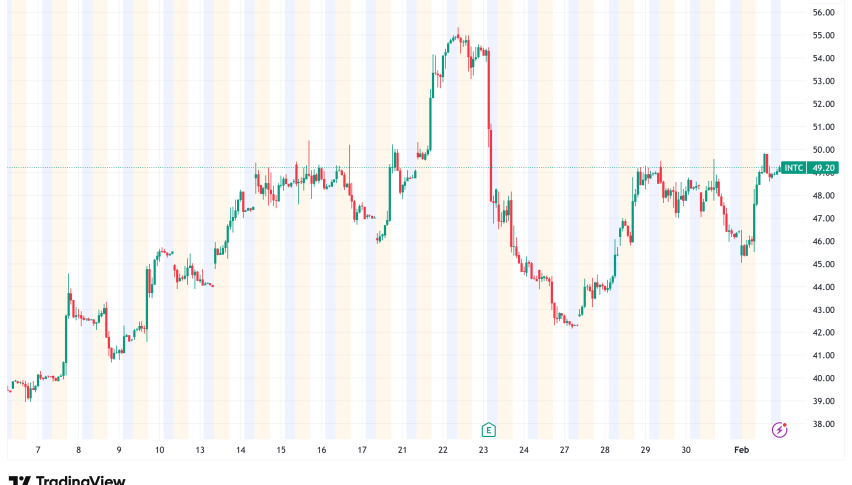
Technically, Intel’s recent price action reflects a market searching for balance. The stock’s post-earnings sell-off erased a breakout above $54 and drove shares down toward the $42.50 area, a zone aligned with prior resistance from October that has since turned into support.
INTC Chart Daily – Bouncing Off $42.50 Support

The successful defense of that level marked a turning point, with the 20 SMA (gray) acting as support on the daily chart. From there, Intel staged a swift rebound, reclaiming $50 despite last week’s 6% pullback. The speed of the bounce suggests that buyers remain willing to step in when valuations appear attractive, even if longer-term conviction remains fragile.
The next test will be whether Intel can sustain trade above former resistance levels and begin forming a higher base rather than another short-lived rally.
Data-Center Demand Shows Resilience
Recent reports indicate that Intel is experiencing supply tightness in parts of its server processor business, particularly in China. Lead times for certain data-center chips are reportedly stretching up to six months, with price increases exceeding 10% across segments.
Given that China accounts for more than 20% of Intel’s revenue, this development is meaningful. Stronger pricing power and inventory drawdowns suggest that AI adoption is lifting traditional compute demand alongside specialized accelerators.
Supply constraints, however, also highlight operational strain. Balancing manufacturing output with demand growth will remain a critical execution test as Intel works to stabilize margins and scale capacity.
Market Share Stabilization Provides Encouragement
In the CPU segment, Intel’s market share ticked higher to 56.64%, marking a modest but symbolic improvement after months of steady declines. While incremental, the stabilization may signal that competitive erosion from Advanced Micro Devices is slowing.
For investors focused on structural recovery, even small gains carry weight. Restoring confidence in Intel’s core franchise is essential before AI initiatives can meaningfully re-rate the stock.
Product Momentum Returns
Excitement around Intel’s upcoming Core Ultra 9 290K Plus processor has also re-entered the narrative. Leaked benchmarks suggest performance improvements of 10–11% versus the prior generation, with gains achieved through higher clock speeds and improved thermal efficiency.
Reported benchmark scores compare favorably against high-end offerings from AMD, including competitive positioning versus the Ryzen 9 9950X3D in certain scenarios. While independent validation remains pending, incremental progress helps rebuild credibility after several uneven product cycles.
Foundry Ambitions Gain Strategic Optionality
Speculation surrounding Intel’s foundry business has added another layer of optimism. Reports suggest that Apple and Nvidia are exploring potential limited manufacturing collaborations later in the decade.
Although highly preliminary, such discussions reflect growing recognition of Intel’s packaging technologies and future process roadmap. The foundry unit is no longer being dismissed outright—a notable shift in perception.
Strong Results, Measured Guidance
Intel’s latest quarterly results exceeded expectations, with adjusted EPS of $0.15 on revenue of $13.67 billion. Datacenter and AI revenue reached $4.74 billion, while Intel Foundry generated $4.51 billion—both ahead of estimates.
Still, conservative guidance for the March quarter, including breakeven EPS and softer margins, tempered enthusiasm. The recovery remains uneven, reinforcing the importance of disciplined execution.
Conclusion: Building Momentum, With Patience Required
Intel’s reported investment in SambaNova highlights a company actively reshaping its AI and manufacturing future. Combined with resilient data-center demand, improving market share signals, product progress, and renewed foundry interest, the long-term narrative is strengthening.
Yet AI competition is fierce, capital demands are heavy, and execution risks persist. Intel’s transformation story is gaining traction—but sustainable re-rating will depend on consistent delivery over multiple quarters.
For patient investors, the rebuilding process appears underway.
- Check out our free forex signals
- Follow the top economic events on FX Leaders economic calendar
- Trade better, discover more Forex Trading Strategies
- Open a FREE Trading Account
- Read our latest reviews on: Avatrade, Exness, HFM and XM


 Save
Save