Oil Price Shock: WTI and Brent Explode Past $100 as Middle East Refineries Face Direct Hits
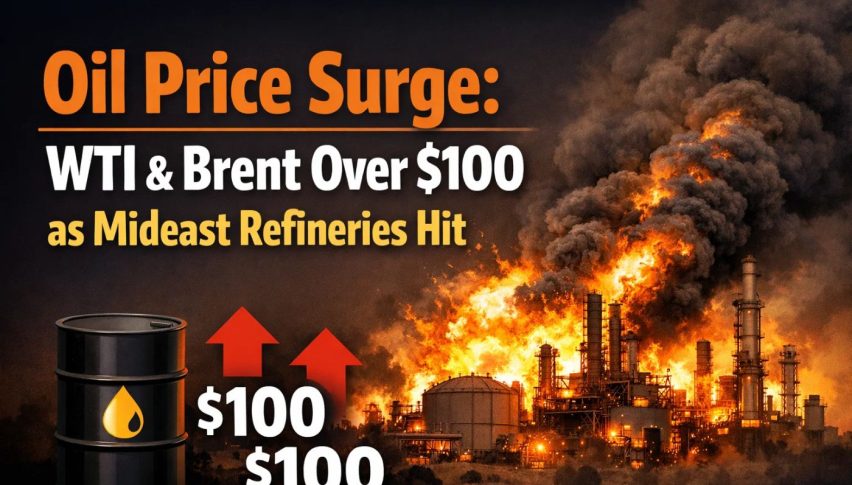
As of March 9, 2026, the global energy market is experiencing a major geopolitical shock. Both West Texas Intermediate (WTI)...
Quick overview
- As of March 9, 2026, WTI and Brent crude prices have surged past $100 due to escalating geopolitical tensions, particularly the US-Israel-Iran conflict.
- The closure of the Strait of Hormuz has led to significant production halts in Gulf oil producers, with Iraq's output dropping by 70%.
- Experts now predict a shift from a projected oil surplus to a significant deficit, with potential oil prices reaching $140 to $150 if disruptions continue.
- Market volatility is high, with daily price swings of 25% to 30%, making risk management crucial for traders in this headline-driven environment.
As of March 9, 2026, the global energy market is experiencing a major geopolitical shock. Both West Texas Intermediate (WTI) and Brent crude have climbed past $100, with WTI reaching $119.48 and Brent close behind at $119.50. This sharp rise marks the biggest short-term rally in decades, and WTI has seen its largest weekly gain in more than 40 years.
This massive “war premium” is almost entirely driven by the escalating US-Israel-Iran conflict, which has moved from regional tension to a direct assault on the world’s most critical energy infrastructure.
Before the conflict, experts expected a large global oil surplus in 2026 and prices around $60. Now, investors are preparing for the possibility that regional supply could be permanently damaged, not just disrupted. Daily price swings of 25% to 30% are becoming common, and the market is having trouble finding stability as the risk of a global energy crisis grows.
War Day 10: Targeted Refinery Strikes and the Hormuz Blockade
On March 7 and 8, Israeli forces carried out targeted strikes on Iranian oil refineries and storage sites in Tehran and Karaj. These actions, meant to cut off Iran’s energy revenue, led to Iranian missile attacks on U.S. bases and major oil producers in the Gulf.
The Strait of Hormuz is now closed, with more than 150 tankers waiting and no movement. This key route, which carries almost 30% of the world’s oil and LNG, is now the main focus of the energy conflict.
- Production Halts: Major Gulf oil producers like Iraq and Kuwait have had to cut production because they have no way to export or store oil. In southern Iraq, production has dropped by 70%.
- LNG Force Majeure: Qatar has declared force majeure on its LNG shipments, which has caused European gas prices to spike and added to global inflation pressures.
- Hardline Continuity: With Mojtaba Khamenei now Iran’s Supreme Leader, the country is likely to take a tougher military stance, making a quick diplomatic solution less likely.
Fundamental Collapse: From Bearish Surplus to Acute Deficit
Before the events of February 28, experts thought the 2026 oil market would have a huge surplus, with up to 3.7 million extra barrels per day. But the blockade and refinery damage have suddenly removed much of this supply, turning the market into a deficit.
Non-OPEC countries were expected to increase oil production this year, but those gains are now being offset by the major disruptions in the Persian Gulf.
Demand remains a complex variable; while military spending and strategic stockpiling provide a short-term boost, the risk of a global recession is rising. As national gasoline prices in the U.S. spike toward $3.41 per gallon and beyond, consumer sentiment is plummeting.
Goldman Sachs has warned that if the Strait of Hormuz remains disrupted for more than 30 days, oil prices could enter a $140 to $150 range, potentially triggering a synchronized global economic downturn.
Technical Analysis: WTI Faces a “God Candle” Scenarios
From a technical standpoint, WTI Crude is in a strong upward trend and has moved past all usual resistance levels. The price is now testing the 1.618 Fibonacci extension near $117.66.
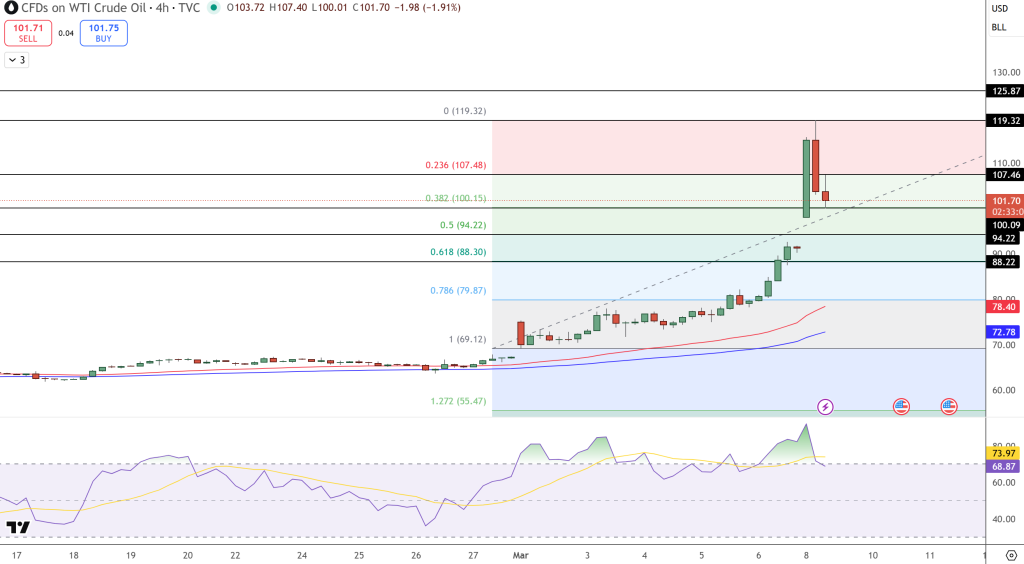
If prices stay above this level for a week, they could move toward the 2.0 extension at $135.00. The Relative Strength Index (RSI) is now extremely high, but in a market affected by geopolitical shocks, these indicators can stay at extreme levels for weeks.
The key support level is now between $100.00 and $102.32, which used to be a strong resistance. If prices fall back to this range, large investors will likely buy as long as the conflict continues.
For tactical traders, the market is currently a “headline-driven” environment where technical levels serve as mere guideposts for extreme volatility. A sudden move toward de-escalation could trigger a $20 to $30 correction in a single session, making risk management the absolute priority for any market participant.
- Check out our free forex signals
- Follow the top economic events on FX Leaders economic calendar
- Trade better, discover more Forex Trading Strategies
- Open a FREE Trading Account
- Read our latest reviews on: Avatrade, Exness, HFM and XM

Related Articles

Sidebar rates

Related Posts
 Save
Save
