Ethereum Slips to $2,200 as Macro Shocks and Leveraged Liquidations Spark 5.6% Correction
After falling 5.6% over the previous day, Ethereum (ETH) is under pressure on Thursday, holding around $2,200. This is a greater loss than
Quick overview
- Ethereum (ETH) has fallen 5.6% to around $2,200, facing pressure from broader macroeconomic factors and a risk-off sentiment in the market.
- The decline is exacerbated by a significant increase in Bitcoin liquidations, which has negatively impacted the entire altcoin market, including Ethereum.
- ETH is currently testing critical support levels, with $2,150 being a key threshold that could determine its near-term direction.
- Despite short-term pessimism, medium-term prospects remain positive due to upcoming upgrades and growing institutional demand for Ethereum.
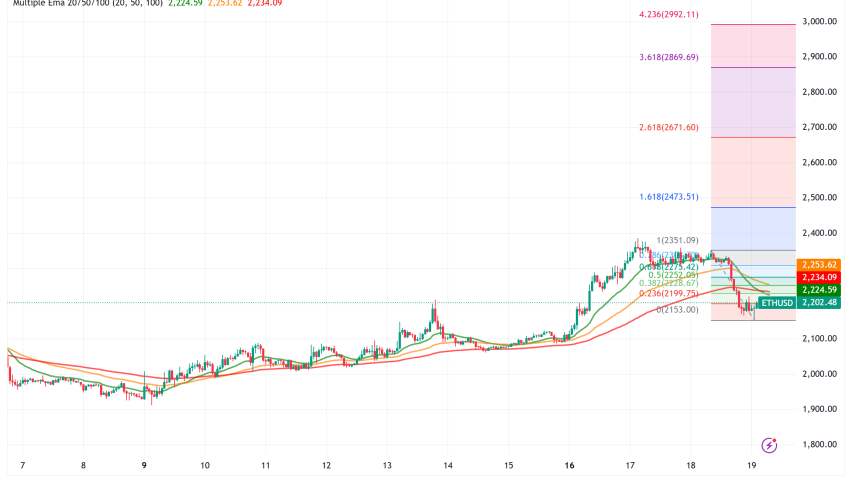
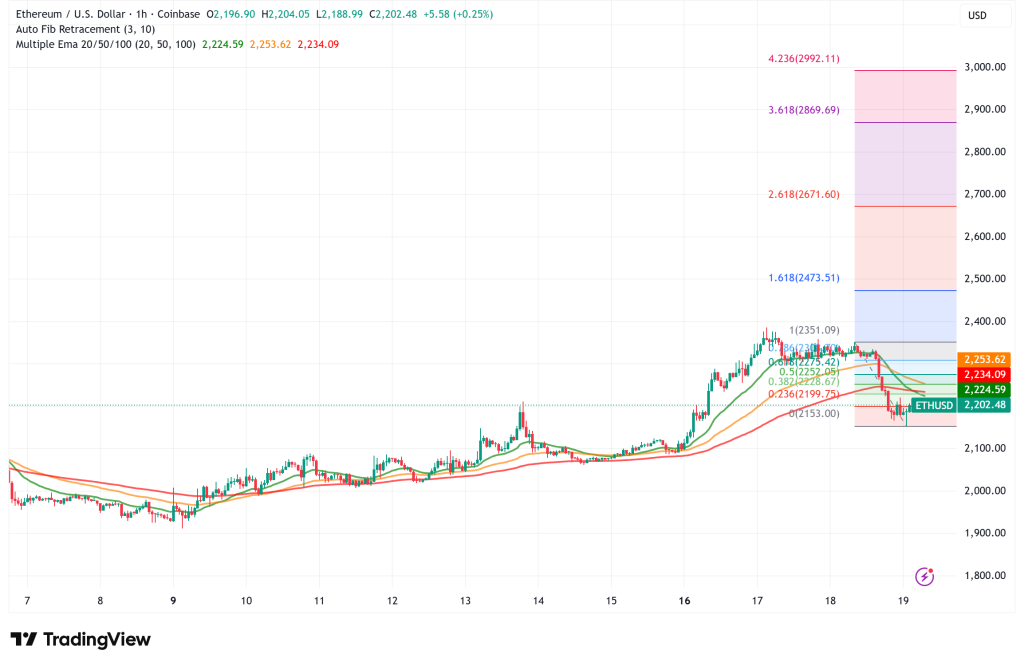
After falling 5.6% over the previous day, Ethereum ETH/USD is under pressure on Thursday, holding around $2,200. This is a greater loss than the 3.59% decline in the larger cryptocurrency market. ETH is at a critical technical crossroads as a result of the sell-off, and analysts are keeping an eye on whether a crucial support level can stop a more severe decline.
Macro Fear Takes the Wheel: Fed Uncertainty and Hot Inflation Data Spark Risk-Off Flight
The main cause of Ethereum’s decline is a larger macro-driven risk-off move rather than a specific cryptocurrency. Prior to the Federal Reserve’s policy meeting on March 18–19, investors were shaken by hotter-than-expected US inflation statistics and escalating geopolitical tensions, which led to a general de-risking of all speculative assets.
As Brent crude has risen above $100 during the closure of the Strait of Hormuz, markets have been positioning ahead of the FOMC rate decision, with investors looking for indications that policymakers are worried about stagflation risks posed by the continued energy shock. With a 3.99% decrease, Phemex Bitcoin spearheaded the cryptocurrency decline, while Ethereum, a historically high-beta trade against BTC, exacerbated the decline. According to Bitwise research, around 65% of ETH’s weekly return variance can be explained by Bitcoin, indicating that macro pressure on BTC typically has a greater impact on ETH.
The conclusion of the FOMC meeting is currently the most significant short-term trigger. A cautious “dot plot” indicating fewer rate cuts in the future or a hawkish tone from Chair Powell might increase selling pressure on riskier assets. The digital assets team at Standard Chartered still has a year-end 2026 ETH objective of $4,000, but it has connected any significant rebound to the Federal Reserve starting rate reduction again, which it does not anticipate before June 2026. Capital.com
Leveraged Long Squeeze: Bitcoin Liquidations Spill Over Into ETH
An unwind in the derivatives market exacerbates the macro challenges. Liquidations of Bitcoin increased by 60.95% in a single day to $150.37 million, which set off a chain reaction of forced sales that affected the whole altcoin market. Because risk algorithms and margin calls require portfolio-wide deleveraging, dominant-asset liquidations of this magnitude typically take ETH and other large-cap coins down with them.
ETH/USD Technical Analysis: $2,150 Support Is the Line in the Sand
Technically speaking, ETH is challenging a crucial near-term support zone that will probably dictate its next course of action.
Ethereum’s main support levels, according to the current classical pivot levels, are $2,290, $2,261, and—most importantly—$2,223. The resistance levels above are $2,357, $2,395, and $2,423.
The most recent swing low, $2,150, is the immediate level to defend. This level is supported by a confluence of Fibonacci retracement support. The fact that EMAs are still below spot price indicates that the larger trend structure has not yet completely collapsed, which is encouraging for bulls.
ETH may settle in a small range before starting to rise again if $2,150 holds. The 50–61.8% Fibonacci retracement zone between $2,025 and $2,094 is accessible, nevertheless, if there is a clear break below that level. Analysts have identified key support levels at $2,073, $2,049, and $2,033. The RSI is currently at 53, which is neutral and does not yet indicate oversold circumstances.
Positively, the first significant indication that the recovery thesis is back in action would be a sustained 4-hour close over $2,475. The next significant obstacle on the way to the ambitious Fibonacci-derived target at $4,956 is the $3,445 level. The 4-hour chart’s invalidation mark for the larger bullish pattern is $1,916; a break below this level would indicate that the corrective phase is still ongoing.
Ethereum Price Prediction: Range-Bound Near-Term, Bullish Medium-Term Catalyst Building
The outlook is cautiously pessimistic for the next 24 to 72 hours. As markets process the FOMC result, ETH is probably going to drop between $2,150 and $2,300. The $2,025–$2,094 Fibonacci zone may need to be tested in the event of a hawkish surprise.
The medium-term setup is more intriguing when looking a little farther ahead. Ethereum upgrade cycles have generally been linked to price appreciation in the 60–90 days prior to deployment, and the forthcoming Glamsterdam hard fork, which is tentatively scheduled for June 2026, is anticipated to further optimize Layer-2 data availability costs and enhance validator efficiency. Phemex Additionally, as recently as March 13, spot Ethereum ETFs had net inflows of almost $27 million, indicating that institutional demand is subtly growing. Capital.com
- Check out our free forex signals
- Follow the top economic events on FX Leaders economic calendar
- Trade better, discover more Forex Trading Strategies
- Open a FREE Trading Account
- Read our latest reviews on: Avatrade, Exness, HFM and XM

Related Articles
Sidebar rates

Related Posts
 Save
Save
