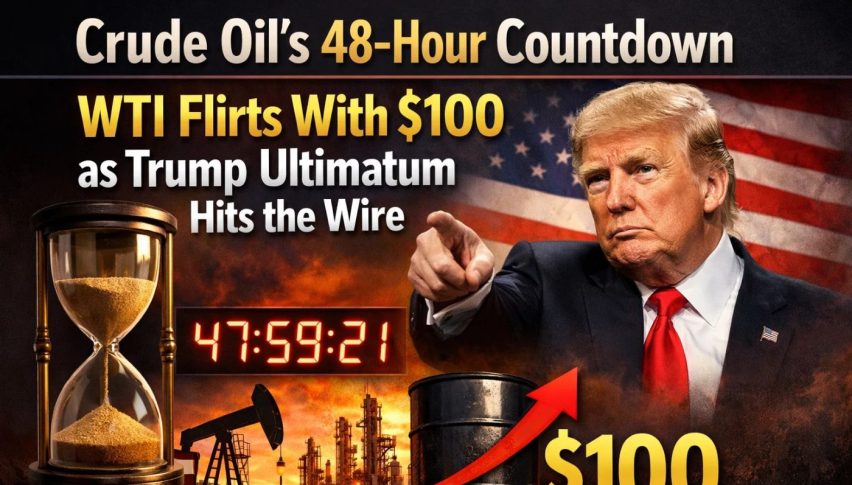
Crude Oil’s 48-Hour Countdown: WTI Flirts With $100 as Trump Ultimatum Hits the Wire
On Monday, March 23, 2026, the global energy market is focused on WTI Crude Oil (USOIL) as it hovers near $100 per barrel...
Quick overview
- WTI Crude Oil prices are hovering near $100 per barrel amid escalating tensions between the US and Iran over the Strait of Hormuz.
- The International Energy Agency warns that the current supply disruption is the largest seen in modern oil market history, affecting 11 million barrels per day.
- Analysts predict that if the conflict continues, oil prices could rise significantly above $100, potentially reaching $130-$150.
- The uncertain outlook for 2026 hinges on whether the Strait reopens or if military action escalates, impacting global demand and economic stability.
On Monday, March 23, 2026, the global energy market is focused on WTI Crude Oil (USOIL) as it hovers near $100 per barrel. After a weekend of tense negotiations, President Donald Trump gave Tehran a 48-hour ultimatum: reopen the Strait of Hormuz or risk attacks on Iran’s energy infrastructure. With the deadline approaching late Monday GMT, oil prices are moving between $98.14 and $99.62, showing how uncertain the market is about whether there will be military action or a diplomatic solution.
This situation is more than a typical geopolitical conflict. It represents the largest supply shock the modern oil market has seen. With the Strait of Hormuz, a key shipping route, nearly closed, about 20% of global petroleum liquids cannot move. The International Energy Agency (IEA) has warned that the 11 million barrels per day currently affected is a bigger disruption than both the 1970s oil crises and the 2022 Ukraine conflict combined.
The Hormuz Blockade Paradox: Why $100 Could Be the Minimum, Not the Maximum
Many analysts see the current $100 price as low, considering the situation. Before the conflict started in late February, WTI was in the $70s because experts expected a supply surplus of 2 to 3 million barrels per day in 2026. That outlook has changed completely. The war has turned a small surplus into a serious shortage.
The US and its allies are working to release oil from the Strategic Petroleum Reserve (SPR), but these efforts are limited compared to the scale of the problem. If Trump carries out his threat to target Iranian power plants and refineries, Iran has said it will respond by attacking desalination plants and IT systems in the Gulf. This back-and-forth could mean that the recent 50% price increase is only the beginning. If the blockade continues through 2026, many analysts expect a period of stagflation, with oil prices staying above $100.
Technical Analysis: WTI’s Upward Trend and the $107 Level
Technically, WTI is holding up well. On the daily chart, oil has moved back above the 0.382 Fibonacci level at $100.11, making what was once a resistance area into a possible support. The price is following a rising trendline from the $69.23 low, with a steady pattern of higher highs and higher lows.
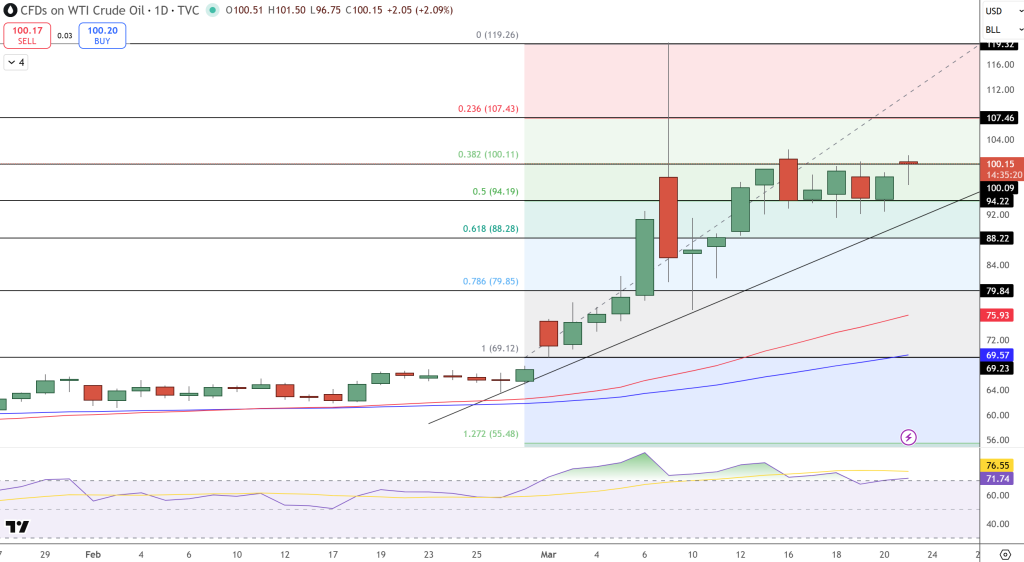
The Relative Strength Index (RSI) is now in the low 70s, which usually means oil is overbought. However, during strong geopolitical events, the RSI can stay high for an extended period.
- Upside Resistance: The next key level is $107.46 (the 0.236 Fibonacci retracement). If oil closes above this, it could move up to test the March high at $119.26.
- Downside Support: If WTI stays above $94.22, the upward trend continues. If it falls below $88.22, it would show that the extra price from the war is quickly disappearing.
Demand Destruction vs. Geopolitical Premium: The 2026 Outlook
Global demand is the unpredictable factor here. With oil above $100, there is a real risk that demand will drop. Airlines, shipping companies, and logistics firms are already struggling as jet fuel and diesel prices rise faster than crude. This situation could lead to stagflation: high energy costs slow the world economy and reduce oil demand, but the supply shock from the war keeps prices high.
The outlook for 2026 is very uncertain. If the Strait reopens after the 48-hour deadline, oil prices could quickly fall back to the $70–$80 range as the risk premium disappears. But if conflict breaks out, prices could jump past $110 and reach $130–$150, with ‘Force Majeure’ becoming a common term. For now, prices are likely to keep rising as the deadline approaches.
- Check out our free forex signals
- Follow the top economic events on FX Leaders economic calendar
- Trade better, discover more Forex Trading Strategies
- Open a FREE Trading Account
- Read our latest reviews on: Avatrade, Exness, HFM and XM

Related Articles

Sidebar rates

Related Posts
 Save
Save
