Intel (INTC) Shares Slip 5% as Technical Weakness and Budget Product Leaks Dampen Sentiment
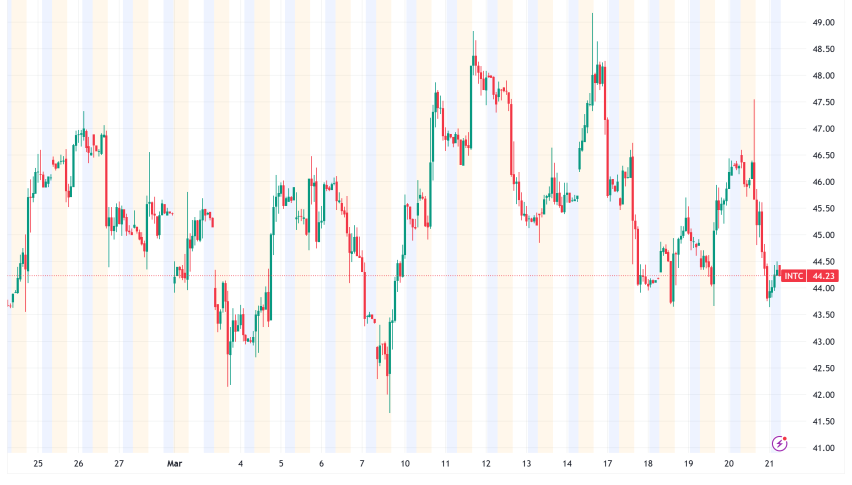
After a difficult week in the markets, shares of Intel Corporation (NASDAQ: INTC) dropped more than 8% before ending Friday at $43.87
Quick overview
- Intel shares dropped over 8% to $43.87, falling below the critical $44 support level amid market turbulence.
- Leaked specifications for upcoming Intel CPUs failed to generate positive market response, indicating a shift in investor focus to fundamentals.
- Analyst opinions on Intel's stock vary widely, with price targets ranging from $30 to $57, reflecting mixed sentiment on its future performance.
- Insider buying activity suggests some confidence in Intel's long-term prospects, particularly in foundry services and AI infrastructure.
After a difficult week in the markets, shares of Intel Corporation (NASDAQ: INTC) dropped more than 8% before ending Friday at $43.87, momentarily dropping below the carefully monitored $44 support level that traders had identified as technically critical. Following Nvidia’s high-profile GTC developer conference, which diverted investor focus from Intel’s own product pipeline to concerns about competitive positioning in the AI age, the semiconductor industry as a whole began to retreat.
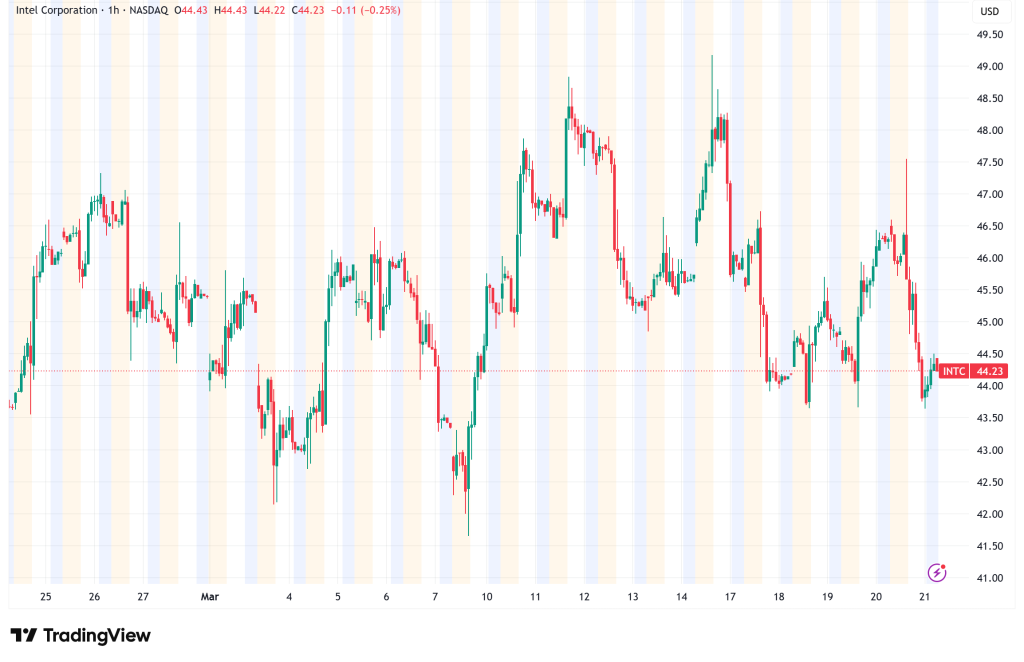
The Relative Strength Index finished close to a neutral 43, indicating that the bullish momentum that defined early 2026 has mostly subsided, while the stock’s decline took it below its 50-day moving average. Instead of retail-driven volatility, the high trading volume suggested institutional repositioning.
Intel Processor Leaks Fail to Move the Needle
Leaked specs for Intel’s forthcoming Arrow Lake-S and Bartlett Lake CPU families appeared over the weekend via benchmark databases and European shops. A French dealer sold the Arrow Lake-S entry-level chip, the Core Ultra 3 205, at about €158. This low-cost SKU is aimed at system integrators rather than high-end consumers. In the meantime, the Bartlett Lake architecture, which lacks efficiency cores, seems to be focused on network infrastructure and edge computing—niche industries that are far different from the broad consumer excitement that investors usually reward.
The muted response from the market was instructive. Ahead of Intel’s Q1 earnings report, which is set for April 23, 2026, investor attention has clearly switched to fundamentals, since neither leak offered the impetus required to recover the week’s losses. As a result of ongoing pressure on Intel’s core business, analysts currently predict a minor loss of four cents per share on revenue of about $12.29 billion.
Mixed Signals From Wall Street on Intel (INTC) Stock Outlook
The opinions of analysts on Intel are still very different. With price estimates ranging from Wedbush’s cautious $30 to Benchmark’s exuberant $57, five firms have buy ratings on the company. Thirty forecasters’ median analyst price objective is $45, which is somewhat above current trading levels. Kevin Cassidy of Rosenblatt has one of the more pessimistic opinions on the Street, with a $30 target that suggests a roughly 32% decline from current prices.
The situation is similarly conflicting on the institutional front. Notably, UBS Asset Management reduced its holding by 76% during the same period, while Nvidia itself added over 214 million Intel shares in Q4 2025—a startling decision given the competitive dynamics of the firms. Capital Research Global Investors significantly increased its holdings by almost 286%, while BlackRock increased its share.
Intel’s Long-Term Case Rests on Foundry and AI Infrastructure
Bulls in Intel point to the company’s foundry aspirations and its statement that Xeon 6 processors will support Nvidia’s DGX Rubin systems despite short-term obstacles, indicating that cooperation rather than competition characterizes the present semiconductor landscape. The long-term investment thesis is still supported by government subsidies obtained under U.S. chip policy and multi-year CPU demand tailwinds, according to Intel’s CFO.
One somewhat positive indication comes from insider activity: CFO David Zinsner bought around $250,000 worth of shares in recent months, while the company’s chief legal officer sold almost $981,000 worth. In the last six months, there have been three purchases compared to one sell in congressional trading, which has similarly slanted toward the buy side.
Intel’s next few weeks could be crucial in evaluating whether the current decline is a buying opportunity or the start of a deeper reset, since earnings are approaching and technical indications are at a turning point.
- Check out our free forex signals
- Follow the top economic events on FX Leaders economic calendar
- Trade better, discover more Forex Trading Strategies
- Open a FREE Trading Account
- Read our latest reviews on: Avatrade, Exness, HFM and XM

Related Articles
Sidebar rates

Related Posts
 Save
Save
