WTI Crude Oil Analysis: $103 as the April 6 Kharg Island Deadline Looms – Two Outcomes, Zero Middle Ground
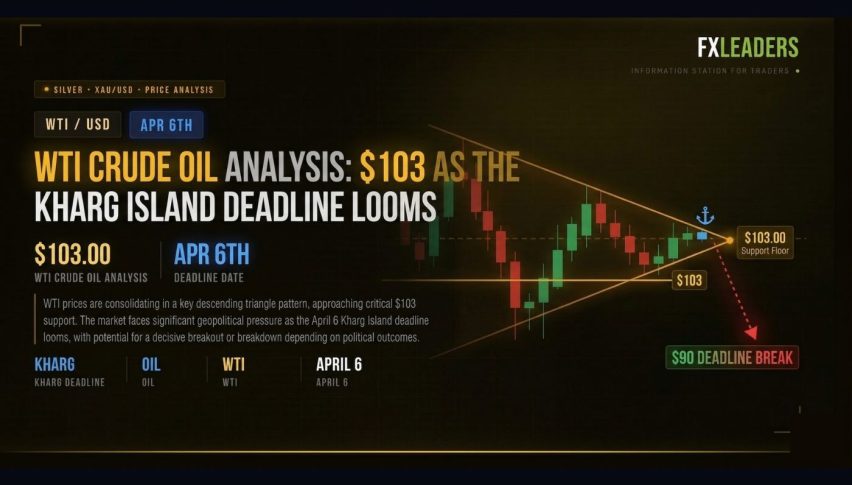
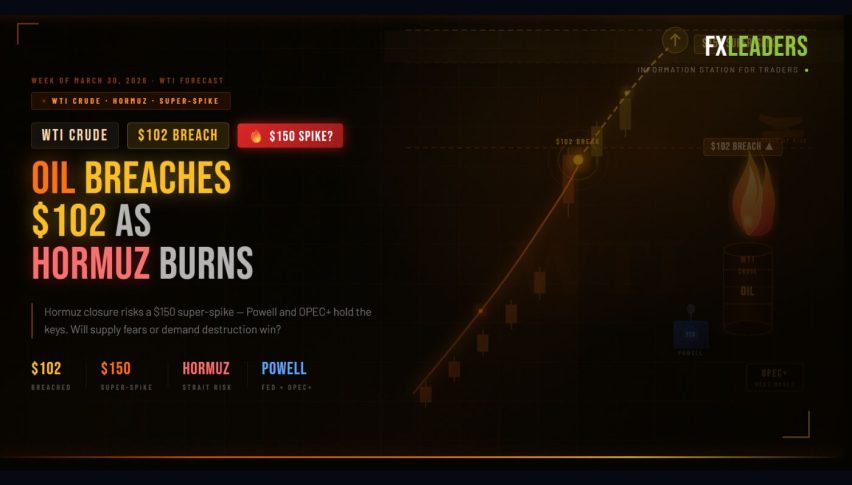
WTI is trading at $102.24 to $103.00 on March 31, 2026, up 48% in March, marking its biggest monthly gain since 2020.
Quick overview
- WTI crude oil prices have surged to $102.24 to $103.00, marking a 48% increase in March, the largest monthly gain since 2020.
- April 6 is a critical deadline set by Trump for Iran to reopen the Strait of Hormuz, with threats of severe consequences if no agreement is reached.
- The destruction of Kharg Island, which manages 90% of Iran's crude exports, could significantly impact global oil supply, potentially removing 1.5 to 2 million barrels per day.
- Market analysts predict that if diplomatic negotiations succeed, oil prices could drop significantly, while continued disruptions could push Brent prices above historical highs.
WTI is trading at $102.24 to $103.00 on March 31, 2026, up 48% in March, marking its biggest monthly gain since 2020. With Trump’s April 6 deadline for Iran to reopen the Strait of Hormuz just six days away and clear threats to destroy Kharg Island, the oil market faces a stark either-or scenario.
The April 6 Deadline: Every Trader’s Single Focus
April 6 is now the main focus for every oil trading desk. This is the deadline Trump set, after extending an earlier window by 10 days, for Iran to reopen the Strait of Hormuz and agree to a peace plan. In a March 30 Truth Social post, Trump threatened to “completely obliterate” Iran’s electric generating plants, oil wells, Kharg Island, and possibly desalination facilities if no deal is made.
Kharg Island manages about 90% of Iran’s crude exports. Destroying it would wipe out Iran’s oil export capacity for years, not just weeks, taking another 1.5 to 2 million barrels per day from an already strained market.
Polymarket now gives an 80.5% chance that the Strait will not return to normal traffic by the end of April. The odds of a ceasefire by April 30 have dropped to 30%, down from 50% last week. Iran has denied any negotiations, with Foreign Minister Abbas Araghchi saying, “no talks have happened with the enemy until now, and we do not plan on any negotiations.”
Adding to the tension, Yemen’s Houthis launched missiles at Israel over the weekend. This is their first direct involvement in the US-Iran conflict and increases the risk of disruption at the Bab el-Mandeb Strait, another key energy shipping route.
WTI Technical Analysis: $106.30 Holds the Key to $112
WTI is moving in a steep upward channel, with the RSI close to 64. This shows strong momentum, but it is not yet overbought. Extreme futures backwardation signals real physical scarcity, outweighing technical indicators.
- Resistance is at $106.30 (0.236 Fibonacci); a 4-hour close above this level targets $112.30. The pivot is $102.24, which is the current intraday battleground. Support S1 is at $98.20 (0.382 Fibonacci, 50-day SMA), and the structural floor S2 is at $91.50 (0.5 Fibonacci).
- Goldman Sachs expects WTI to reach $105 in April if Hormuz flows stay at 5% of normal through April 10. If the disruption lasts ten weeks, Brent could surpass its 2008 all-time high.
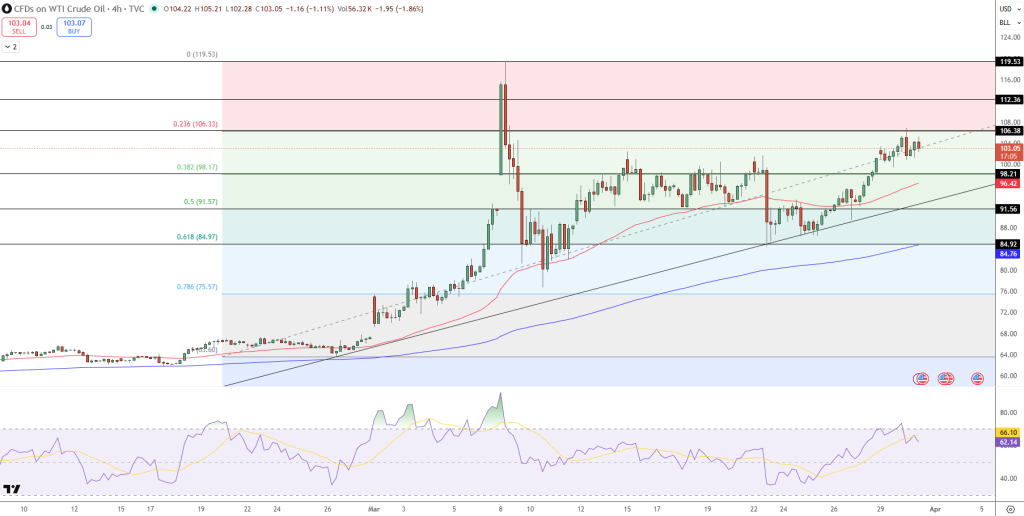
Bullish trade idea: Go long if there is a confirmed break above $106.30, with a target of $112.30. This assumes escalation or a missed deadline.
Bearish trade idea: Go short if there is a diplomatic breakthrough, targeting $95 to $98. This assumes the war premium disappears quickly.
Risk management: With OVX above 55, use wide stops below $101.80 and keep position sizes smaller. Intraday swings of more than $5 are now common.
FAQ: WTI Crude Oil – April 6 Deadline, Kharg Island Risk, and Market Outlook
What happens to oil prices if Trump strikes Kharg Island?
Kharg Island handles 90% of Iran’s crude exports, or about 1.5 to 2 million barrels per day. A strike would remove this supply for years. Goldman Sachs warns Brent could go above its 2008 record of $147 if Strait disruptions continue and get worse. BCA Research analysts estimate global oil supply losses could double by mid-April even without a Kharg strike.
What happens to oil if a ceasefire is announced?
If there is a confirmed diplomatic breakthrough, the $14 to $18 per barrel Goldman Sachs risk premium would quickly disappear. Analysts say WTI could drop to the mid-$80s if a ceasefire is announced, and the EIA forecasts Brent could fall to around $80 by the third quarter if the Strait fully reopens.
Why hasn’t the 400-million-barrel IEA release capped oil prices?
The IEA emergency release has limited price increases but has not fixed the supply shortage. The strategic reserve can provide up to 3 million barrels per day, but this does not make up for the 17.8 million barrels per day lost from Hormuz disruption. It helps relieve pressure, but it is not a full solution.
- Check out our free forex signals
- Follow the top economic events on FX Leaders economic calendar
- Trade better, discover more Forex Trading Strategies
- Open a FREE Trading Account
- Read our latest reviews on: Avatrade, Exness, HFM and XM

Related Articles
Sidebar rates

Related Posts
 Save
Save
