Nvidia (NVDA) Becomes World’s Most Valuable Company Ever, Topping $5.3 Trillion
Investor confidence remains high with the acceleration of AI infrastructure spending, driving Nvidia’s market valuation to a record $5.26T
Quick overview
- Investor confidence is high as Nvidia's market valuation reaches a record $5.26 trillion, the largest ever for a publicly traded company.
- Nvidia's stock surged following a partnership announcement between Qualcomm and OpenAI, contributing to a significant rise in data center sales.
- The company holds a dominant 92% share of the data center GPU market, with projected revenues indicating strong growth potential through 2027.
- Despite the optimistic outlook, Nvidia's upcoming earnings report will be crucial in assessing the sustainability of its momentum in the AI sector.
Investor confidence remains high with the acceleration of AI infrastructure spending, driving Nvidia’s market valuation to a record $5.26 trillion on Monday, the biggest ever recorded by any publicly traded company in history.
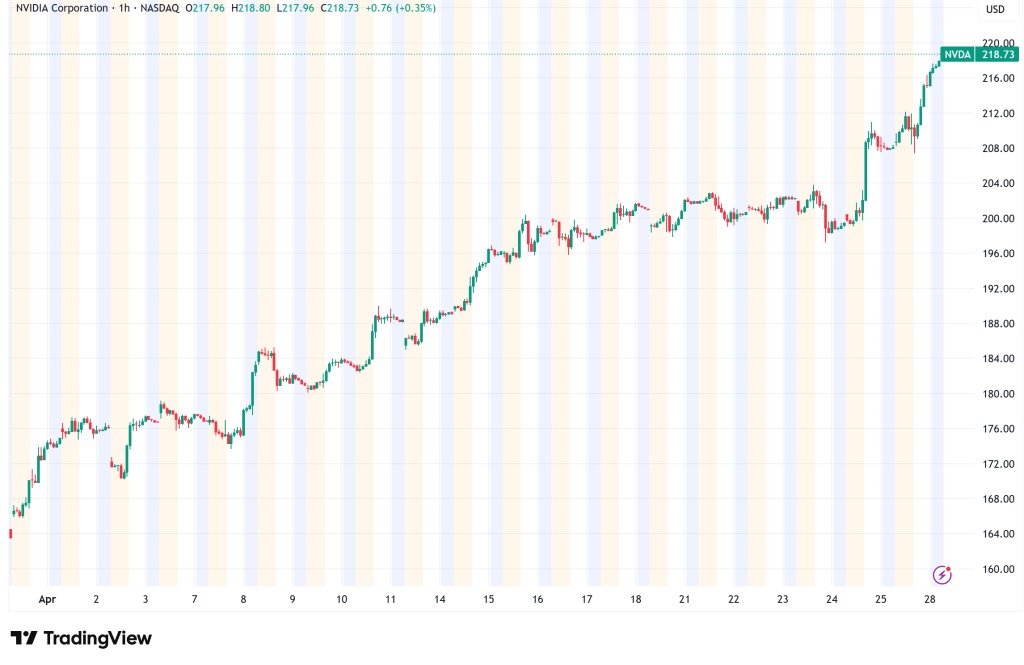
NVIDIA’s Historic Milestone as Valuation Crosses $5T
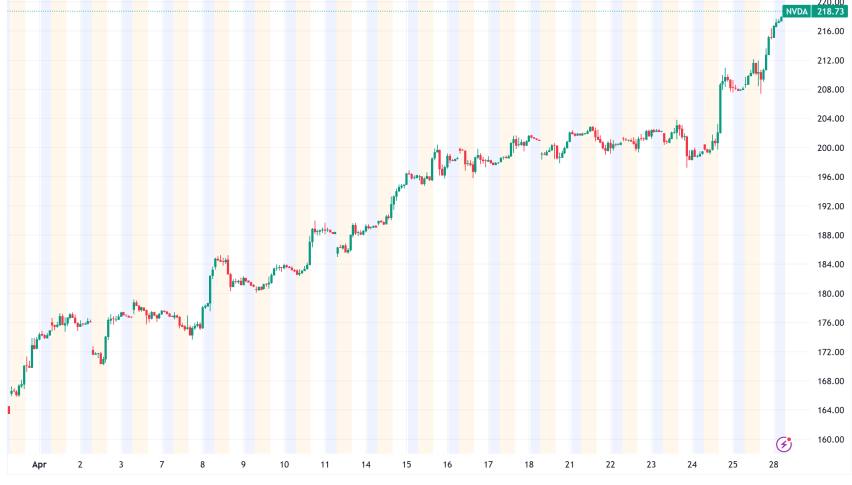
Shares closed Monday just below their intraday highs, rising in after-hours trading to $218.75, solidifying Nvidia’s lead over Google ($4.2 trillion) and Apple ($3.9 trillion) – the next two closest challengers for the title of the world’s most valuable corporation. The S&P 500 also hit a new record on the same day, finishing at 7,173.91.
The NVDA stock was boosted by an agreement Monday unveiling a partnership between Qualcomm and OpenAI, a big Nvidia customer, to co-develop smartphone processing chips. Qualcomm’s own shares jumped roughly 1% on the news, adding to an 18.2% rise for the month of April.“We are going to be short – I’m sure the computing demand will be much higher than that. Nvidia CEO Jensen Huang on the company’s own $1T chip-sales target through end of 2027.
AI Boom Drives NVIDIA (NVDA) Higher
The milestone represented a historic turning point for Nvidia from a gaming chip firm to the top provider of the AI era. The company has an estimated 92% share of the data center GPU market, and its latest quarterly results showed how quickly that sector is developing. Fiscal fourth-quarter revenue was $68.1 billion, up 73% year-over-year, fueled almost entirely by $62.3 billion in data center sales. Earnings per share jumped 82 percent.
Management has guided to revenue of approximately $78 billion in the current quarter, which is about 77% growth year-over-year. Analysts’ average forecasts imply cumulative revenue of around $855 billion over the next two years, but Huang himself has said the number could be far too conservative, projecting “at least” $1 trillion from sales of Blackwell and Vera Rubin chips alone by the end of 2027.
NVIDIA Stock Outlook: Big Earnings Week Ahead
But this week Nvidia will provide a real test of the optimism. Amazon, Meta, Microsoft and Alphabet – all big buyers of Nvidia chips – are reporting profits and any evidence of slowing AI spending might harm the chipmaker’s momentum. Wedbush analysts are looking for a strong tone from the Magnificent 7 cohort while JPMorgan sees Nvidia’s data center GPU business on a “multi-year runway of growth.” Of the 13 analysts tracked by Visible Alpha, 12 presently rate the company a buy, with a mean price target of nearly $268, or about 24% over Monday’s finish.
Nvidia itself isn’t scheduled to announce results until May 20. Jensen Huang, CEO, meantime, has a net worth estimated at $187.1 billion, making him ninth on the list of the world’s wealthiest people. On Monday he recorded the highest single-day growth in net worth of any billionaire, $7.1 billion in one day. However, the stock is still trading at just 26 times forecast earnings, a value that analysts still find appealing for a company generating high double-digit revenue and profit growth.
- Check out our free forex signals
- Follow the top economic events on FX Leaders economic calendar
- Trade better, discover more Forex Trading Strategies
- Open a FREE Trading Account
- Read our latest reviews on: Avatrade, Exness, HFM and XM

Related Articles

Sidebar rates

Related Posts
 Save
Save