Bitcoin Holds $64K as Short-Squeeze Setup Builds: Can BTC Reclaim $75,000?
Bitcoin (BTC) is currently trading in a tight range around $64,000, as the market balances aggressive long liquidations against a growing
Quick overview
- Bitcoin is currently trading around $64,000 after a significant market liquidation of nearly $507 million in derivatives.
- The recent volatility may have set the stage for a potential short squeeze, with a notable imbalance in short positions above $70,000.
- Despite macroeconomic challenges, historical trends suggest Bitcoin could rebound, as seen in past market recoveries following similar conditions.
- Bitcoin's mining strength has recovered, alleviating concerns about a prolonged downturn, while the price target remains at $75,000 if market conditions improve.
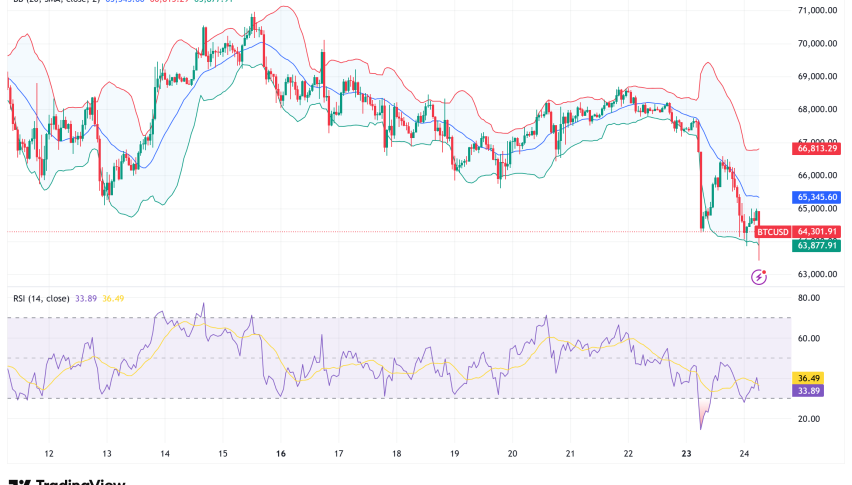
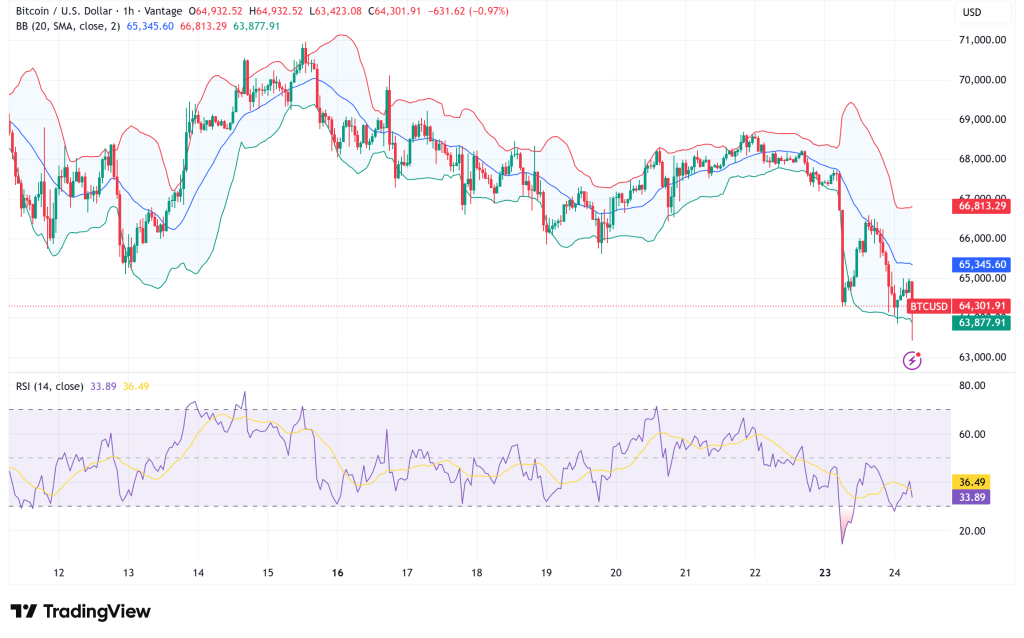
As the market recovers after a tumultuous period that witnessed the liquidation of almost $507 million worth of cryptocurrency derivatives in a single day, Bitcoin BTC/USD is hovering around $64,000, essentially unchanged over the last day. During Monday’s New York session, the coin briefly fell to a weekly low of $64,111 before leveling off, trapping traders between increasing technical indicators indicating a turnaround might be imminent and growing macro uncertainty.
A Market Flush That May Have Cleared the Path Higher
For leveraged bulls, the most recent volatility was severe and quick. In a few short hours, Bitcoin went from $67,700 to $64,300, causing $438 million in lengthy liquidations, or around 86% of the $507 million that was lost in the market. Of those closures, $233 million were due to Bitcoin alone.
Ironically, though, the flush might have created a more positive atmosphere. An unbalanced $3.5 billion in short positions becomes susceptible near $70,000, while approximately $1 billion in long holdings remain at risk if Bitcoin drops below $63,000, according to liquidation heatmap data from CoinGlass. A strong liquidity magnet to the upside is produced by the unequal concentration of short exposure above the present price.
BTC Derivatives Data Signals a Potential Short Squeeze
The four-hour chart of Bitcoin perpetual futures shows that funding rates have gone negative, which means that short sellers are now paying longs to keep their positions. A short squeeze is typically preceded by this defensive strategy and price holding above established range support.
In tandem, Bitcoin’s open interest has dropped to $19.5 billion, or around half of its January top of $38.3 billion, indicating a sharp decline in risk-taking in the market. The significant tightening of the Bollinger Bands indicates compressed volatility and the possibility of an explosive directional move once the price finds its catalyst.
Bitcoin has “finally grabbed the $64,500 liquidity,” according to trader Lennaert Snyder, who also suggested that regaining $67,751 may lead to $76,971. Christopher Inks, an analyst at TexasWest Capital, notes that rising volume and a developing bullish RSI divergence on the daily chart have historically preceded recoveries.
Macro Headwinds Are Real, But History Favors Bitcoin
The background is still difficult. Investors have turned to cash and government bonds as a result of President Trump’s increasing tariff regime, which resulted in a 34% tax on Chinese imports and a baseline 15% tax on the majority of trading partners. Widespread retail concern is reflected in the drop in Bitcoin Open Interest and the spike in negative social sentiment to a two-week high.
History, however, suggests that Bitcoin should not be written out. Early in April 2025, when the Trump administration slapped broad reciprocal tariffs, Bitcoin fell to a five-month low of $74,600 before rising 38% the next month. The scenario of the 2020 COVID crisis was even more bleak: when liquidity flooded the system, Bitcoin dropped to $4,400 before rising to $42,000. Expert traders seem to be learning the same lesson today. According to CFTC statistics, big speculators have switched their position on CME Bitcoin futures from net short to net long. Analyst Tom McClellan claims that this change in stance has preceded two notable BTC price bottoms in the past.
Bitcoin Mining Strength Removes a Key Bear Case
The fact that Bitcoin’s network hashrate has entirely recovered after a 25% decline in January is one underrated upside. At energy prices as low as $0.07 per kilowatt-hour, ASIC miners from 2024 and early 2025 continue to turn a profit, allaying concerns about a protracted “miner death spiral” that would have contributed to ongoing selling pressure on the market.
Bitcoin Price Prediction: $63K Is the Line in the Sand, $75K Is the Target
It is impossible to rule out a short-term decline to the $63,000 order block, which may be beneficial in the short run as it would clear out any remaining long liquidity before a more robust rebound attempt. The way toward the mid-range at $67,000–$68,000 opens up if buyers defend that zone; the next significant resistance cluster is above $70,000.
Bitcoin’s next upside target is $75,000, assuming macro conditions improve, especially if the Federal Reserve’s liquidity operations grow or concerns about the valuation of the AI industry lead to a wider rotation. The bullish trend structure that has been under pressure for the last eighteen days would be restored with a sustained break above that level.
- Check out our free forex signals
- Follow the top economic events on FX Leaders economic calendar
- Trade better, discover more Forex Trading Strategies
- Open a FREE Trading Account
- Read our latest reviews on: Avatrade, Exness, HFM and XM

Related Articles

Sidebar rates

Related Posts
 Save
Save