Bitcoin Holds $71,000: Can Institutional Buying Ignite the Next Bull Run?
Although Bitcoin (BTC) is currently trading at almost $71,000 on Friday, up 2.4% from the previous day, the price action reveals a more
Quick overview
- Bitcoin is currently trading around $71,000 but struggles to establish a solid support level and faces significant resistance at $75,000.
- The futures market indicates a bearish sentiment, with short sellers showing strong conviction as funding rates drop to -7%.
- Traditional assets like gold and rising Treasury yields are challenging Bitcoin's appeal as a safe haven amid geopolitical tensions and economic uncertainty.
- Despite the pessimistic outlook, institutional demand for Bitcoin is subtly increasing, with potential for significant price movements depending on macroeconomic developments.
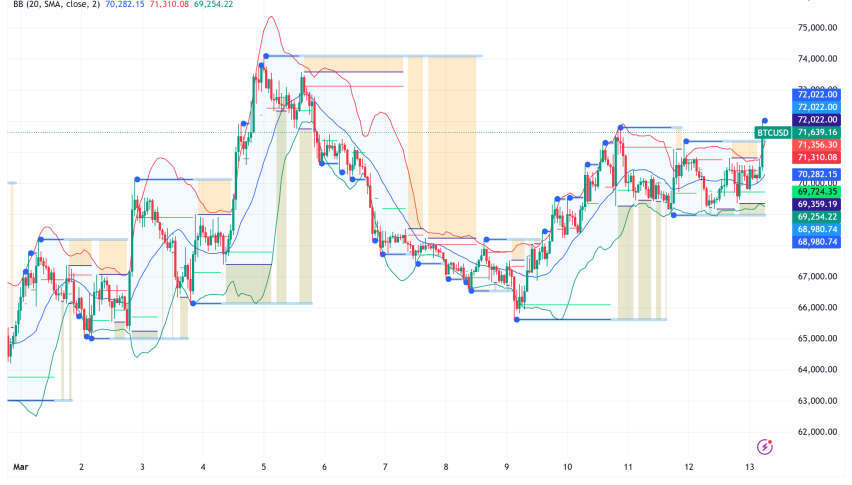
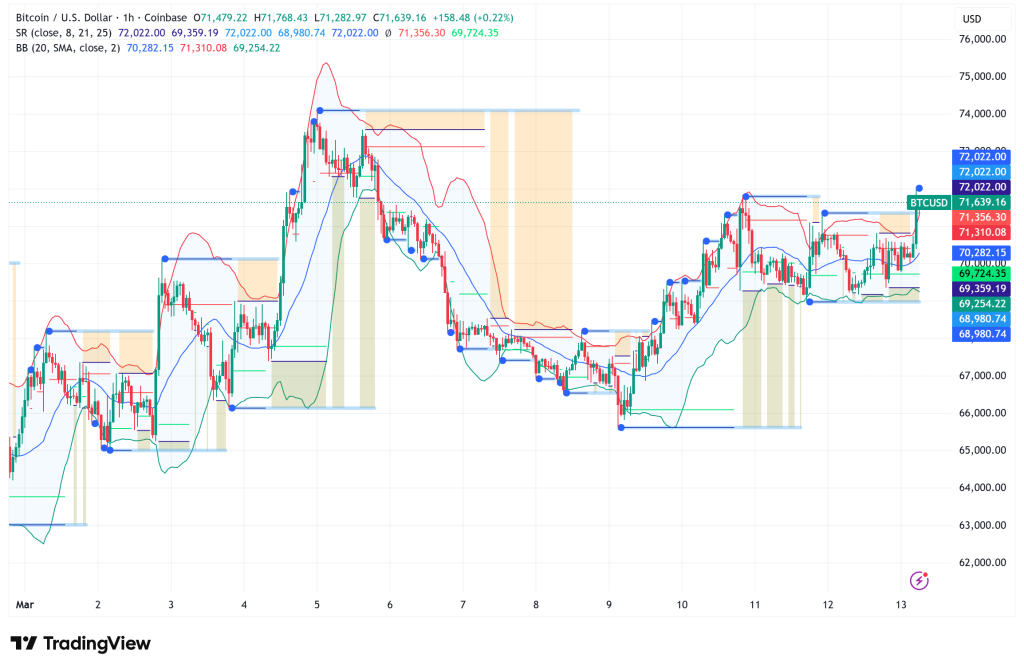
Although Bitcoin BTC/USD is currently trading at almost $71,000 on Friday, up 2.4% from the previous day, the price action reveals a more cautious story underneath. BTC has consistently failed to turn $71,000 into a solid floor, let alone challenge the crucial $75,000 resistance level that bulls must cross to resume upward momentum, despite a slight daily gain.
Bears Pile In as BTC Stalls Below Key $75,000 Resistance
The everlasting futures market for Bitcoin is the most obvious indicator of a gloomy outlook. Short sellers are now paying to keep their positions open, a sign of strong negative conviction, since the annualized funding rate has fallen to -7%. When funding rates become extremely negative, it indicates that traders are placing more aggressive bets on future price drops than on a recovery.
For a number of weeks in a row, the two-month futures basis rate for Bitcoin has stayed below the neutral 5% mark. The market’s lack of enthusiasm is highlighted by the fact that Bitcoin is still about 45% behind its all-time high while the Nasdaq 100 is only 6% below its own record peak, even though this does not yet signal extreme stress.
Gold Above $5,100 and Rising Treasury Yields Undercut BTC’s Safe-Haven Appeal
A significant increase in traditional sources of value is making it more difficult for Bitcoin to draw in safe-haven flows. Gold has soared beyond $5,100, offering a direct challenge to BTC’s ‘digital gold’ narrative at precisely the moment when macro uncertainty is at its peak. Concurrently, as investors want higher returns to keep fixed-income assets, rates on 5-year US Treasury notes have surged to 3.80%, quickly recovering from a decline below 3.50% in late February.
Growing geopolitical tensions are exacerbating these challenges. Fears of a protracted confrontation and its effects on the world’s energy markets have been raised by US President Donald Trump’s pledge to “finish the job” in Iran. The economic outlook is further clouded by weak US labor data, which showed 1.85 million continuing jobless claims for the week ending February 28, slightly over expectations. In this context, institutional allocators do not yet find Bitcoin’s hard-coded monetary policy to be a compelling safe haven.
The $2 Trillion Private Credit Time Bomb: Crash First, Rally Later?
The rapid decline in the private credit sector is arguably the biggest macro risk hanging over Bitcoin at the moment. There are significant gaps in this non-bank loan business, which has grown from $500 billion to over $2 trillion in just five years. In the midst of AI-driven shocks to the software industry, Blue Owl Capital has stopped redemptions, BlackRock has restricted withdrawals from its $26 billion flagship credit fund, and UBS has issued a warning that in the worst-case scenario, default rates might approach 15%.
JPMorgan has also restricted lending to its private credit funds, and market analysts are drawing unpleasant comparisons to the CDO-squared arrangements that sparked the 2008 global financial crisis. Investors shut out of illiquid private credit portfolios may turn to Bitcoin, which trades continuously and has no lockup periods, as a first-resort source of funding in the event of a liquidity crisis. This situation is similar to March 2020, when Bitcoin fell 50% before emergency actions by the Federal Reserve sparked a 1,400% increase to $69,000 by year’s end.
Institutional ETF Flows and Strategy Accumulation: The Bull Case Beneath the Noise
Institutional demand is subtly increasing in the face of this pessimistic outlook. Strategy (MSTR) has been actively buying Bitcoin through its yield-linked products, and Bitcoin spot ETFs have consistently recorded net inflows. According to analysts, sellers below $75,000 will ultimately run out of coins, paving the way for a dramatic upside rise. They contend that at current price levels, persistent institutional buying is absorbing the sell-side pressure.
In the meantime, the Federal Reserve is faced with a challenging policy conundrum: although rate decreases are necessary to support labor markets and avoid credit market contagion, stubbornly high oil prices are keeping inflation high. Less than 1% of a rate drop at the FOMC meeting on March 18 is priced in by futures markets. However, the ensuing growth of liquidity might be a potent driver for Bitcoin if a private credit crisis compels the Fed to act, as it has in every significant financial shock since 2008.
BTC/USD Technical Analysis and Price Prediction: $66,000 Retest Risk Before $78,000 Breakout
Technically speaking, the near-term picture for Bitcoin is a constricted range with increasing tail risks in both directions. A persistent violation of the immediate support zone, which is between $68,000 and $70,000, especially on high volume, would reveal the $66,000 level, where derivatives data indicates significant buying activity is there. Even though the -7% financing rate is negative on its own, it also sets the stage for a short squeeze should favorable events materialize.
$75,000 continues to be the biggest resistance level to the upside. A strong weekly close above this level, either due to new institutional inflows or a dovish Fed signal, would probably set off a quick test of $78,000, which analysts have identified as the starting point for the next wave higher. Bulls in Bitcoin could have to wait until March for the macro setting to work in their favor.
In the long run, the scenarios diverge dramatically. Since forced selling affects liquid assets first, a brief fall to the $55,000–$60,000 level cannot be ruled out if the private credit crisis worsens without Fed action. However, institutional ETF demand, limited supply, and an increased money supply might drive Bitcoin to new all-time highs well above $100,000 if—or when—the Fed switches to monetary easing. More optimistic projections call for $250,000 over a 12- to 18-month period.
- Check out our free forex signals
- Follow the top economic events on FX Leaders economic calendar
- Trade better, discover more Forex Trading Strategies
- Open a FREE Trading Account
- Read our latest reviews on: Avatrade, Exness, HFM and XM

Related Articles



Sidebar rates

Related Posts
 Save
Save