XRP Price Today: Can Ripple Break $1.60 Before the March 27 ETF Deadline?
Quick overview
- As of March 21, 2026, XRP is trading around $1.44, forming a tightening ascending triangle amid low volatility and anticipation of an SEC ETF decision.
- XRP's market cap is approximately $88 billion, making it the fourth largest cryptocurrency, with a significant trading volume decline indicating market caution.
- The upcoming SEC ETF deadline on March 27 could be a major catalyst for XRP, with analysts predicting up to $8 billion in inflows if approvals are granted.
- Ripple's ecosystem is expanding, with increasing transaction volumes and regulatory clarity, but the future price of XRP remains uncertain, heavily influenced by legislative outcomes.
On March 21, 2026, XRP is trading around $1.44 and has been stuck in a tightening ascending triangle for several weeks. With the SEC ETF deadline only six days away and a new commodity classification in place, XRP holders are all wondering the same thing: is this a quiet period before a breakout, or a pause before a bigger drop?
Whether you’re new to XRP or have been trading crypto for years, here’s what you need to know.
What Is XRP Doing Right Now? Live Price Snapshot
As of March 21, 2026, XRP is trading between $1.43 and $1.46, with 24-hour trading volume between $1.59 and $2.1 billion. Its market cap is about $88 billion, making it the fourth largest cryptocurrency. There are about 61.34 billion XRP in circulation out of a maximum of 100 billion.
Today’s price range has been narrow, with lows near $1.437 and highs at $1.4508. This low volatility has been typical for XRP since late January. The trading volume is about 28% below the 90-day average of $3.23 billion, which usually means the market is waiting for a catalyst, not losing interest.
For context, XRP reached $2.42 in early January 2026 and briefly climbed back to $1.60 mid-month before sellers pushed it down. That move created a classic bearish signal at the top of the range. Since the January high, XRP has dropped about 40%, but it’s still holding above the important $1.42 to $1.39 support zone, which has acted as a floor since February.
The Chart Setup: Ascending Triangle Building Pressure at $1.44
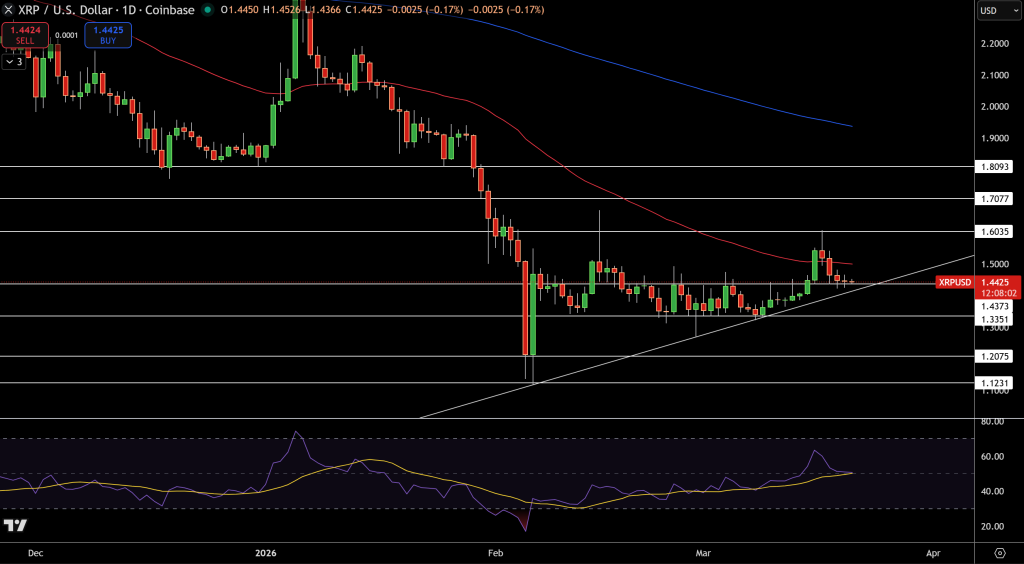
The daily chart shows that XRP has been making higher lows since the $1.12 base in February, forming the bottom of an ascending triangle. Sellers have consistently held the $1.50 to $1.60 area, creating a flat top. This pattern is usually bullish, as buyers are stepping in more strongly with each dip while sellers are slowly running out of steam.
The 50-day moving average is flat near the current price and has served as both support and a guide for the range. The 200-day moving average is still above the price, showing that the overall trend is still recovering from the 2025 peak near $3.66. The RSI is between 51 and 55, suggesting a slight bullish tilt without being overbought. MACD momentum is weak but slowly improving.
Key levels every trader should have marked:
- Support zone: $1.42 to $1.39 (structural floor, stop-loss area)
- Secondary support: $1.33 and $1.20 (major demand if the floor breaks)
- Deep structural demand: $1.12 (the February base)
- Immediate resistance: $1.49 to $1.51
- Breakout trigger: a daily close above $1.60
- Upside targets on breakout: $1.70, then $1.80
The main trade idea is to buy if XRP breaks above $1.60, aiming for $1.75, and set a stop loss below $1.44. The risk is clear, and the potential reward makes this setup worth keeping an eye on.
Why March 27 Could Be the Most Important Date for XRP This Year
In six days, the SEC will reach its final deadline for the last group of spot XRP ETF applications. This isn’t just another regulatory event, it could be the biggest catalyst for XRP since the Ripple vs. SEC lawsuit ended.
Spot XRP ETFs are already available in the U.S. and have attracted $1.44 billion in total inflows so far, mostly from retail investors. If the final round of ETF approvals from firms like Grayscale, 21Shares, Bitwise, Canary Capital, WisdomTree, and CoinShares goes through, it would open the door for large institutional investors. Analysts expect up to $8 billion could flow in from pension funds and IRAs if approvals are granted. As of now, the chance of approval is over 90%.
This deadline is especially important because of the recent regulatory changes. On March 17, 2026, just four days ago, the SEC and CFTC officially classified XRP as a digital commodity, ending over four years of legal uncertainty. This decision removes the compliance hurdles that kept banks, hedge funds, and asset managers from investing in XRP under securities law. Now, XRP is regulated like gold and oil.
Goldman Sachs is already the biggest buyer of XRP ETFs. Mastercard has included Ripple in its crypto payments program, and Deutsche Bank has connected with the XRP Ledger. All of this happened before the commodity ruling. Now, the big question is whether institutional investors who have been waiting will finally get involved.
Standard Chartered has set its 2026 target for XRP at $8.00 if the CLARITY Act passes. Without that legislation, their target drops to $2.80. This shows just how much XRP’s outlook depends on what happens in April’s legislative session.
The Bigger Picture: Ripple’s Fundamentals Have Never Been Stronger
Looking past the charts and regulatory news, Ripple’s ecosystem has been steadily growing in 2026, which is important for long-term holders and patient traders.
The XRP Ledger now handles between 2 million and 2.8 million transactions daily, with successful payments recently topping 2.7 million per day. There are about 7.7 million active wallet addresses. The DeFi layer supports around 27,000 active liquidity pools, covers over 16,000 tokens, and locks about 12 million XRP in liquidity. Tokenized real-world assets are growing, and AI agents are now making live on-chain transactions.
Ripple’s RLUSD stablecoin now has a market cap over $1.6 billion and is gaining popularity for enterprise payments and as collateral in prime brokerage. Japan, which handles more than half of Ripple’s global payment volume, will soon get RLUSD through SBI, creating stablecoin rails that help banks avoid long-standing payment issues.
In banking, Ripple got conditional approval for a national trust bank charter from the Office of the Comptroller of the Currency in December 2025 and has applied for a Federal Reserve master account. If approved, Ripple could hold RLUSD reserves directly at the central bank, which is a rare advantage for crypto companies.
The CLARITY Act is still the key piece of legislation for Ripple. CEO Brad Garlinghouse puts the odds of it passing by late April at 80%. Polymarket estimates the chance at about 70 to 72%. Galaxy Digital warns that if the bill doesn’t pass committee by the end of April, it will likely be delayed until after the 2026 midterm elections. Time is short and the stakes are high.
There are some macroeconomic challenges, but they seem manageable. The Fed kept rates steady at its March meeting and signaled that rates will stay high due to inflation. This took away some short-term momentum and led to a 5% drop earlier in March. Still, XRP’s main use in cross-border payments isn’t as affected by interest rates as growth stocks are, and the new regulatory clarity provides a support level that wasn’t there a year ago.
What the Range of Price Forecasts Actually Tells You
XRP price forecasts for 2026 cover a wide range. If the CLARITY Act fails and there are no new ETF catalysts, XRP could stay between $1.00 and $1.40. Bitrue Research’s base case, based on solid institutional analysis, predicts $2.50 to $4.00 for the year, with a midpoint of $3.00 to $3.50. CoinCodex expects $2.04 by September 2026. Standard Chartered’s bullish scenario of $8.00 depends on the Clarity Act passing and strong ETF inflows.
Finance Magnates points out a bearish short-term scenario where XRP could fall to $1.13 to $1.26 if the current consolidation fails and the $1.42 support breaks. However, this outlook would change if XRP closes above $1.60 for a full day.
Some technical models predict XRP could drop to $1.04 if selling picks up, which would be a 28% fall from current prices. On the other hand, five-year algorithmic forecasts go as high as $7.70. This wide range isn’t confusion—it shows that XRP is at a real turning point, and its future depends on how regulatory and economic factors play out.
For traders, the short-term setup is clear. For investors, it all depends on whether ETF approvals and the CLARITY Act finally bring in the institutional money that’s been waiting. Both scenarios are possible, but neither is certain.
- Check out our free forex signals
- Follow the top economic events on FX Leaders economic calendar
- Trade better, discover more Forex Trading Strategies
- Open a FREE Trading Account
- Read our latest reviews on: Avatrade, Exness, HFM and XM

Related Articles
Sidebar rates

Related Posts
 Save
Save