XRP Price Prediction: $1.32 Support Shakes as Digital Commodity Rally Fades; What Comes Next?
XRP trades at $1.32–$1.33 as buy-the-rumour selling and risk-off macro reverse the commodity classification rally.
Quick overview
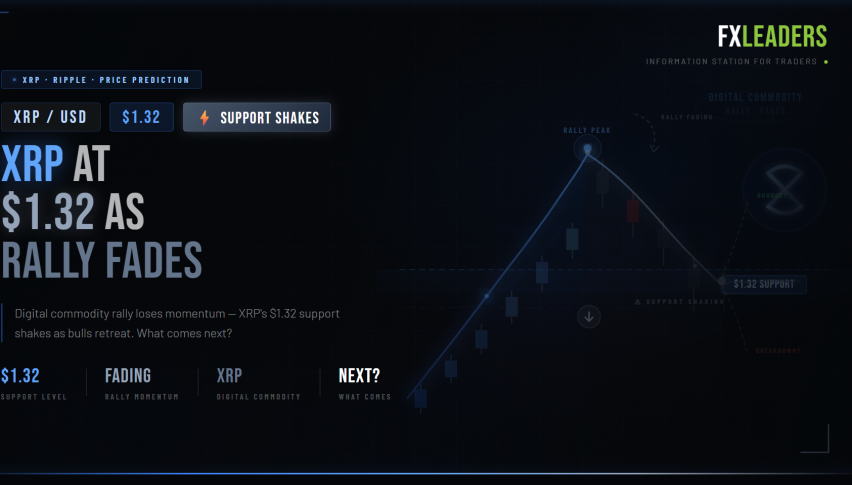
- XRP is currently trading between $1.32 and $1.33, down 2-3% in the last 24 hours and 8% over the week.
- Despite regulatory clarity from the SEC and CFTC, XRP's price has declined about 40% from its 2026 peak due to cautious market sentiment and net outflows from XRP ETFs.
- Key support for XRP is at $1.317; if it falls below this level, it could drop to $1.29, a significant psychological barrier.
- Long-term prospects for XRP remain positive, with institutional interest growing, but immediate price recovery hinges on market conditions and ETF inflows.
Live XRP/USD Chart

On March 28, 2026, XRP/USD is trading between $1.32 and $1.33, down 2–3% in the past 24 hours and 8% over the week. The SEC and CFTC’s “digital commodity” classification led to an initial rally up to $1.60. However, after the news, profit-taking and cautious market sentiment erased those gains, putting pressure on the $1.317 support level.
Why XRP Is Falling Despite Historic Regulatory Clarity
The joint SEC and CFTC announcement back in March 17 that classified XRP as a digital commodity was a major breakthrough, ending years of legal grey areas and giving the green light for more institutional money to come in.
Notwithstanding this breakthrough, XRP’s price has not moved in sync with the rest of the market – it’s actually down about 40% from its 2026 peak. The big story here is that a shift is happening as far as ETF flows go : after a whopping $1.2 billion of inflows since November 2025, XRP spot ETFs suddenly saw net outflows in March – with a not-insignificant $28 million in redemptions, according to SoSoValue figures.
The real reason behind XRP’s decline is the general state of the market right now. It’s the Iran situation that’s spoiling the party. OPEC’s refusal to join in on the peace talks has been pushing oil prices up towards $94, sending investors running for cover and making them a lot more cautious about anything too high risk.
Moreover, with no promise of a rate cut from the Fed in 2026 and Treasuries yields nudging 4.5%, holding onto assets that don’t give you any interest is starting to get a little pricey. And to make matters worse for XRP, it’s got a low market turnover ratio of 2.99%, which means there just isn’t that much liquidity – and that just means selling pressure can push prices down a lot easier.
XRP Technical Analysis: $1.317 Is the Line in the Sand
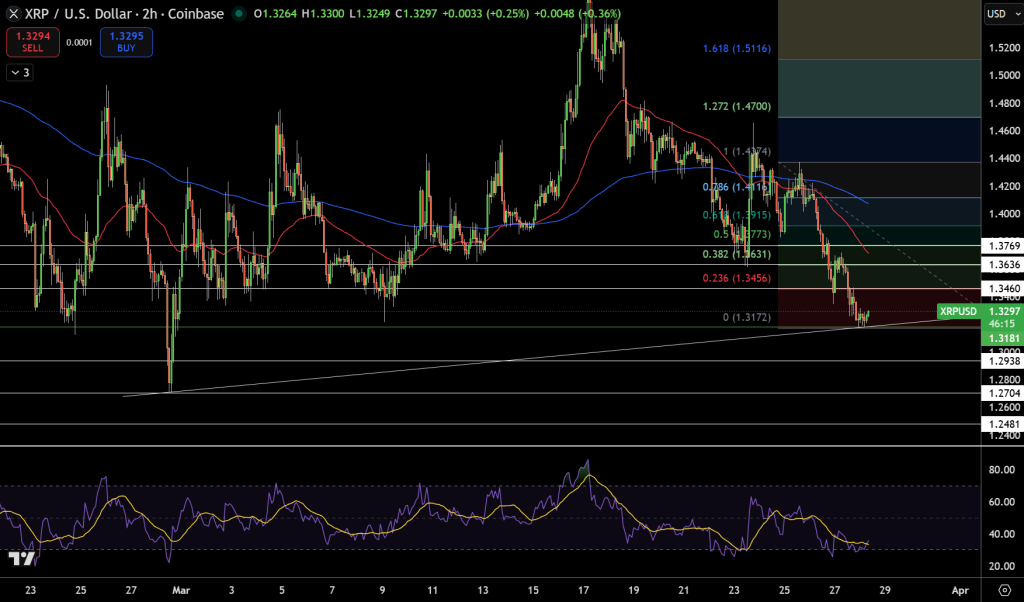
The chart shows a clear bearish trend.
After a sharp rejection at the $1.41 Fibonacci level, XRP fell below the 0.236 retracement at $1.345. The 50-period EMA at $1.377 has turned into resistance, stopping every recovery attempt. Bearish candlestick patterns, with long red bodies and small lower wicks, show sellers are still in control. The RSI is at 35 and close to oversold, but there’s no bullish divergence to suggest a reversal yet.
$1.317 is the key support right now. If XRP closes below this level, it could fall to $1.29, which is an important psychological barrier for Q2. To ease selling pressure, XRP needs to move back above $1.346.
Trade idea (short bias): Sell if XRP fails to bounce above $1.346, set a stop above $1.377, and aim for a target of $1.293.
The Institutional Bull Case Remains, But Needs a Catalyst
Even with short-term pressure, the long-term case for XRP in 2026 still looks strong.
- Six spot XRP ETFs now hold over $1.53 billion combined, and Goldman Sachs has disclosed more than $152 million in ETF exposure.
- A Coinbase/EY survey of 351 institutional investors found that 25% plan to add XRP to their portfolios in 2026.
- XRPL is now among the top 10 chains for real-world asset tokenisation, hosting $2.3 billion in RWAs and ranking second in 30-day RWA growth at 15.37%. The RLUSD stablecoin market cap has jumped over 1,800% since launch, now reaching more than $1 billion in monthly volume.
- Standard Chartered keeps an $8.00 year-end target if the CLARITY Act passes. Without it, their target drops to $2.80. The CLARITY Act Senate markup is planned for the second half of April. If it misses that window, Senator Moreno has warned it may not move forward in 2026.
Here’s an important detail:
XRPL adoption is growing fast, but most institutions are settling in RLUSD instead of XRP. Transaction fees are just a fraction of a cent, so network growth doesn’t always lead to more demand for the XRP token.
FAQ: XRP Price, $1.317 Support, and the Commodity Ruling Explained
Why is XRP price falling after the SEC commodity classification?
Regulatory clarity removes a barrier to buying, but it doesn’t create demand on its own. In March, XRP ETFs saw $28 million in net outflows. The Iran conflict has made investors more cautious, which is hurting speculative assets in general. Also, the “buy the rumour, sell the news” effect has reversed the initial rally from $1.33 to $1.60.
What happens to XRP if $1.317 support breaks?
If XRP closes below $1.317 for a while, it could fall to $1.29, which is an important psychological level. The 200-day moving average at $1.3824 marks the bigger bull/bear line. Analysts warn that if XRP drops below $1.35, it could fall further toward $1.10.
What is the XRP price target for 2026?
Standard Chartered has an $8.00 target if the CLARITY Act passes, but this drops to $2.80 if it doesn’t. Most analysts expect XRP to trade between $1.35 and $3.20 in 2026. For XRP to reach the higher end, ETF inflows need to pick up, RLUSD must gain traction with institutions in Asia, and BTC should stabilise.
- Check out our free forex signals
- Follow the top economic events on FX Leaders economic calendar
- Trade better, discover more Forex Trading Strategies
- Open a FREE Trading Account
- Read our latest reviews on: Avatrade, Exness, HFM and XM

Related Articles

Sidebar rates

Related Posts
 Save
Save