Russia’s 300k Ruble Retail Cap: A Strategic Pivot Toward Institutional Crypto Rails
The Russian government approved a major set of laws that moves the country’s cryptocurrency market from a mostly unregulated space...
Quick overview
- The Russian government has approved new laws to regulate the cryptocurrency market, transitioning it from an unregulated space to a state-controlled sector.
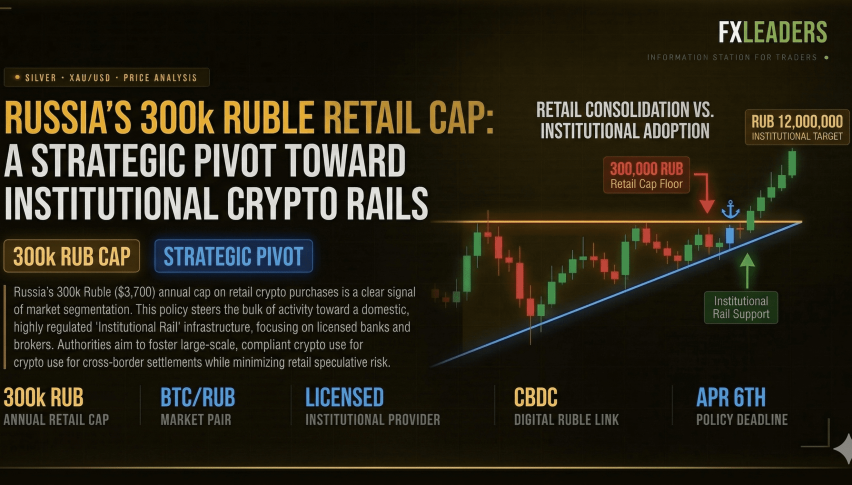
- Retail investors are limited to an annual investment of 300,000 rubles, while accredited investors face no limits, promoting institutional use over retail speculation.
- All crypto transactions must now go through licensed brokers, eliminating peer-to-peer trading to enhance state monitoring.
- The new regulations aim to position crypto as a 'survival tool' amid global sanctions, with implications for cross-border payments and market maturity.
The Russian government approved a major set of laws that moves the country’s cryptocurrency market from a mostly unregulated space to a state-controlled financial sector.
By setting an annual investment limit of 300,000 rubles (about $3,300) for regular investors, Moscow is making it clear that it values institutional use of crypto more than retail speculation.
This tiered access system aims to protect new traders from the sharp price swings seen earlier in 2026. At the same time, it allows sanctioned Russian businesses to use digital assets for exports and cross-border payments.
The Dual-Track Regulatory Framework
The legislation, which is expected
- Retail investors who are not accredited can invest up to 300,000 rubles per year through licensed domestic brokers. They can only buy assets from a white list of highly liquid options, like BTC and ETH, approved by the Bank of Russia. They also have to pass a required knowledge test.
- Qualified Investors (Accredited): Qualified, accredited investors do not have any limits on how much digital assets they can buy, but they still need to pass a qualification test. This allows large amounts of capital to enter the sector without the restrictions placed on retail investors.
- The new rules ban direct peer-to-peer (P2P) trading in Russia. All crypto transactions must go through licensed brokers, banks, or investment platforms, so the state can fully monitor the movement of digital currency within the country.
Strategic Impact: From Speculation to “Survival Tool”
The timing of this bill is intentional. With global sanctions, including the proposed EU 20th Sanctions Package, now targeting stablecoins and the digital ruble, Russia is turning to crypto as a way to keep its payment systems independent.
| Metric | Current 2026 Market Status | Strategic Implication |
| Cross-Border Usage | Increasing for “hidden exports” | Crypto has evolved into a component of the balance of payments. |
| Stablecoin Status | Legal “gray area” | A dedicated stablecoin law is expected by Q3 2026. |
| Retail Liquidity | Likely to shift offshore | Domestic caps will push smaller traders to foreign platforms. |
| Institutional Flow | “Coming of Age” | 2025 was the turning point for large capital entry. |
XRP Analysis: The “Liquid Asset” Advantage
For people who hold XRP, Russia’s new rules have both pros and cons. The 300,000 ruble cap will limit the big retail-driven price surges often seen in Russia, but XRP’s usefulness and liquidity make it likely to be included on the central bank’s approved list.
XRP Performance Snapshot (March 31, 2026):
- Current Price: 108.92 RUB (~$1.20)
- Monthly Trend: XRP surged over 20% mid-month before consolidating.
- Regulatory Outlook: Since XRP is often used for cross-border payments, it will probably be classified as a highly liquid digital asset. This means retail investors should still be able to access it, even with the new limits. new caps.
Technical Verdict: Market Maturity Phase
Switching to a system where only licensed brokers can operate, and where monthly transaction volumes must be over ₽3.5 million, means small, informal crypto services will disappear in Russia.
Analyst Note: This move is a cleanup of the market. By setting the 300,000 ruble limit, Russia is following the cautious regulatory approach seen in the EU and Australia.
Although domestic liquidity might fall for a while, making crypto part of the official financial system means digital assets are now a lasting and regulated part of Russia’s economy.
- Check out our free forex signals
- Follow the top economic events on FX Leaders economic calendar
- Trade better, discover more Forex Trading Strategies
- Open a FREE Trading Account
- Read our latest reviews on: Avatrade, Exness, HFM and XM

Related Articles
Sidebar rates

Related Posts
 Save
SaveAva

